
Non-FictionInformativeEducational
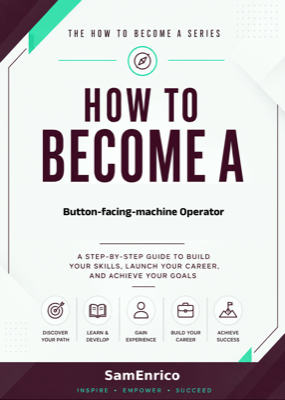
How to Become a Button-facing-machine Operator eBook
How to Become a Button-facing-machine Operator
by William Kip
How to Become a Button-facing-machine Operator
Formats
Free sample
Chapter 1: The Last Artisans...--It is a Tuesday morning in a low-slung concrete building on the edge of a town you have probably never heard of. The air smells of industrial lubricant, fine dust, and the faint sweetness of melting acrylic. Behind a safety shield, a machine the color of faded mint green performs a mechanical dance: a brass chuck spins, a carbide drill bit descends, and in less than two seconds, a raw plastic disc becomes a finished button with four clean holes and a concave face. The woman watching this machine is sixty-two years old. Her hands are scarred from forty years of lever pulls and drill changes.
She can hear a misalignment from twenty feet away. She is one of perhaps two hundred people in North America who truly understand this machine. And she plans to retire next spring.Her employer—a mid-sized garment trim manufacturer—has posted the job opening three times. Zero qualified applicants. The machine will sit idle when she leaves, because button‑facing is a forgotten trade.
There is no certificate program. No You Tube tutorial with millions of views. No community college course. There is only this book, the dust on the factory floor, and the slow realization that obsolete skills are sometimes the most valuable ones.You are holding this book because you suspect something that most people have not yet figured out: when a trade disappears, the people who still know it become irreplaceable. This is not a book about buttons.
This is a book about becoming a specialist in a niche so narrow that the demand for your work will outlast the supply of practitioners by a decade or more. It is about mechanical empathy, material science, safety discipline, and the quiet satisfaction of running a machine that transforms inexpensive raw blanks into essential components of the global garment industry.If you follow the chapters ahead—if you learn to load a hopper without causing micro‑cracks, align a chuck by sound, recognize a dull drill bit from the pitch of its whine, and perform daily maintenance that prevents catastrophic jams—you will possess a skill set that factory owners are desperate to find. You will name your wage. You will work as long as you want, in as many factories as you can travel to, or in a single shop where you become the person everyone relies on. This chapter introduces you to the hidden world of button‑facing, why it matters, what you will earn, and how this book will transform you from a complete novice into a master operator.The Button You Have Never Thought About Take a moment to look at the shirt you are wearing.
Run your finger along the buttons. Feel their smooth faces, the slight concavity of a well‑made dress shirt button, the crisp edges of the four drill holes. Now consider this: each of those buttons passed through a machine very similar to the one described in these pages. A machine that held a raw blank, drilled it, shaped its face, and ejected it—all while an operator watched, listened, and adjusted.The global garment industry produces an estimated 20 billion buttons every year. The vast majority are made from polyester, acrylic, or metal.
But before a button can be sewn onto a garment, it must be faced. Facing is the process of creating the button's finished front surface: the shallow dish that catches the thread, the smooth rim that won't snag fabric, the precisely spaced holes that allow the button to be attached. A button that has not been properly faced is useless. It will spin in the sewing machine, crack under tension, or simply look wrong.Button‑attaching—the sewing of buttons onto garments—is a separate trade, one that still has training programs and automated machines. Button‑facing, by contrast, has largely been forgotten.
Mass production moved overseas. Old operators retired. And the machines themselves—often called "batteries" because early models had multiple spindles lined up like artillery—gathered dust in warehouse corners. But a strange thing happened in the last decade. Supply chains became fragile.
Factories in North America and Europe began reshoring small‑batch production. Custom garment makers, upholsterers, costume designers, and restoration specialists discovered that they could not find anyone to face buttons for their niche orders. The machines still worked. The blanks were still available. The operators were gone.This is your opportunity.Why This Trade, Why Now Let me be direct about the economics.
A junior operator in a mass‑production factory starts between 16and16 and 16and20 per hour, depending on region. With three months of experience, that rises to 22–22–22–26 per hour. A senior operator who can run multiple materials and train others earns 28–28–28–35 per hour. A setup mechanic—the person who changes dies, adjusts timing, and keeps the battery running—commands 38–38–38–50 per hour or more, plus overtime. These are not Silicon Valley salaries.
But they are stable, they require no college debt, and they come with the kind of job security that tech workers envy.The numbers change when you work for yourself. Small custom shops, restoration specialists, and costume houses will pay 60–60–60–100 per hour for small‑batch facing work because they have no other options. I have personally seen invoices for 1,200toface500mother‑of‑pearlbuttonsfora Broadwaycostumerestoration.Theworktooksixhours.Theoperatorcharged1,200 to face 500 mother‑of‑pearl buttons for a Broadway costume restoration. The work took six hours. The operator charged 1,200toface500mother‑of‑pearlbuttonsfora Broadwaycostumerestoration.Theworktooksixhours.Theoperatorcharged200 per hour.
The customer paid without negotiation.Regional demand varies. In the United States, the highest concentration of button‑facing work is in Los Angeles (garment district and costume houses), New York (fashion sample rooms and restoration), and the Southeast (industrial uniform and workwear manufacturers). Internationally, the trade is strongest in Italy (high‑end fashion), Turkey (mass production), and parts of China (where automation is replacing human operators, creating a different kind of opportunity for repair and maintenance specialists). The key insight is this: you do not need to live in a garment hub. Many operators work remotely, traveling to factories for week‑long contracts, or running a small machine in a garage workshop and shipping finished buttons across the country.What You Will Learn in This Book This book is divided into four parts, each building on the last.
By the time you finish, you will have a complete mental model of the button‑facing machine and the skills to operate, maintain, and troubleshoot it.Part I: The Foundations of the Trade establishes the knowledge you need before touching a machine. You will learn to identify the five most common button materials (polyester, acrylic, casein, corozo, and mother‑of‑pearl) and understand how each behaves under heat and pressure. You will learn the anatomy of the battery machine—hopper, transport mechanism, chuck, drill bits, and shaping tools—and the vocabulary that mechanics use. Most importantly, you will learn the safety rules that keep your fingers attached to your hands.Part II: Core Operations and Daily Workflows gets you running the machine. You will master the "Hand Scoop" technique for loading blanks without causing cracks.
You will learn to align a chuck by sight and sound, distinguishing between daily operator adjustments (your job) and post‑crash…
This is the end of the free sample. Get the eBook to keep going. Buy now
About this book
Details
- Author
- William Kip
- Publisher
- SamEnrico
- Language
- English
- ISBN
- 9781505788341
- Genre
- Non-Fiction, Informative, Educational
- Released
- 2026-05-11
- Pages (approx.)
- 151
- Available as
- eBook, Paperback, Audiobook

Read better in the ZLOADR app
Your eBooks on your phone or tablet. Sign in with your SamEnrico account and start reading.
More by William Kip
 HIIT for Pilates LoversWilliam Kip$11.99
 Vision Loss Writing GuideWilliam Kip$11.99
 Parental Addiction and LyingWilliam Kip$11.99
 Unprosecuted Heist PlayersWilliam Kip$11.99
 Smoking Cessation Menopause SymptomsWilliam Kip$11.99
 The Silent Revolution: How a 1997 Tesla Prototype Nearly Changed the WorldWilliam Kip$11.99
 Understanding Carpenter–hunter TypeWilliam Kip$17.99
 Desk Clearance ChecklistWilliam Kip$12.99
 Startup Business Credit PlaybookWilliam Kip$12.99
 Accounts Receivable SpecialistWilliam Kip$11.99
You may also like
 Hong Kong Handover 1997Dunn Johnnie$11.99
 Zumba For Postnatal Recovery CourseNeal Christian$11.99
 Zumba for BeginnersLadner Nikia$11.99
 YouTube Comment Mining GuideHumes Pandora$12.99
 Worry Box MeditationCarlin Rudy$11.99
 Workplace Stress MeditationNguyen Lynn$11.99
 Workplace Stress and Sleep RepairHawley Ivory$11.99
 Workplace Perfectionism CureDelaney Jeffry$11.99
 Workplace Injustice Anger GuideWallen Isabelle$11.99
 Work Addiction and Burnout LinkGreenwood Ester$11.99
 Women in Yoga and WellnessBeattie Galina$11.99
 Women in Stand Up ComedyChun Evangeline$11.99