
Non-FictionInformativeEducational
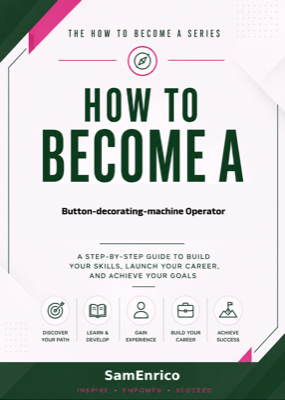
How to Become a Button-decorating-machine Operator eBook
How to Become a Button-decorating-machine Operator
How to Become a Button-decorating-machine Operator
Formats
Free sample
Chapter 1: The $70k Secret...--–- Most people walk past button-decorating machines every day without ever noticing them. They see finished shirts, jackets, and jeans hanging on store racks, and they never think about the person who made sure those buttons stayed on through forty washes, three hundred tugs, and one unfortunate encounter with a car door. That person is you. Or rather, that person could be you, starting six months from now, earning more than many college graduates while sitting at a machine that most office workers wouldn't dare touch.The Button-Decorating-Machine Operator – let's call them BDMOs from here on, because typing that full title every time will get old fast – occupies a strange and wonderful place in the modern economy. You are simultaneously invisible and indispensable.
No customer has ever walked into a store and said, "I'd like to thank the person who attached these buttons." Yet those same customers will instantly reject a garment with a loose button, a crooked placement, or a thread tail hanging off the back. You are the last line of defense between a finished product and a quality failure. And here is the secret that the garment industry doesn't want you to know: you have more power than you realize.The Great Misunderstanding Let me clear something up immediately. When most people hear "button-decorating machine operator," they imagine someone hunched over an old sewing machine from the 1950s, poking buttons onto shirts one at a time while a supervisor breathes down their neck. That image is wrong on every single count.
Modern button-decorating machines are sophisticated pieces of industrial equipment that combine mechanical precision, computerized controls, and often a surprising amount of artistic judgment. You are not a button-pusher. You are a precision technician who happens to work with fabric and thread instead of metal and welds.The misunderstanding runs deeper than just outdated imagery. Ask ten factory managers what a BDMO actually does, and you'll get ten different answers. Some will say it's purely functional – attaching buttons so they don't fall off.
Others will describe intricate decorative work where the button itself becomes a design element. Both are right, and that ambiguity is actually your advantage. A narrow job can be automated. A broad, flexible skillset that spans functional attachment, decorative embellishment, quality inspection, and machine maintenance – that is much harder to replace.Consider the range of work that falls under this title. At the functional end, you might spend a shift attaching uniform buttons to thousands of police shirts.
The button is simple, the placement is standard, but the required durability is extreme. Those buttons need to survive being yanked, caught on seatbelts, and washed hundreds of times. At the decorative end, you might work on a limited run of designer jackets where each button features a hand-painted resin face that must be oriented perfectly every time. The volume is lower, but the precision and care required are much higher. Most BDMOs work somewhere in the middle, handling everything from basic tack buttons to custom logo placements, often within the same shift.The Economic Reality That Changes Everything Here is where this career stops being a curiosity and starts being genuinely interesting.
The Bureau of Labor Statistics and various industry salary surveys paint a consistent picture: entry-level BDMOs start between 28,000and28,000 and 28,000and35,000 annually. That is not wealth, but it is a living wage that beats many retail or food service positions. The trajectory, however, is where things get exciting.Within two to three years of consistent work and skill development, a BDMO typically advances to Set-up Technician, earning 38,000to38,000 to 38,000to48,000. At this level, you are no longer just running the machine – you are configuring it, troubleshooting basic problems, and training new operators. Another two years often brings a move to Quality Control Specialist at 45,000to45,000 to 45,000to55,000, where your eye for defects becomes the factory's primary defense against recalls.Shift Supervisor positions pay 55,000to55,000 to 55,000to70,000, and the top end of the field – Plant Industrial Engineer or QA Manager – regularly clears 70,000to70,000 to 70,000to90,000.
Let me put those numbers in perspective. A four-year college degree costs an average of 120,000intuitionalone,andthemedianstartingsalaryforgraduatesis120,000 in tuition alone, and the median starting salary for graduates is 120,000intuitionalone,andthemedianstartingsalaryforgraduatesis55,000. A BDMO who invests in learning and advancement can reach that same income without student debt, often faster than a graduate lands their first professional job. The difference is that nobody tells you this path exists. High school guidance counselors don't mention button decorating.
Career fairs don't have booths for garment finishing. The opportunity sits in plain sight, ignored by almost everyone.Why You? Why Now?Three trends are converging to create unusual demand for skilled BDMOs. First, fast fashion has accelerated production cycles to absurd speeds. A design that appears on a runway in Paris might need to be in stores worldwide within six weeks.
That pressure creates chaos on factory floors, and chaos creates demand for operators who can work quickly without sacrificing quality. Second, the customization boom means that even mass-market brands now offer personalized options – monogrammed buttons, limited edition colorways, regional variations. Each customization requires setup changes, which rewards operators who understand their machines deeply rather than those who just repeat the same motion all day.Third, and perhaps most importantly, the existing workforce is retiring. The average age of an industrial sewing and finishing operator in the United States and Western Europe is over fifty. Younger workers have been systematically directed away from manufacturing toward college and white-collar careers.
The result is a looming labor shortage that will force employers to raise wages, improve conditions, and compete for talent in ways they never have before. You are arriving at exactly the right moment.Let me tell you about Diane, a woman I interviewed while researching this book. Diane started as a button-sewer in a Massachusetts factory twenty-three years ago, making 12anhour.Shelearnedeverymachineonthefloor,volunteeredforweekendmaintenanceshifts,andstartedkeepinganotebookofeveryproblemshesolved.Byyeareight,shewasthego−topersonforanydifficultsetup.Byyearfifteen,shewasthefactory′s Industrial Engineer,redesigningworkflowstocutwaste.Lastyear,shemade12 an hour. She learned every machine on the floor, volunteered for weekend maintenance shifts, and started keeping a notebook of every problem she solved. By year eight, she was the go-to person for any difficult setup.
By year fifteen, she was the factory's Industrial Engineer, redesigning workflows to cut waste. Last year, she made 12anhour.Shelearnedeverymachineonthefloor,volunteeredforweekendmaintenanceshifts,andstartedkeepinganotebookofeveryproblemshesolved.Byyeareight,shewasthego−topersonforanydifficultsetup.Byyearfifteen,shewasthefactory′s Industrial Engineer,redesigningworkflowstocutwaste.Lastyear,shemade89,000. Diane never went to college. She never took out a loan. She just learned her craft, paid attention, and stayed when everyone else left.
There are hundreds of Dianes out there. You could be the next one.The Day in the Life Before we dive into the technical details, let me paint a picture of what this job actually looks like hour by hour. A typical shift starts fifteen minutes before the machines turn on. You walk onto the floor, grab your clipboard or tablet, and check the production board. Today's assignment: two thousand custom denim jackets with copper tack buttons, followed by five hundred uniform shirts with standard plastic buttons.
The tack buttons require impact pressure – a different machine setup than the shirts, which need traditional stitching.You head to your workstation and perform…
This is the end of the free sample. Get the eBook to keep going. Buy now
About this book
Details
- Author
- Whelan Camila
- Publisher
- SamEnrico
- Language
- English
- ISBN
- 9781505788303
- Genre
- Non-Fiction, Informative, Educational
- Released
- 2026-05-04
- Pages (approx.)
- 132
- Available as
- eBook, Paperback, Audiobook

Read better in the ZLOADR app
Your eBooks on your phone or tablet. Sign in with your SamEnrico account and start reading.
More by Whelan Camila
 Mezzanine Debt GuideWhelan Camila$11.99
 Phone Tap BetrayalWhelan Camila$11.99
 Parental Addiction and Sex WorkWhelan Camila$11.99
 Vision Loss Financial ManagementWhelan Camila$11.99
 Smoking Cessation Anxiety ReductionWhelan Camila$11.99
 The Heartbeat Heist: How a Stolen Idea Saved MillionsWhelan Camila$11.99
 The Forgotten Medics of Bastogne: Angels in the ArdennesWhelan Camila$11.99
 Understanding Carpotarsal OsteochondromatosisWhelan Camila$17.99
 Watch And Jewelry RulesWhelan Camila$12.99
 Trade Credit Vendor GuideWhelan Camila$12.99
 Black Ash HarvestingWhelan Camila$11.99
You may also like
 Hong Kong Handover 1997Dunn Johnnie$11.99
 Zumba For Postnatal Recovery CourseNeal Christian$11.99
 Zumba for BeginnersLadner Nikia$11.99
 YouTube Comment Mining GuideHumes Pandora$12.99
 Worry Box MeditationCarlin Rudy$11.99
 Workplace Stress MeditationNguyen Lynn$11.99
 Workplace Stress and Sleep RepairHawley Ivory$11.99
 Workplace Perfectionism CureDelaney Jeffry$11.99
 Workplace Injustice Anger GuideWallen Isabelle$11.99
 Work Addiction and Burnout LinkGreenwood Ester$11.99
 Women in Yoga and WellnessBeattie Galina$11.99
 Women in Stand Up ComedyChun Evangeline$11.99