
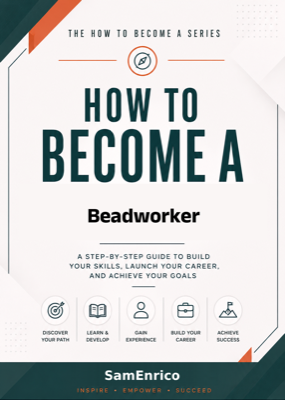
How to Become a Beadworker eBook
How to Become a Beadworker
How to Become a Beadworker
Formats
Free sample
Chapter 1: Your First Bead--– The first time I held a bead that mattered, I was twenty-three years old, sitting on a worn-out couch in a basement apartment, and the bead was not even mine. It was a single 11/0 seed bead, matte turquoise, that had fallen from my grandmother’s broken necklace—a piece I had never seen her wear but that my mother kept in a Ziploc bag labeled “do not throw away.” I picked it up between my thumb and forefinger, and something shifted. The bead was tiny—smaller than a grain of rice—but it had a hole drilled perfectly through its center, a fingerprint of frost on its surface, and a weight that felt deliberate. I had no needle, no thread, no pattern. I had no idea what peyote stitch meant or why tension mattered.
But I sat there for an hour, just holding that single bead, turning it over, wondering who made it, who strung it, who wore it, and why it had outlasted them all.That curiosity is the only prerequisite for becoming a beadworker.Not patience. Not steady hands. Not an art degree. Not a trust fund for supplies. Just the willingness to sit with a small thing and ask: What can I make with this?This chapter is not about stitches.
You will learn plenty of those later. This chapter is about the ground beneath those stitches: the tools, materials, body awareness, and mindset that will determine whether your first week of beadwork ends in frustration or fascination. The best beadworkers I know are not the ones with the most expensive beads or the fanciest looms. They are the ones who learned early to see beadwork as a conversation between their hands, their eyes, and a thousand tiny objects that demand respect. You are about to start that conversation.What No One Tells You Before You Buy Your First Bead Before you spend a single dollar, let me save you the three most common beginner mistakes—mistakes I made, mistakes every experienced beadworker has made, and mistakes that are completely avoidable if you know they are coming.Mistake #1: Buying the cheapest bead mix on Amazon.
Those $9.99 “10,000-piece bead bonanza” kits are not a bargain. They are a trap. The beads are inconsistently sized (some too fat, some too thin), the holes are misaligned (your needle will jam), and the dye rubs off on your fingers. You will spend more time fighting the materials than learning the craft. This is like learning to cook with a bent pan and a dull knife—possible, but miserable.Mistake #2: Starting with a complex project.
A beaded cuff with a built-in clasp and a fringe of dagger beads looks gorgeous on Instagram. It is also a terrible place to begin. You need to learn to walk before you run a marathon in beaded shoes. Start with a sampler band. Ten rows of peyote stitch, no pattern, just beads and thread.
Your first piece will be ugly. That is not failure. That is data.Mistake #3: Ignoring your body. Beadwork is sedentary, close-up, and repetitive. Your neck will ache.
Your eyes will strain. Your wrists will complain. This is not weakness; it is physics. The solution is not to “tough it out” but to build ergonomics into your practice from Day One. You will thank yourself in ten years when your hands still work.This chapter exists to help you avoid all three mistakes before they become habits.
By the time you finish reading, you will know exactly what to buy (and what to avoid), how to set up your workspace, and how to train your mind for the peculiar patience that beadwork requires.The Beadworker’s Toolkit: What You Actually Need (And What You Don’t)Walking into a bead shop—or scrolling through an online store—can feel overwhelming. There are beads the size of sand and beads the size of grapes. Needles in sizes numbered like shoe widths. Threads with names that sound like fishing equipment. Looms that cost as much as a used bicycle.Let me simplify.A beginner beadworker needs exactly seven things.
Everything else is optional or advanced. Here is your starter list, with specific recommendations and budget tiers.The Non-Negotiable Seven1. Seed beads, size 11/0, in two contrasting colors. Not size 15/0 (too small for beginners). Not size 8/0 (too large for most off-loom stitches).
Size 11/0 is the goldilocks bead—small enough to look delicate, large enough to see without a microscope. Buy Japanese or Czech brands: Miyuki, Toho, Preciosa, or Matsuno. Buy opaque colors (matte black and bright white are ideal for learning because contrast shows your stitch structure clearly). Do not buy transparent or iris finishes yet; they are harder to see. Do not buy “value packs” from unknown brands.
Expect to pay 5–5–5–10 per 10-gram tube. Yes, that sounds expensive. It is not. A 10-gram tube contains approximately 1,000 beads—enough for dozens of small projects.2. Beading needles, size 10 or 12.
Beading needles are thinner than sewing needles and have eyes that are almost invisible. Size 10 is slightly thicker and more forgiving for beginners. Size 12 is finer and better for passing through beads multiple times. Buy a pack of 10 needles. You will break some.
You will lose some. This is normal. Brands: John James, Pony, or Tulip (Tulip is expensive but wonderful). Never use a sewing needle for beadwork; the eye is too wide and will split your thread.3. Beading thread, two types.
Start with Nymo (size B or D) for most off-loom stitching. It is nylon, slightly waxy, and easy to knot. Then buy a small spool of Fire Line (6 or 8 lb test) for projects that need stiffness or strength. Fire Line is a fused braided fishing line—sounds odd, works brilliantly. Do not use sewing thread, embroidery floss, or dental floss.
Each has problems: too fuzzy, too stretchy, or too thick.4. Beeswax or Thread Conditioner. Thread conditioner (sometimes sold as “Thread Magic”) coats your thread, reduces tangling, and helps the thread slide through beads. Run your thread through the conditioner twice before threading your needle. Yes, it makes that much difference.
A small block costs $3 and lasts a year.5. Small, sharp scissors. Not the kitchen shears. Not nail clippers. You need scissors fine enough to cut thread flush against your beadwork without nicking the beads.
Embroidery scissors or thread snips work perfectly. Expect to pay $8–15.6. A bead mat. Beads are round. Round things roll.
Rolling things fall onto the floor, where they vanish into another dimension. A bead mat is a soft, slightly textured surface (often made of velour or silicone) that keeps beads where you put them. A $5 silicone beading mat will save you hours of crawling on the floor.7. Good light. This is not a metaphor.
You need a desk lamp or clip-on light that illuminates your work area without casting shadows. Daylight-spectrum bulbs (5000K–6500K) are best because they show true colors and reduce eye strain. A $20 LED desk lamp from any office supply store is fine. Do not rely on overhead room lighting.Budget Tiers Tier Total Cost What You Get Basic ($30)2 tubes of seed beads (2 colors), 10 needles, small spool Nymo, beeswax, scissors, mat. Light not included (use…
This is the end of the free sample. Get the eBook to keep going. Buy now
About this book
Details
- Author
- Garland Marilu
- Publisher
- SamEnrico
- Language
- English
- ISBN
- 9781505777758
- Genre
- Non-Fiction, Informative, Educational
- Released
- 2026-05-02
- Pages (approx.)
- 145
- Available as
- eBook, Paperback, Audiobook

Read better in the ZLOADR app
Your eBooks on your phone or tablet. Sign in with your SamEnrico account and start reading.
More by Garland Marilu
 The ED Treatment WorkbookGarland Marilu$11.99
 Occipital Neuralgia ReliefGarland Marilu$11.99
 Wholesaling without MoneyGarland Marilu$11.99
 Maintenance Innovation GuideGarland Marilu$11.99
 Cat Loss Bereavement SupportGarland Marilu$11.99
 Restructuring Anger for Chronic PainGarland Marilu$11.99
 Automated Freelance SystemsGarland Marilu$11.99
 Gaming Therapy OptionsGarland Marilu$11.99
 The Sugar Barons of the Caribbean: How Black Entrepreneurs Built EmpiresGarland Marilu$11.99
 Frozen Echoes of the Lost Vikings: The Greenland Saga UnearthedGarland Marilu$11.99
 How to Produce Fabric and UpholsteryGarland Marilu$11.99
 A Collector's Handbook to the Alfa Romeo Giulia 1300tiGarland Marilu$11.99