
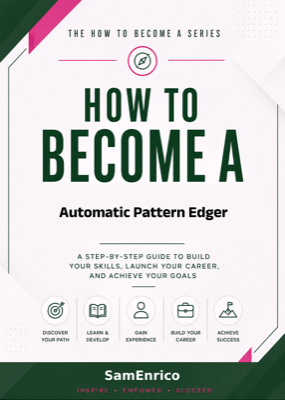
How to Become a Automatic Pattern Edger eBook
How to Become a Automatic Pattern Edger
by Lin Deandrea
How to Become a Automatic Pattern Edger
Formats
Free sample
Chapter 1: The $100 Border...--–- I finished my first blanket on a Tuesday night in February. The kind of Tuesday night that feels like all the other Tuesday nights – gray sky, weak coffee, the distant hum of traffic that you stop noticing after a while. I had spent six weeks knitting that blanket. Six weeks of counting stitches, fixing dropped loops, ripping back rows when my tension went haywire, and watching You Tube tutorials at 2 AM because I could not figure out why my edges were curling. When I finally wove in the last end – that tiny, tedious act of threading a needle through the final loose tails – I held the blanket up to the light and felt something I did not expect.Disappointment.The blanket was technically perfect.
The tension was even from one end to the other. The color changes – I had used three different shades of blue, fading from pale sky to deep navy – were seamless. Not a single stitch was out of place. I had counted. Twice.
But the blanket looked… homemade. Not in the charming, rustic way that Etsy sellers call "artisanal" and charge two hundred dollars for. It looked homemade in the way that makes people tilt their heads and say, "Oh, you made this?" while avoiding eye contact. The way that makes you want to add, "It's okay, you can be honest," before they even answer.I did not know what was wrong until my grandmother visited three weeks later. She walked into my living room, spotted the blanket draped over the back of my couch, and picked it up without asking.
She ran her fingers along the raw edge – the bound-off edge where I had simply tied off the yarn and called it finished – and said something I have never forgotten."You built a beautiful house, sweetheart," she said, turning the blanket over in her hands. "You just forgot to put the frame on."That night, she showed me what she meant. She went out to her car – she always traveled with a bag of yarn and hooks, like other people travel with snacks – and came back with a tiny steel crochet hook that looked more like a dental tool than anything I had ever used. She also brought a small ball of yarn in the darkest blue from my blanket, the navy that I had used for the bottom edge.In less than an hour, while I watched over her shoulder like a child seeing a magic trick for the first time, she added a simple scalloped border to my sad, raw-edged blanket. She worked the hook along the edge, pulling up loops, counting under her breath, turning corners with a little twist of her wrist that looked effortless.
When she finished, she held the blanket up again.The difference was staggering.The same blanket that had looked like a craft project – something you might see at a church bazaar, priced at fifteen dollars and still not sell – now looked like something from a department store catalog. Like something you would see in a magazine spread, draped over a white couch with strategically placed throw pillows. The edges were crisp. The corners were sharp. The whole thing seemed to sit up straighter, as if it had been given a spine.
The scallops marched along the border in perfect formation, each one identical to the last, each one catching the light differently because of the way the yarn twisted."How did you do that?" I asked.She shrugged. "I just edged it."That was the moment I learned the secret that this entire book is built upon. A secret that most crafters never learn because no one tells them. A secret that separates projects that look handmade from projects that look heirloom.Edging is not an afterthought. It is the single highest-return investment you can make in any textile project.In the years since that Tuesday night, I have become obsessed with edging.
Not in a casual, "oh, that's nice" way. In a deep, methodological, take-notes-and-run-experiments way. I have edged hundreds of projects. I have edged knit blankets and crochet shawls. I have edged store-bought tank tops and thrift store cardigans.
I have edged dish towels, pillowcases, jean jackets, a pair of khaki shorts that looked hopelessly boring until I added a ruffle to the hem, and even a wool sweater that had a hole in the elbow – I edged around the hole and called it a design feature.And every single time, I have watched the same transformation happen. Raw fabric becomes finished art. The thing that looked incomplete suddenly looks intentional. The project that you were slightly embarrassed to give as a gift becomes something you are proud to sign your name to.This chapter is called "The $100 Border" because that is the promise of this book. Not that you will save one hundred dollars – though you will, by upcycling thrift store finds instead of buying new clothes, and by extending the life of the things you already own.
But that a well-executed border will make your project look like it cost one hundred dollars more than it did.That is not marketing hype. That is math. And we are going to prove it together.The Frame Theory of Textile Design Think about the last time you walked through an art museum. I want you to think specifically about the frames. Not the paintings themselves – the frames.You probably noticed the frames only if they were unusual.
A gilded baroque frame on a Renaissance painting. A sleek black frame on a modern photograph. A massive, ornate frame on a portrait of some long-dead aristocrat. But here is the thing about frames: even when you do not notice them, they are working on you.Now imagine the museum without frames. Imagine canvases hanging on the wall with raw, exposed edges.
The staples visible. The canvas fraying at the corners. The paint stopping abruptly at the edge of the stretcher bars, leaving a ragged line where the artist's brush hesitated.Would you perceive those paintings the same way? Of course not. The frame tells your brain that what you are looking at is finished.
It is a boundary between the art and the world. It signals intentionality, care, and professionalism. It says, "Someone made this, and someone else decided it was worth displaying properly."Your textile projects are no different.A raw edge – whether it is the bound-off edge of a knit scarf, the cut hem of a woven dish towel, the unfinished cuff of a store-bought sweater, or the selvage edge of a crochet blanket – signals incompleteness to the human brain. Your brain registers it, even if you do not consciously notice. The project looks "homemade" because, well, it is homemade.
And there is nothing wrong with homemade in the right context. But if you want your work to be seen as professional, as valuable, as worthy of being passed down to your grandchildren, then you need to finish it properly.A crocheted border tells a different story. It tells your brain that someone cared enough to finish the job. That attention was paid. That this object was not rushed out the…
This is the end of the free sample. Get the eBook to keep going. Buy now
About this book
Details
- Author
- Lin Deandrea
- Publisher
- SamEnrico
- Language
- English
- ISBN
- 9781505786286
- Genre
- Non-Fiction, Informative, Educational
- Released
- 2026-04-25
- Pages (approx.)
- 149
- Available as
- eBook, Paperback, Audiobook

Read better in the ZLOADR app
Your eBooks on your phone or tablet. Sign in with your SamEnrico account and start reading.
More by Lin Deandrea
 High Yield Bond DatabaseLin Deandrea$11.99
 Solar Temple Cult Dynamics CourseLin Deandrea$11.99
 Chronic Illness Isolation GuideLin Deandrea$11.99
 Free Analytics Creator DashboardLin Deandrea$11.99
 Gluten Free Pizza Making CourseLin Deandrea$11.99
 Sunrise Over the Sahara: The Desert Bloom RevolutionLin Deandrea$11.99
 The Plague Doctor of Bukhara: Unraveling the Secrets of the Black DeathLin Deandrea$11.99
 Understanding Centrotemporal EpilepsyLin Deandrea$17.99
 Scholarships For Dubai StudentsLin Deandrea$12.99
 Tech Sector ESG Performance GuideLin Deandrea$12.99
 Aguilarite MiningLin Deandrea$11.99