
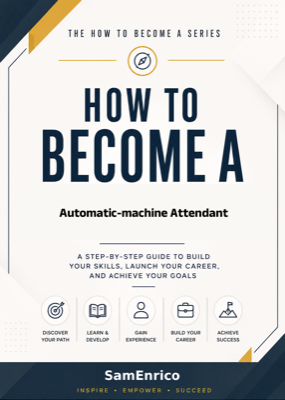
How to Become a Automatic-machine Attendant eBook
How to Become a Automatic-machine Attendant
How to Become a Automatic-machine Attendant
Formats
Free sample
Chapter 1: The Button is Dead...--–- The year is 1995. A factory in Toledo, Ohio. A man named Dave stands at a hydraulic press for ten hours a day. He loads a metal stamping into a fixture with his right hand. He presses a green button with his left thumb.
The press comes down with a thud. He unloads the finished part with his right hand. He stacks it on a pallet. Repeat. Four hundred times per shift.
Six days per week. Dave is a button pusher. He is paid for his hands. He is paid for his thumb. He is paid for his ability to withstand boredom.–- The year is 2025.
A factory outside Chicago. A woman named Maria stands at an automated assembly line. She does not press a button. She holds a tablet. On that tablet, she sees a live dashboard: production count, reject rate, line speed, and a list of the last twelve faults.
She watches a six-axis robot place components with precision her hands could never match. She watches a vision system inspect each part at sixty frames per second. She does not load parts. She does not press buttons. She watches.
She thinks. She decides.–- The press that Dave ran required a thumb. The line that Maria runs requires a brain. Dave’s job was to be present. Maria’s job is to be prepared.
Dave was paid to show up. Maria is paid to solve problems. Dave’s job is almost extinct. Maria’s job is the future.–- This book exists because most people—including many factory managers—still believe the job of an automatic-machine attendant is Dave’s job with a fancier machine. They think you stand there, watch the robot, and hit a reset button when something blinks red.
They think you are a warm body with a pulse and a pair of steel-toed boots.–- They are wrong. And being wrong is expensive. A factory that treats its attendants like button pushers loses money every single day. Machines run slower. Downtime lasts longer.
Quality drifts until customers complain. And the best operators—the ones who could actually fix things—quit out of frustration and take their skills to the plant down the road.–- This chapter is the funeral for the button pusher. It is also the birth announcement for the role you are about to step into: the data-driven analyst, the first responder of the factory floor, the person who turns red lights into green ones not by magic but by method. By the time you finish this chapter, you will understand why reading a screen is more important than turning a wrench, why the fault list is your best friend, and why the old rule—“if it ain’t broke, don’t fix it”—is the fastest way to get fired from a modern automation job.The Great Disappearing Act–- Let us begin with a number that should scare you: according to the Bureau of Labor Statistics, the number of purely manual “machine feeder and offbearer” jobs in the United States has declined by more than forty percent in the last twenty years. That is not a prediction.
That is a fact. Those jobs did not go to China. They did not go to Mexico. They went to robots, conveyors, and automated feeders.–- Here is another number: in that same twenty-year period, the number of “industrial machinery mechanic” and “automation technician” jobs has grown by twenty-eight percent. And the growth is accelerating.
Every factory that replaces ten button pushers with two automated lines still needs someone to tend those lines. But that someone is not Dave. That someone is Maria. That someone is you.–- The shift from manual to automated production is not a theory. It is not a future trend you can afford to ignore.
It is happening right now, in every sector that makes physical things: automotive, food and beverage, pharmaceuticals, consumer goods, aerospace, logistics. If a product can be made or moved in high volume, someone is trying to automate it. And every automated line still needs a human. But the human’s job has changed completely.–- The old job was about physical effort. You loaded, you pressed, you unloaded.
Your value was in your muscles and your endurance. The new job is about information. You monitor, you diagnose, you decide. Your value is in your attention and your judgment.–- This is not an opinion. This is the mechanical reality of how modern automation works.
A machine from 1995 had a motor, a switch, and a hardwired relay logic panel. When it stopped, you looked for the stuck part, the tripped breaker, or the broken belt. You could see the problem with your eyes. You could touch it with your hands.–- A machine from 2025 has a programmable logic controller (PLC), a human-machine interface (HMI), dozens of sensors, and an Ethernet connection to the factory network. When it stops, the problem might be invisible.
A sensor might be dirty, not broken. A logic condition might not be met because an upstream machine is running three seconds behind schedule. A safety interlock might be open because someone left a guard door ajar fifty feet away. You cannot see these problems. You cannot touch them.
You can only read them.–- That is why the button pusher is dead. Not because machines are smarter than people—they are not. Not because factories hate workers—they do not. But because the nature of the problem has changed from physical to informational. And the person who only knows how to press a button cannot solve informational problems.The Data-Driven Analyst: Your New Identity–- Let us define the role you are stepping into.
An automatic-machine attendant in the modern factory is not a passive observer. You are not a security guard for a robot. You are the first responder, the triage nurse, and sometimes the surgeon for a piece of equipment that costs more than your house.–- Your primary tool is not a wrench. Your primary tool is information. Specifically, the information that flows from the machine to you through the Human-Machine Interface—the screen, the tablet, the dashboard, the blinking lights that tell a story if you know how to read it.–- What kind of information?
Let me give you a real example from a factory that makes plastic bottles. An attendant named Carlos arrives for his shift. The line is stopped. A new operator tells him, “The machine just stopped. I hit reset.
It didn’t work.” Carlos does not open a panel. He does not grab a tool. He walks to the HMI mounted on the side of the machine. He navigates to the alarm history. He sees a list:09:47:22 – Fault 142: Reject conveyor jam09:45:01 – Fault 142: Reject conveyor jam09:42:17 – Fault 142: Reject conveyor jam09:38:55 – Fault 142: Reject conveyor jam–- In thirty seconds, Carlos knows what the previous operator could not see: the same fault has happened four times in the last ten minutes.
It is not a random glitch. It is a pattern. He walks to the reject conveyor. He finds a crushed bottle jammed under the belt. He clears…
This is the end of the free sample. Get the eBook to keep going. Buy now
About this book
Details
- Author
- Moeller Berniece
- Publisher
- SamEnrico
- Language
- English
- ISBN
- 9781505786361
- Genre
- Non-Fiction, Informative, Educational
- Released
- 2026-04-25
- Pages (approx.)
- 147
- Available as
- eBook, Paperback, Audiobook

Read better in the ZLOADR app
Your eBooks on your phone or tablet. Sign in with your SamEnrico account and start reading.
More by Moeller Berniece
 Free Creator Community BuildingMoeller Berniece$11.99
 Solar Temple Star Chamber PrimerMoeller Berniece$11.99
 Migraine Meditation ReliefMoeller Berniece$11.99
 LBO Model Macros GuideMoeller Berniece$11.99
 Gluten Free Pasta Making GuideMoeller Berniece$11.99
 The Billionaire's Secret War: How Mike Lazaridis Built BlackBerry and Lost It AllMoeller Berniece$11.99
 The Frozen Cartographers: Mapping the Last Unknown Shores of AustraliaMoeller Berniece$11.99
 Understanding Cerebellar AgenesisMoeller Berniece$17.99
 Australian University Dubai GuideMoeller Berniece$12.99
 ESG Controversy Tracker GuideMoeller Berniece$12.99
 Algorithm-Aware Content PlanningMoeller Berniece$11.99