

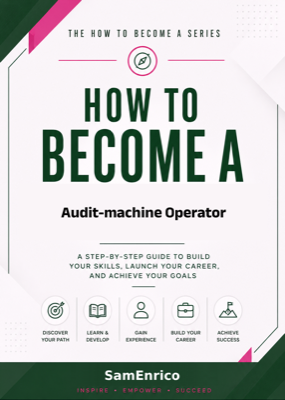
Non-FictionInformativeEducational
How to Become a Audit-machine Operator Paperback
How to Become a Audit-machine Operator
by Turley Hiedi
How to Become a Audit-machine Operator
Formats
Free sample
Chapter 1: The Obsolete Auditor...–- On a Tuesday morning in October 2019, a mid-level auditor named Thomas signed off on a balance sheet that showed 1.9billionincash.Thecashdidnotexist.Theauditorhadnottouchedasinglebankterminal,verifiedasinglesignature,orquestionedasingle PDFattachment.Hehadtrustedthemachine.Themachinewasaspreadsheet.Thespreadsheetwasalie.Withinsixmonths,Wirecard—a Germanpaymentprocessinggiantoncevaluedat1.9 billion in cash. The cash did not exist. The auditor had not touched a single bank terminal, verified a single signature, or questioned a single PDF attachment. He had trusted the machine. The machine was a spreadsheet.
The spreadsheet was a lie. Within six months, Wirecard—a German payment processing giant once valued at 1.9billionincash.Thecashdidnotexist.Theauditorhadnottouchedasinglebankterminal,verifiedasinglesignature,orquestionedasingle PDFattachment.Hehadtrustedthemachine.Themachinewasaspreadsheet.Thespreadsheetwasalie.Withinsixmonths,Wirecard—a Germanpaymentprocessinggiantoncevaluedat24 billion—would file for insolvency in what became the largest accounting fraud in European history. Thomas lost his job. His certification was reviewed. His career never recovered.
He was not a bad auditor. He was an obsolete one.This is not a book about Wirecard. This is a book about the quiet catastrophe unfolding across every industry where humans trust machines without understanding them. The catastrophe has many names: sensor drift, algorithm bias, false precision, black box liability, abstraction decay. But the outcome is always the same.
An auditor—whether in a glass office tower inspecting general ledgers or on a factory floor inspecting machined parts—looks at a digital readout, nods, stamps a form, and moves on. The machine said everything was fine. The machine was wrong. And the auditor had no idea why.The traditional auditor, as you have known it, is dying. The role that relied on sampling, checklists, and manual testing is being consumed by automation at an accelerating rate.
But here is the paradox that this book will resolve: while thousands of auditors fear being replaced by machines, almost none of them are learning to operate the machines that are replacing them. The result is a workforce caught between two worlds—not skilled enough to trust the machines intelligently, not fast enough to compete with them manually. This chapter will show you the trap, the way out, and the new role waiting for you on the other side: the Audit-machine Operator.The Two Worlds That Were Never Separate For most of the twentieth century, financial auditing and physical quality assurance evolved on parallel tracks that never intersected. On one track sat the financial auditor—CPA, suit, spreadsheet, sampling 100 invoices out of 100,000, testing internal controls over journal entries, signing off on material misstatement. On the other track sat the quality inspector—blue collar, calipers, micrometer, sampling 10 parts out of 10,000, testing conformance to blueprints, signing off on dimensional tolerance.The tools were different.
The vocabulary was different. The certifications were different. But the core function was identical: gather evidence, compare it to a standard, and render a judgment about a population based on a sample.Then automation arrived. Not gradually, but in waves that crashed over both professions simultaneously.For financial auditors, the first wave was Computer-Assisted Audit Techniques (CAATs)—software that could test 100% of transactions instead of a sample. Tools like ACL and IDEA allowed an auditor to scan every invoice in an ERP system, flag every journal entry over a threshold, and run Benford's Law analysis on millions of rows of data.
For the first time, sampling became optional. But most auditors did not learn the tools. They outsourced the work to IT specialists who did not understand audit risk.For quality inspectors, the first wave was Coordinate Measuring Machines (CMMs)—hardware that could measure 100% of dimensions on 100% of parts automatically. A CMM could probe a complex aerospace component in 90 seconds, compare every measurement to a CAD model, and flag…
This is the end of the free sample. Get the Paperback to keep going. Buy now
About this book
Details
- Author
- Turley Hiedi
- Publisher
- SamEnrico
- Language
- English
- ISBN
- 9781505786101
- Genre
- Non-Fiction, Informative, Educational
- Released
- 2026-05-08
- Pages (approx.)
- 155
- Available as
- eBook, Paperback, Audiobook

Read better in the ZLOADR app
Your eBooks on your phone or tablet. Sign in with your SamEnrico account and start reading.
More by Turley Hiedi
 Creative Professional Stress GuideTurley Hiedi$11.99
 Coffee While FastingTurley Hiedi$11.99
 Pitch Deck Validation ResearchTurley Hiedi$11.99
 Grief and Loss Dream HealingTurley Hiedi$11.99
 Group Creative RitualsTurley Hiedi$11.99
 Cigarette Butt Pollution GuideTurley Hiedi$11.99
 TM for ParalegalsTurley Hiedi$11.99
 Shirley Chisholm UnboughtTurley Hiedi$11.99
 HGH And MitochondriaTurley Hiedi$11.99
 The Great Circus Heist: The Untold Tale of P.T. Barnum's Stolen ElephantTurley Hiedi$11.99
 The Click That Changed Everything: How a Single Amazon Button Reshaped RetailTurley Hiedi$11.99
 Silk and Shadows: The Lost Codex of ConstantinopleTurley Hiedi$11.99
You may also like
 Hong Kong Handover 1997Dunn Johnnie$11.99
 Zumba For Postnatal Recovery CourseNeal Christian$11.99
 Zumba for BeginnersLadner Nikia$11.99
 YouTube Comment Mining GuideHumes Pandora$12.99
 Worry Box MeditationCarlin Rudy$11.99
 Workplace Stress MeditationNguyen Lynn$11.99
 Workplace Stress and Sleep RepairHawley Ivory$11.99
 Workplace Perfectionism CureDelaney Jeffry$11.99
 Workplace Injustice Anger GuideWallen Isabelle$11.99
 Work Addiction and Burnout LinkGreenwood Ester$11.99
 Women in Yoga and WellnessBeattie Galina$11.99
 Women in Stand Up ComedyChun Evangeline$11.99