
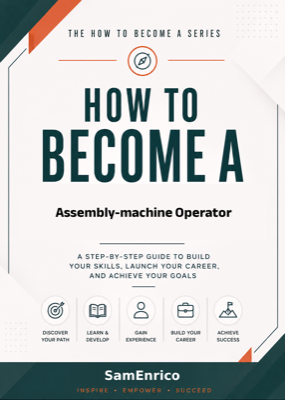
How to Become a Assembly-machine Operator eBook
How to Become a Assembly-machine Operator
How to Become a Assembly-machine Operator
Formats
Free sample
Chapter 1: The Ghost in the Assembly Line...–- On a humid Tuesday night in suburban Detroit, a forty-year-old assembly machine named Press Line Four produced 847 perfect engine blocks. The only human in the cell, a fifty-seven-year-old operator named Frank, spent most of his twelve-hour shift sitting on a stool, scrolling through his phone. When the machine stopped, which it did four times that night, Frank pressed a button, cleared a jam, and resumed scrolling. Frank was not a bad worker. He was simply a product of an outdated system that had trained him to be a babysitter rather than an operator.
Across town, at a medical device plant, a twenty-four-year-old named Maya ran a flexible assembly cell that produced three different surgical tools in the same shift. She spent only twenty percent of her time at the machine. The other eighty percent she spent interpreting data dashboards, recalibrating a torque driver, troubleshooting a vision sensor that had drifted out of alignment, and walking a trainee through a root cause analysis of a recurring misfeed. Maya and Frank held the same job title. Their lives on the floor could not have been more different.
This chapter is about the gap between those two realities—and why the Maya model is the only future worth training for.The modern assembly machine operator is one of the most misunderstood roles in industrial manufacturing. Ask a stranger on the street to describe the job, and you will hear some variation of the same answer: repetitive, low-skill, mind-numbing, destined for automation. That stranger is wrong, and their ignorance is expensive. In the last decade, the assembly line has undergone a transformation more radical than anything since Henry Ford introduced the moving belt. Machines that once required a warm body to pull a lever now require a thinking person to manage a system.
Sensors that once only detected the presence of a part now transmit real-time torque curves, vibration spectra, and thermal profiles to cloud-based analytics engines. The operator who treats this data as background noise will be replaced within five years. The operator who reads this data as a language will write their own ticket.This chapter dismantles the myth of the passive button pusher and replaces it with a single, unshakable philosophy that will guide the entire book: the modern assembly machine operator is an active diagnostician, quality guardian, safety enforcer, and continuous improvement agent—all wrapped into one role. Every chapter that follows, from mechanical aptitude to lean manufacturing to career planning, is merely an application of this core idea. You are not learning to push buttons more efficiently.
You are learning to own the asset.The Three Faces of Assembly Automation Before you can understand the operator's role, you must understand the machine you will tend. Assembly automation falls into three broad categories, each with its own demands on the human standing beside it. Do not skip this section. The type of automation in your future workplace will determine eighty percent of your daily stress, boredom, or satisfaction.Manual assembly is the oldest and simplest. A human uses hand tools and simple fixtures to join parts.
There may be a conveyor, a torque driver hanging from a balancer, and a bin of components. The "machine" is often just a workbench. Manual assembly cells are common in low-volume, high-mix environments like aerospace overhaul shops, prototype labs, and job shops that produce custom assemblies. The operator in a manual cell exercises high judgment and dexterity but low machine-interfacing skill. Your success here depends on hand speed, attention to detail, and fatigue management.
The downside is that manual assembly is the most physically punishing and the most likely to be partially automated away.Fixed automation is the world of dedicated, high-speed machinery. Think of a transfer line that stamps, welds, and assembles an automotive cylinder head at a rate of one part every twelve seconds. Fixed automation is expensive to build, fast to run, and nearly impossible to change. It is justified only by massive production volumes—millions of identical parts per year. The operator in a fixed automation cell is primarily a monitor and a jam clearer.
This is the Frank model. The job can be tedious, and the cognitive demands are low until something breaks. The risk is that your brain will atrophy from disuse. The opportunity is that fixed automation plants, because they run so fast, cannot afford downtime. A skilled operator who prevents breakdowns is worth far more than a button pusher.Flexible automation is the frontier.
These are programmable systems that can change over from product A to product B in minutes rather than hours. Robots with quick-change grippers, CNC-controlled assembly stations, vision-guided part presenters, and modular feeders that reconfigure themselves. Flexible cells are common in electronics assembly, medical device manufacturing, and any industry where product variants multiply every year. The operator in a flexible cell is Maya. You will spend less time standing and staring and more time programming, measuring, troubleshooting, and optimizing.
The cognitive load is high. The job satisfaction, for the right person, is also high. The challenge is that flexible automation exposes every weakness in your technical and problem-solving skills. There is nowhere to hide.Most assembly machine operators will encounter a mix of these three types. A typical factory might have fixed automation for high-volume base components, flexible cells for final assembly of variants, and manual benches for rework or low-volume specialty products.
Your ability to move between these worlds will determine your career trajectory.Where the Jobs Are: A Sector Tour of Assembly Work Not all assembly machine operator jobs are created equal. The machines differ. The tolerances differ. The consequences of error differ. And the pay, predictably, differs by an order of magnitude.
Here is a sector-by-sector breakdown of what you can expect.Automotive and Heavy Equipment This is the largest employer of assembly machine operators in North America and Europe. You will work on engine blocks, transmissions, axles, brake systems, steering racks, electrical harnesses, battery packs, and interior modules. The automation level ranges from highly fixed (engine block transfer lines) to moderately flexible (final assembly of vehicle variants on a single line). Tolerances are in the range of 0.1 to 1.0 millimeters for most fits, though valve train and fuel system components demand much tighter control. The pace is relentless.
Cycle times are measured in seconds. The physical demands are high—lifting, bending, reaching, standing on concrete. The union presence varies by region but is strongest in legacy automotive plants. Pay ranges from $18 to $35 per hour, with overtime common. The greatest risk is cyclical layoffs.
The greatest opportunity is that automotive companies invest heavily in training and certification.Aerospace and Defense This sector operates on a different rhythm. Volumes are low. Parts are expensive. Tolerances are measured in ten-thousandths of an inch. A single rejected fastener on a wing spar can ground an aircraft and trigger a cascade of paperwork that takes weeks to resolve.
Assembly machines in aerospace tend to be semi-automated or manual, with a heavy emphasis on torque control, fastener verification, and non-destructive testing. You will work on wiring harnesses, hydraulic tube assemblies, engine modules, landing gear components, and flight control…
This is the end of the free sample. Get the eBook to keep going. Buy now
About this book
Details
- Author
- Drayton Gracia
- Publisher
- SamEnrico
- Language
- English
- ISBN
- 9781505785357
- Genre
- Non-Fiction, Informative, Educational
- Released
- 2026-04-25
- Pages (approx.)
- 158
- Available as
- eBook, Paperback, Audiobook

Read better in the ZLOADR app
Your eBooks on your phone or tablet. Sign in with your SamEnrico account and start reading.
More by Drayton Gracia
 Postpartum Partner Support GuideDrayton Gracia$11.99
 ABCDE For Kanban BoardsDrayton Gracia$11.99
 Customer Feedback SynthesisDrayton Gracia$11.99
 Deodorant Aluminum GuideDrayton Gracia$11.99
 Spinal Cord StimulatorDrayton Gracia$11.99
 The Senior Pet GoodbyeDrayton Gracia$11.99
 Sam Sheppard Prosecution MisconductDrayton Gracia$11.99
 Alcohol Relapse Prevention PlanDrayton Gracia$11.99
 The Botanist of Timbuktu: Al-Hassan ibn Muhammad’s Green RevolutionDrayton Gracia$11.99
 Masonry Sleep Problem SystemDrayton Gracia$11.99
 Barley & Blood: The Untold Saga of the Viking BrewmastersDrayton Gracia$11.99
 The Unseen Crown: The Rise and Reinvention of Queen LatifahDrayton Gracia$11.99