
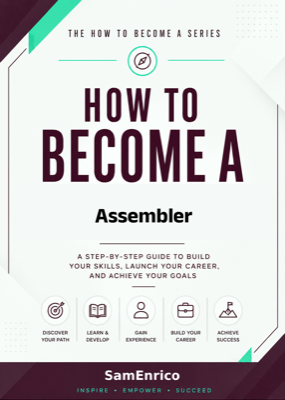
Non-FictionInformativeEducational
How to Become a Assembler eBook
How to Become a Assembler
How to Become a Assembler
Formats
Free sample
Chapter 1: The Fork in the Road--The first and most important decision you will make on the path to becoming an assembler has nothing to do with tools, codes, or hardware. It has everything to do with language. The word “assembler” has two completely different meanings, and choosing the wrong one based on a misunderstanding will waste months of your time, if not years. Some people who call themselves assemblers write software that talks directly to a computer’s processor using a language called Assembly. Others call themselves assemblers because they build physical electronic devices by hand, soldering components onto circuit boards and wiring up machinery.
These two careers share a name, but they share almost nothing else. They require different skills, different training, different tools, and they lead to different job markets. This chapter exists to make sure you start down the correct fork in the road.The confusion is understandable. In the world of computers, an assembler is a piece of software that converts human-readable Assembly language into machine code that the processor can execute. A person who writes that Assembly language is often called an Assembly programmer or, informally, an assembler.
In the world of manufacturing, an assembler is a person who puts together components—screwing, soldering, crimping, or gluing parts into a finished product. Both jobs involve precision. Both jobs require attention to detail. Both jobs reward patience. But the day-to-day reality of each could not be more different.Consider two people who both call themselves assemblers.
Maria works in a clean, well-lit electronics factory. She sits at a workstation with an ESD mat, a soldering iron, a microscope, and a tray of tiny surface-mount components. She uses tweezers to place a resistor the size of a grain of sand onto a circuit board, then solders it with a hot air gun. She listens to podcasts while she works. Her hands are steady, her eyes are sharp, and her work is inspected under magnification.
She earns an hourly wage with benefits and overtime. She never writes code, never uses a command line, and never thinks about register allocation or system calls.Now consider Priya. She works from a home office with three monitors, a mechanical keyboard, and a Linux workstation. She writes Assembly code for a real-time embedded system in a medical device. Her code determines whether a pump delivers insulin at the correct moment.
One mistake in her code could crash the device. She uses a debugger, a disassembler, and a logic analyzer to trace execution. She earns a salary several times higher than Maria’s, but she also faces a much steeper learning curve and a smaller job market. She never touches a soldering iron, never worries about ESD, and never reads a bill of materials.Both Maria and Priya are correct in calling themselves assemblers—but only within their own communities. A job posting for an “assembler” at a manufacturing company means something completely different from a job posting for an “assembler” at a software company.
If you apply to a factory job with Assembly programming skills, you will be rejected. If you apply to a software job with soldering skills, you will be rejected. This is why the first chapter of this book is not about registers or soldering irons. It is about choosing your path with open eyes.The Digital Assembler: Who This Path Is For The digital assembler writes code in Assembly language. This is the lowest level of human-readable programming.
One line of Assembly typically corresponds to one machine instruction. The programmer controls exactly what the CPU does, down to which registers are used, how memory is accessed, and how interrupts are handled. High-level languages like Python, Java, or even C hide these details. Assembly exposes them.Who should choose the digital path? You might be a good fit if you answer yes to most of these questions.
Do you enjoy solving puzzles that require understanding how things work at the deepest level? Have you written at least a few hundred lines of code in any programming language? Are you comfortable with the command line, compilers, and debuggers? Do you have patience for learning syntax that feels arcane compared to modern languages? Do you want to work on operating systems, embedded devices, game engines, or security research?
Are you willing to accept that Assembly jobs are fewer in number than high-level programming jobs, but often pay more and require deeper expertise?The digital path is not for beginners who have never programmed. It assumes you understand what a variable, a loop, a function, and a pointer are. If those terms are unfamiliar, you should not start here. Instead, learn C or Python first, then return to this path. The digital assembler is a specialist, not an entry-level role.
Most professional Assembly programmers started with higher-level languages and moved down the stack as they gained experience.The Physical Assembler: Who This Path Is For The physical assembler builds real things. You might be assembling printed circuit boards (PCBs), wiring up control panels, or integrating electronic components into mechanical systems. You might work in a factory, a repair shop, a prototyping lab, or even from a home workshop. The work is tactile, visual, and manual. You will use soldering irons, wire strippers, crimpers, multimeters, and microscopes.
You will read schematics and bills of materials. You will inspect your work for defects and rework it when necessary.Who should choose the physical path? You might be a good fit if you answer yes to most of these questions. Do you enjoy working with your hands? Have you ever repaired a broken appliance, built a model kit, or done any kind of detailed craft?
Are you comfortable sitting and focusing on small parts for extended periods? Do you have steady hands and good close-up vision (or are willing to use magnification)? Do you prefer clear, tangible results over abstract reasoning? Are you looking for a stable career that does not require a four-year degree? Are you willing to start at an entry-level wage and advance through demonstrated skill?The physical path is genuinely entry-level.
Many successful physical assemblers started with no prior experience, learned on the job, and advanced through certifications like IPC-A-610. High school graduates, career changers, and hobbyists all find their way into this field. If you have no programming experience and no desire to learn, the physical path is almost certainly the right choice.The Cost of Choosing Wrong To understand why this decision matters, consider the sunk cost of heading down the wrong path. A digital assembler spends months learning instruction sets, addressing modes, calling conventions, and debugging at the binary level. The investment in time is substantial.
If that person then applies for a physical assembly job, their Assembly programming skills count for nothing. Employers will see a resume with no relevant experience—no soldering, no ESD knowledge, no IPC certifications. The digital assembler would have to start over as a complete beginner.The reverse is equally painful. A physical assembler who decides to become a digital assembler has no programming foundation. They would need to learn basic programming concepts first (variables, loops, conditionals), then learn C, then learn Assembly.…
This is the end of the free sample. Get the eBook to keep going. Buy now
About this book
Details
- Author
- Stamm Katherin
- Publisher
- SamEnrico
- Language
- English
- ISBN
- 9781505785050
- Genre
- Non-Fiction, Informative, Educational
- Released
- 2026-05-23
- Pages (approx.)
- 151
- Available as
- eBook, Paperback, Audiobook

Read better in the ZLOADR app
Your eBooks on your phone or tablet. Sign in with your SamEnrico account and start reading.
More by Stamm Katherin
 Breath Awareness for Anxiety ReliefStamm Katherin$11.99
 LTC Insurance Medical UnderwritingStamm Katherin$11.99
 Imposter Workplace CultureStamm Katherin$11.99
 Cocaine Recovery WorkbookStamm Katherin$11.99
 TM For Stress ReductionStamm Katherin$11.99
 Southeast Asia Bribery CasesStamm Katherin$11.99
 Spiritual Language Preservation GuideStamm Katherin$11.99
 Vacation Planning GuideStamm Katherin$11.99
 Software Developer Crunch StressStamm Katherin$11.99
 The Pi Puzzle: Unraveling the Secret of the Ancient Babylonian TabletStamm Katherin$11.99
 The Opal Hunters of Lightning Ridge: A Glimpse into the Earth's Hidden TreasuresStamm Katherin$11.99
 AI Stack Overflow ReplacementStamm Katherin$12.99
You may also like
 Hong Kong Handover 1997Dunn Johnnie$11.99
 Zumba For Postnatal Recovery CourseNeal Christian$11.99
 Zumba for BeginnersLadner Nikia$11.99
 YouTube Comment Mining GuideHumes Pandora$12.99
 Worry Box MeditationCarlin Rudy$11.99
 Workplace Stress MeditationNguyen Lynn$11.99
 Workplace Stress and Sleep RepairHawley Ivory$11.99
 Workplace Perfectionism CureDelaney Jeffry$11.99
 Workplace Injustice Anger GuideWallen Isabelle$11.99
 Work Addiction and Burnout LinkGreenwood Ester$11.99
 Women in Yoga and WellnessBeattie Galina$11.99
 Women in Stand Up ComedyChun Evangeline$11.99