
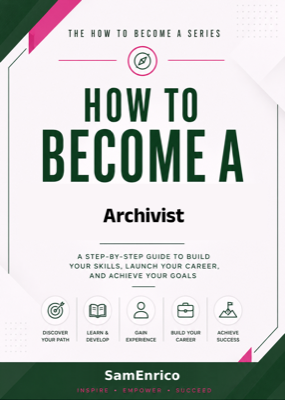
Non-FictionInformativeEducational
How to Become a Archivist
How to Become a Archivist
How to Become a Archivist
Formats
About this book
Free sample
Chapter 1: The Memory Keepers--The first time I held a letter written by a soldier who would die the following week, I understood something that four years of university had failed to teach me. Archives are not storage facilities. They are time machines made of paper and pixels, and the people who tend them are not clerks. They are guardians of the last conversation, the final signature, the only remaining evidence that something happened at all. This chapter will redefine what you think you know about archivists, and by the end, you will see that the quiet person in the reading room wearing clean bare hands is one of the most powerful, and least understood, professionals in the information age.Before you can become an archivist, you must understand what an archivist actually is.
And that, surprisingly, is where most aspiring archivists stumble. They confuse us with librarians, or museum curators, or records managers, or historians. They think we catalog books, or hang paintings, or answer historical trivia questions. They imagine dusty basements, endless boxes, and a profession frozen in the 1950s. Nothing could be further from the truth.The Great Confusion: Why Everyone Gets It Wrong Walk into any social gathering and tell someone you are an aspiring archivist.
Watch their face. Nine times out of ten, they will say something like, “Oh, so you organize old books?” Or, “Like a museum?” Or, most frustratingly, “That must be so quiet and boring.”The confusion is understandable. Archives are invisible to most people. You have visited a library. You have walked through a museum.
But have you ever stepped inside the closed stacks of a major archival repository? Probably not. Archivists work behind the scenes, and the public sees only the tip of the iceberg—the reading room, the online finding aid, the occasional exhibition.But the distinction matters enormously because the skills, training, and daily work of an archivist are fundamentally different from those of other information professionals. Let me draw these distinctions clearly, once and for all.Librarians collect, organize, and provide access to published materials. Books, journals, magazines, newspapers, DVDs—items that…
This is the end of the free sample. Get the eBook to keep going. Buy now
Contents
- Chapter 1
- Chapter 2
- Chapter 3
- Chapter 4
- Chapter 5
- Chapter 6
- Chapter 7
- Chapter 8
- Chapter 9
- Chapter 10
- Chapter 11
- Chapter 12
Details
- Author
- Matos Melonie
- Publisher
- SamEnrico
- Language
- English
- ISBN
- 9781505784367
- Genre
- Non-Fiction, Informative, Educational
- Released
- 2026-05-08
- Pages (approx.)
- 134
- Available as
- eBook, Paperback, Audiobook

Read better in the ZLOADR app
Your eBooks on your phone or tablet. Sign in with your SamEnrico account and start reading.
More by Matos Melonie
 Youth Mental Health First Aid In SchoolsMatos Melonie$11.99
 Pattern Recognition TipsMatos Melonie$11.99
 Highway Fury Self Control GuideMatos Melonie$11.99
 Delegation JournalMatos Melonie$11.99
 TM For MenopauseMatos Melonie$11.99
 The Catholic Art PurgeMatos Melonie$11.99
 Light Exposure and RecallMatos Melonie$11.99
 Sexual Addiction Residential CareMatos Melonie$11.99
 Affirmations For Job LossMatos Melonie$11.99
 Whispers of the Forbidden Shore: The Secret Affair That Shook a NationMatos Melonie$11.99
 The Lost Voyage of the San José: Survival and Betrayal in the AmazonMatos Melonie$11.99
 The Golden Treasury of Queen Tiya: How an Ethiopian Monarch Built a Dynasty of Wealth and WisdomMatos Melonie$11.99
You may also like
 Hong Kong Handover 1997Dunn Johnnie$11.99
 Zumba For Postnatal Recovery CourseNeal Christian$11.99
 Zumba for BeginnersLadner Nikia$11.99
 YouTube Comment Mining GuideHumes Pandora$12.99
 Worry Box MeditationCarlin Rudy$11.99
 Workplace Stress MeditationNguyen Lynn$11.99
 Workplace Stress and Sleep RepairHawley Ivory$11.99
 Workplace Perfectionism CureDelaney Jeffry$11.99
 Workplace Injustice Anger GuideWallen Isabelle$11.99
 Work Addiction and Burnout LinkGreenwood Ester$11.99
 Women in Yoga and WellnessBeattie Galina$11.99
 Women in Stand Up ComedyChun Evangeline$11.99