
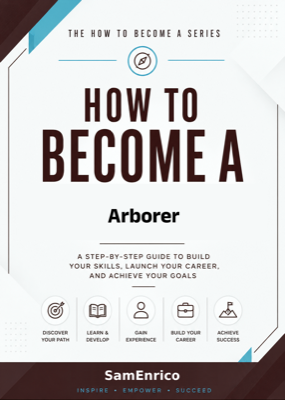
How to Become a Arborer
How to Become a Arborer
by Pagan Mallie
How to Become a Arborer
Formats
About this book
Free sample
Chapter 1: The Language of Trees--–- Every time you look at a tree, you are seeing a survivor. That oak in the city park has outlasted droughts, construction, pests, and probably a dozen amateur pruners who had no idea what they were doing. The maple in your client’s backyard has been quietly compartmentalizing decay for decades, walling off wounds like a medieval fortress under siege. And that dead elm standing in the field? It is not dead yet.
Not really. It is sending chemical messages through its root system to neighboring trees, warning them of the beetles that killed it.Trees are not statues. They are not slow, simple plants that just stand there until someone cuts them down. Trees are living, breathing, fighting organisms with complex internal systems, evolved defenses, and communication networks that scientists are only beginning to understand. And if you want to become an arborer—not just a tree trimmer, but a true professional—you need to learn their language before you ever make your first cut.This chapter is not a dry biology lecture.
It is the foundation of everything that follows. Every rope you tie, every branch you remove, every tree you save or dismantle depends on one thing: understanding how a tree lives and dies. Make a cut without this knowledge, and you might as well be using a chainsaw blindfolded. Master it, and you will see things that landscape crews miss—the early signs of failure, the hidden cracks, the trees that can be saved and the ones that cannot.Let us begin with the most important truth in arboriculture: a tree does not heal. It seals.The Myth of Healing: Why CODIT Changes Everything If you ask most people what happens when a tree gets a wound, they will say it heals.
That is what human skin does. That is what animal bones do. But trees are not animals. They do not regenerate damaged tissue. They do not grow new bark over a wound to make it disappear.
Instead, they do something far more clever and far more limiting: they compartmentalize.The scientific name for this process is CODIT…
This is the end of the free sample. Get the eBook to keep going. Buy now
Contents
- Chapter 1
- Chapter 2
- Chapter 3
- Chapter 4
- Chapter 5
- Chapter 6
- Chapter 7
- Chapter 8
- Chapter 9
- Chapter 10
- Chapter 11
- Chapter 12
Details
- Author
- Pagan Mallie
- Publisher
- SamEnrico
- Language
- English
- ISBN
- 9781505784220
- Genre
- Non-Fiction, Informative, Educational
- Released
- 2026-05-02
- Pages (approx.)
- 132
- Available as
- eBook, Paperback, Audiobook

Read better in the ZLOADR app
Your eBooks on your phone or tablet. Sign in with your SamEnrico account and start reading.
More by Pagan Mallie
 Nap Grogginess PreventionPagan Mallie$11.99
 Micronutrients For Menopause GuidePagan Mallie$11.99
 MBSR for Social Media StressPagan Mallie$11.99
 Cross Border VC TermsPagan Mallie$11.99
 Caregiver for ALS PatientsPagan Mallie$11.99
 Forgiveness Hypnosis ScriptsPagan Mallie$11.99
 Fibromyalgia Sleep Recovery PlanPagan Mallie$11.99
 The Sketch Group BreakupPagan Mallie$11.99
 Love, Lies, and a Royal Scandal: The Untold Story of Princess Margaret and Peter TownsendPagan Mallie$11.99
 Tangaroa’s Tide: The Ocean’s Forgotten DebtPagan Mallie$11.99
 The Strategist's Guide to Direct MarketingPagan Mallie$11.99
 Stardust and the Forgotten Pioneer: The Untold Story of the First Woman in SpacePagan Mallie$11.99