
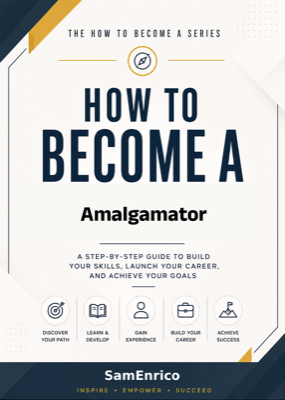
How to Become a Amalgamator eBook
How to Become a Amalgamator
How to Become a Amalgamator
Formats
Free sample
Chapter 1: The Identity Crucible...--–- Most people who try to become Amalgamators fail before they buy their first company. They fail not because they lack capital, intelligence, or connections. They fail because they show up to a street fight thinking they are playing chess. They believe that deal-making is a sport for the patient and the analytical—spreadsheets, term sheets, and polite dinners. But the truth is far messier, far more demanding, and far more rewarding.
The Amalgamator does not sit behind a desk allocating capital. The Amalgamator steps into the arena, gets their hands dirty, and builds something that did not exist before. This chapter is not a gentle warm-up. It is an invitation to decide, once and for all, whether you have the stomach for the work ahead.The Great Misunderstanding Walk into any business school classroom or any investment conference, and you will hear a chorus of voices discussing "value creation." They will talk about multiples, about arbitrage, about unlocking shareholder value. But listen carefully, and you will notice something missing.
They are talking about the stock market as if it were a video game. They are talking about buying low and selling high as if the companies in between were interchangeable tokens. This is the language of the Investor, and it is seductive because it is clean. It is numerical. It does not require you to fire anyone, to sit in a room with a weeping founder, or to explain to a thirty-year technician why their 401(k) is changing.The Investor buys a sliver of a company.
The Amalgamator buys the whole thing. The Investor diversifies across fifty industries. The Amalgamator goes all-in on one fragmented, messy, unglamorous industry. The Investor waits for the market to revalue their asset. The Amalgamator forces revaluation through sweat, confrontation, and relentless execution.Here is the distinction in its simplest form.
The Investor asks: "What will the market pay for this tomorrow?" The Amalgamator asks: "What can I make this into by Friday?"Most people who claim to want to be Amalgamators are actually Investors. They want the returns without the responsibility. They want the title without the trench warfare. And the market punishes them for this confusion. They buy a company, install a management team they barely know, and wonder why the numbers never materialize.
They pay for an earn-out, and the seller walks away disengaged. They acquire a platform, and then they suffocate it with centralized bureaucracy. They fail because they never made the psychological transition from spectator to participant.This book is not for those people. If you are looking for a passive income stream, put this book down now and buy an index fund. But if you are willing to wake up at 3:00 AM to solve a payroll problem, to fly to a remote location to reassure a frightened workforce, to tell a seller that their baby is about to change—then keep reading.
You are my people.The Fragmented Industry Thesis Why does amalgamation work at all? Why do we not simply let fragmented industries stay fragmented? The answer lies in a simple observation about the nature of small businesses. A mom-and-pop HVAC shop in a mid-sized city might generate $2 million in revenue and $400,000 in EBITDA. The owner works sixty hours a week, handles customer complaints personally, negotiates with suppliers individually, and has no marketing budget to speak of.
They cannot afford a CFO, an HR director, or a dedicated IT team. They are trapped.Now imagine that same shop as part of a platform of fifty similar shops. The combined entity negotiates with suppliers for a 20% volume discount. It centralizes payroll, benefits, and accounting, cutting back-office costs in half. It deploys a customer retention system that reduces churn from 30% to 15%.
It offers technicians a career path and a 401(k) match that no independent shop could afford. The whole becomes vastly more valuable than the sum of its parts.This is not theory. This is the playbook that has created billions of dollars of wealth in industries ranging from waste management to dental services to commercial landscaping. The fragmented industry is the Amalgamator's hunting ground because it is full of trapped value. The owners are tired.
The systems are outdated. The competition is fierce but localized. And the opportunity is enormous.But here is the catch. You cannot amalgamate every industry. Some industries are structurally immune to consolidation.
Restaurants, for example, have high failure rates, thin margins, and virtually no customer stickiness. A restaurant customer will follow a good chef, not a brand. Construction is project-based, with no recurring revenue and constant capital demands. Retail is being eaten by e-commerce. Technology startups are valued on narrative, not earnings, making rational multiples impossible.The successful Amalgamator knows how to say no.
They know that their first decision—which industry to enter—determines 80% of their eventual success. And they make that decision with cold, analytical rigor, not with the warmth of a personal passion. Do not buy a business because you love it. Buy a business because the industry structure is broken in a way you can fix.The Platform Company: Your First and Most Important Acquisition The most common mistake first-time Amalgamators make is trying to start with a small tuck-in acquisition. They find a tiny business with a tired owner, buy it for a low multiple, and then try to build an empire around it.
This almost never works. A $1 million revenue company does not have the infrastructure to absorb other companies. It does not have a scalable accounting system, a professional management team, or the cultural gravity to attract other sellers.You must start with a Platform Company. The platform is your first acquisition, but it is not a small one. It should have at least $5 million in revenue, and preferably $10 million or more.
It should have professional management beyond the founder—a controller, an operations manager, a sales leader. It should have clean financials that would pass a bank audit. It should have a physical and operational footprint that can absorb add-ons: extra office space, management bandwidth, and systems that can scale.Think of the platform as the mothership. Every subsequent acquisition will be an add-on that docks into this mothership. The add-on brings customers, technicians, and local relationships.
The platform brings infrastructure, purchasing power, and professional discipline. The platform does the integrating; the add-on gets integrated.This means that your first deal is also your most important deal. You cannot afford to get it wrong. If you buy a weak platform, everything you attach to it will be compromised. If you buy a platform with a toxic culture, that toxicity will infect every add-on.
If you buy a platform with a founder who refuses to let go, you will face a governance crisis with every subsequent acquisition.So how do you evaluate a platform? You look for five characteristics. First, professional management that can run the business day-to-day without the founder. Second, clean financials that have been audited or at least reviewed by an independent CPA. Third, scalable infrastructure, meaning IT and HR systems that can handle ten times the current headcount.
Fourth, a defensible market position, ideally as the number one or two player in its local market. Fifth, cultural health…
This is the end of the free sample. Get the eBook to keep going. Buy now
About this book
Details
- Author
- Banuelos Dayna
- Publisher
- SamEnrico
- Language
- English
- ISBN
- 9781505782936
- Genre
- Non-Fiction, Informative, Educational
- Released
- 2026-05-02
- Pages (approx.)
- 120
- Available as
- eBook, Paperback, Audiobook

Read better in the ZLOADR app
Your eBooks on your phone or tablet. Sign in with your SamEnrico account and start reading.
More by Banuelos Dayna
 LinkedIn Resume Integration GuideBanuelos Dayna$11.99
 Forgiveness for Career SetbacksBanuelos Dayna$11.99
 Benzodiazepine and Alcohol Dual GuideBanuelos Dayna$11.99
 Managing Family Distractions GuideBanuelos Dayna$11.99
 Metta for a Wild AnimalBanuelos Dayna$11.99
 1031 Exchange Execution ManualBanuelos Dayna$11.99
 Ocean Depths DescentBanuelos Dayna$11.99
 Steve Jobs RealityBanuelos Dayna$11.99
 Combat Medic Master GuideBanuelos Dayna$11.99
 Tiamat's Cosmic Forge: When Chaos Shaped the WorldBanuelos Dayna$11.99
 The Shadow Sultan: How a Eunuch Ruled an EmpireBanuelos Dayna$11.99
 The Anthrax Letters: A Deadly PuzzleBanuelos Dayna$11.99