
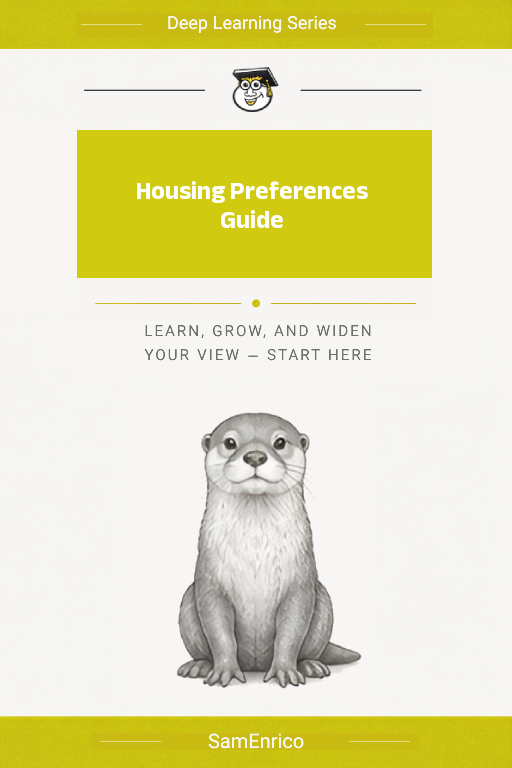
Non-FictionConsumer Mind ReportHousing
Housing Preferences Guide eBook
Compare homeownership vs renting, urban vs suburba
Compare homeownership vs renting, urban vs suburban, single-family vs multifamily, and renovation spending.
Formats
Free sample
Chapter 1: The Broken Ladder--–- In 1950, a young factory worker in Detroit could purchase a three-bedroom house, a new car, and support a family of four on a single income. The math was simple: the house cost 2.2 times his annual salary, the mortgage rate was fixed and low, and the suburban street he moved to would double in value every decade. That was the American Dream—a ladder with rungs evenly spaced, predictable, and waiting for anyone willing to work. Seventy years later, that ladder has not just been moved; it has been shattered, reassembled backward, and set on fire. The median home now costs more than six times the median income.
Student debt, gig economy volatility, remote work, climate migration, and delayed family formation have turned housing into a complex puzzle with no single correct answer. Yet most of us still carry the 1950s script in our heads: buy a single-family home in the suburbs with a thirty-year mortgage, stay for decades, watch it appreciate. This chapter dismantles that script and replaces it with a framework—the Housing Triangle—that will guide every decision in this book.The Myth of the Universal Housing Ladder We inherit housing beliefs the way we inherit recipes: passed down, rarely questioned, and often disastrous when applied to different ingredients. The post–World War II housing model was not a timeless truth but a historical accident. The GI Bill offered zero-down mortgages.
The Federal Highway Act subsidized suburban sprawl. Zoning laws effectively banned multifamily housing in vast swaths of the country. And critically, wages rose in lockstep with productivity for three decades, making mortgage payments progressively easier.That world is gone. Real wages for most workers have barely budged since 1973 while home prices have tripled in inflation-adjusted terms. The fixed-rate mortgage still exists, but the job attached to it is no longer fixed.
The average American now changes jobs every 4.1 years and careers three to seven times in a lifetime. The suburban house that promised stability now threatens to become a golden handcuff when a better job appears three states away.This book does not argue that homeownership is bad, or that renting is superior, or that cities beat suburbs, or that multifamily living is the future. It argues something more uncomfortable: the best housing choice depends entirely on your specific Life Phase, Financial Stage, and Psychological Profile. The factory worker of 1950 had one profile. You have another.
The goal of this book is to help you build a decision-making system, not to sell you a single answer.The Three Housing Myths That Keep Us Stuck Before introducing the Housing Triangle, we must clear away three persistent myths that distort every housing conversation. These myths appear in personal finance blogs, real estate agent scripts, and dinner table arguments. They feel true because they contain a grain of truth. But grains of truth are not whole loaves.Myth One: “Rent is throwing money away.” This statement assumes that mortgage interest, property taxes, insurance, maintenance, and transaction costs are not also thrown away. They are.
The average homeowner spends roughly 3 to 4 percent of the home’s value annually on unrecoverable costs. A renter spends 100 percent of rent on unrecoverable costs. Which number is higher? That depends entirely on the ratio of home prices to rents in your specific market. In San Francisco, renting has been cheaper for two decades.
In Detroit, buying has been cheaper. The myth collapses when you do the math—which we will, extensively, in Chapter 3.Myth Two: “A house is always a good investment.” This confuses an asset with an investment. An asset is something you own that has value. An investment is something you buy specifically to generate a financial return greater than its cost. Houses can be both.
But historically, homes have appreciated only slightly above inflation, roughly 1 to 2 percent real annually, compared to the S&P 500’s 7 to 10 percent real return. Add in maintenance, taxes, and insurance, and the average home is a mediocre investment and an expensive place to live. The exceptions—hot markets like coastal cities—often see that appreciation eaten by property taxes and insurance when you sell. A house is a place to live that may also build wealth. It is not a guaranteed wealth machine.Myth Three: “You should buy as much house as you can afford.” This is perhaps the most dangerous myth because it comes wrapped in the language of prudence.
Lenders will approve you for a mortgage that consumes up to 43 percent of your gross monthly income. That number exists to maximize the bank’s profit, not your life satisfaction. Buying the maximum house leaves no room for job loss, medical emergency, or simply wanting to save for retirement. It turns your home into a prison cell with granite countertops. Throughout this book, we will use conservative affordability metrics that prioritize your freedom over the bank’s approval.The Housing Triangle: Wealth, Well-Being, and Flexibility Every housing decision involves trade-offs.
You cannot have everything. Recognizing which trade-offs you are willing to make is the first step toward a choice you will not regret. The Housing Triangle provides a simple but powerful framework for understanding these trade-offs.At the three corners of the triangle are Wealth, Well-Being, and Flexibility. Each represents a priority that pulls against the others.Wealth means growing your net worth through housing. This includes equity accumulation from mortgage paydown, potential appreciation, forced savings, and the inflation hedge of a fixed-rate mortgage.
Wealth-focused choices often involve buying rather than renting, single-family rather than multifamily (due to higher appreciation historically), and suburban rather than urban (more square footage per dollar). The pure Wealth choice is buying the cheapest house in the best neighborhood you can afford, holding it for decades, and renting out extra space if possible.Well-Being means minimizing stress, maximizing daily happiness, and creating a living environment that supports your mental and physical health. This includes short commutes, quiet neighborhoods, good schools, safe streets, green space, and a home that feels like a sanctuary rather than a financial spreadsheet. Well-being-focused choices often favor renting over owning (to avoid maintenance stress), urban over suburban (for walkability and cultural amenities), and multifamily over single-family (to outsource exterior maintenance). The pure Well-Being choice is renting an apartment within walking distance of work, with a responsive landlord and no yard work.Flexibility means the ability to change your housing situation quickly and at low cost.
This includes moving for a better job, downsizing after children leave, upsizing when a parent moves in, or simply trying a new neighborhood. Flexibility-focused choices always favor renting over owning (transaction costs to sell a home are 6 to 10 percent of the value), urban over suburban (rental markets are thicker in cities), and multifamily over single-family (easier to sublet or break a lease). The pure Flexibility choice is month-to-month renting with minimal possessions.Here is the crucial insight: you cannot maximize all three corners simultaneously. Every housing choice privileges some corners at the expense of others.Buying a fixer-upper in a rising neighborhood maximizes Wealth potential but crushes Well-Being (constant stress, unexpected costs) and Flexibility (can’t easily sell before renovations are complete).Renting a luxury apartment downtown maximizes Well-Being…
This is the end of the free sample. Get the eBook to keep going. Buy now
About this book
Details
- Author
- Gooden Violeta
- Publisher
- SamEnrico
- Language
- English
- Genre
- Non-Fiction, Consumer Mind Report, Housing
- Released
- 2026-05-30
- Pages (approx.)
- 146
- Available as
- eBook, Audiobook

Read better in the ZLOADR app
Your eBooks on your phone or tablet. Sign in with your SamEnrico account and start reading.
More by Gooden Violeta
 Cultural Training For FranchiseesGooden Violeta$11.99
 Improv for CreativityGooden Violeta$11.99
 Amber Ruffin Peacock HostGooden Violeta$11.99
 Cloud Security Spending ForecastGooden Violeta$11.99
 Beach Sunset Visualization GuideGooden Violeta$11.99
 The Clockwork Genius: Harrison and the Quest for LongitudeGooden Violeta$11.99
 Understanding Ramon SyndromeGooden Violeta$17.99
 Mercury vs Brex Non ResidentGooden Violeta$12.99
 How to Become a Pneumatic-jack OperatorGooden Violeta$11.99
 Health & Safety RepresentativeGooden Violeta$11.99
You may also like
 Hong Kong Handover 1997Dunn Johnnie$11.99
 Zumba For Postnatal Recovery CourseNeal Christian$11.99
 Zumba for BeginnersLadner Nikia$11.99
 YouTube Comment Mining GuideHumes Pandora$12.99
 Worry Box MeditationCarlin Rudy$11.99
 Workplace Stress MeditationNguyen Lynn$11.99
 Workplace Stress and Sleep RepairHawley Ivory$11.99
 Workplace Perfectionism CureDelaney Jeffry$11.99
 Workplace Injustice Anger GuideWallen Isabelle$11.99
 Work Addiction and Burnout LinkGreenwood Ester$11.99
 Women in Yoga and WellnessBeattie Galina$11.99
 Women in Stand Up ComedyChun Evangeline$11.99