
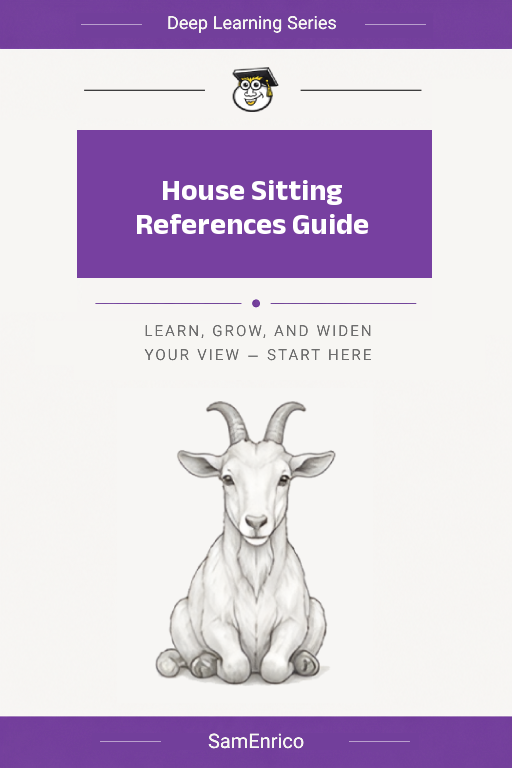
Non-FictionSide Hustle ArchitectReferencesTrust
House Sitting References Guide eBook
Get strong house sitting references from past sits
Get strong house sitting references from past sits to secure future opportunities worldwide.
Formats
Free sample
Chapter 1: The Trust Deficit--–- Every morning, thousands of homeowners wake up in a quiet panic. They have spent months planning a dream vacation—a safari in Kenya, a vineyard tour in Tuscany, a month-long trek through Patagonia. The flights are booked. The bags are packed. The itinerary is perfect.
And yet, as the departure date approaches, a single thought gnaws at them in the dark hours before dawn: I am about to hand the keys to my home—my entire life—to a complete stranger from the internet.This is the Trust Deficit. And until you understand it at a visceral, almost uncomfortable level, you will never be a truly successful house sitter.The Trust Deficit is not a small hesitation or a minor concern. It is the single most powerful psychological force operating in every house sitting transaction. It is the reason why some sitters receive glowing five-star reviews and automatic repeat invitations, while others—equally skilled, equally responsible—send out dozens of applications and receive nothing but silence. It is the hidden variable that separates the sitters who travel the world for free from the sitters who give up after three rejected applications.This book is not about how to water plants or clean a litter box.
You can learn those skills from a two-minute You Tube video. This book is about something far more valuable and far more rare: the systematic engineering of trust. Specifically, it is about how to collect, curate, and deploy the one asset that no amount of charm or enthusiasm can replace—a verified, performance-based reference from a past homeowner who will swear to a stranger that you are safe, responsible, and worthy of their most precious possession.Welcome to The House Sitting References Guide. By the time you finish this chapter, you will understand the psychology of trust better than ninety percent of the sitters competing against you for every desirable sit worldwide. And by the time you finish this book, you will have a complete system—not just tips, not just tricks, but a proven, repeatable system—for turning every house sit into a reference that opens doors on every continent.The Invisible Economy of Trust Let us start with a simple observation that sounds almost too obvious to state: house sitting is not like renting an apartment.
When you rent an apartment, you sign a lease. You pay a deposit. You undergo a credit check. You provide proof of income. The landlord has legal recourse if you damage the property.
There are layers of institutional protection designed to make the transaction safe for both parties.None of that exists in house sitting.When a homeowner accepts your application, they are not protected by a lease. They are not protected by a credit check. They are not protected by a security deposit that meaningfully covers the value of their home. They are protected by exactly one thing: their belief that you are who you say you are. That is it.
That is the entire safety net.This is why the Trust Deficit is so acute. Homeowners are not irrational for feeling anxious. They are rational. They are handing over control of their home, their pets, their vehicles, their mail, their privacy, and sometimes their children's bedrooms to someone they have met, at most, through a thirty-minute video call. The fact that anyone agrees to this arrangement at all is a testament to the power of platforms like Trusted Housesitters to facilitate trust between strangers.
But the platforms can only do so much. They can verify an email address. They can run a basic background check. They cannot verify that you will actually wake up at 6 AM to walk a dog with a sensitive bladder. They cannot verify that you will notice a dripping pipe before it becomes a flooded basement.
They cannot verify that you will treat someone's grandmother's antique vase with the reverence it deserves.That verification must come from somewhere else. That somewhere else is references.Why a Five-Star Review Is Worth More Than a Five-Year Rental History Let me say something that will sound controversial but is demonstrably true: a single detailed, performance-based reference from a past house sit is worth more than a five-year history of perfect rent payments. I want you to sit with that for a moment, because it runs counter to everything we have been taught about trust and responsibility.Rental history proves that you paid money on time. That is not nothing. But it does not prove that you cared for a property.
It does not prove that you noticed when something was wrong. It does not prove that you communicated proactively. It does not prove that a living creature thrived under your care. Rental history is a financial transaction record. A house sitting reference is a character and competence testimonial.Consider the difference from the homeowner's perspective.
A prospective sitter provides a rental history. The homeowner thinks: Great, they paid their landlord. But my home is not a landlord's investment property. My home is where my children took their first steps. My dog is not a piece of property—he is a member of my family.
I am not asking this person to deposit a check on the first of the month. I am asking them to notice if my dog stops eating, to comfort him during a thunderstorm, to know which toy is his favorite.Rental history cannot speak to any of that. A rental history is a number. A performance reference is a story. And humans are moved by stories.Now consider a different scenario.
A homeowner reads a reference from a past sit: "When our elderly cat needed subcutaneous fluids, Sarah administered them twice daily without a single missed dose. She sent us a video every evening of the cat purring in her lap. When we returned, the house was cleaner than we left it, and there was a handwritten note on the counter listing every funny thing the cat did during our absence."That is not a number. That is a narrative of competence, empathy, and over-delivery. That reference answers every unspoken question the homeowner has: Will they care for my pet like I would?
Will they notice if something is wrong? Will they communicate with me? Will they respect my home? These are the real questions. Everything else is noise.Character References versus Performance References: The Crucial Distinction Let me introduce a distinction that will appear throughout this book.
It is simple, but mastering it will change how you approach every house sit you ever take.A character reference is a statement about who you are. "Jane is honest and trustworthy." "John is a kind person." "Maria is very responsible." These are nice things to say. They feel good to read. And they are almost worthless to a skeptical homeowner.Why? Because anyone can say them.
A character reference requires no evidence. It requires no observation of specific behavior. It is an opinion, not a fact. A stranger reading a character reference has no way of knowing whether the writer actually observed responsible behavior or simply liked the sitter as a person. Character references are cheap.
The market is flooded with them.A performance reference is a statement about what you did. "Jane administered insulin injections twice…
This is the end of the free sample. Get the eBook to keep going. Buy now
About this book
Details
- Author
- Totten Tarsha
- Publisher
- SamEnrico
- Language
- English
- Genre
- Non-Fiction, Side Hustle Architect, References, Trust
- Released
- 2026-06-01
- Pages (approx.)
- 156
- Available as
- eBook, Audiobook

Read better in the ZLOADR app
Your eBooks on your phone or tablet. Sign in with your SamEnrico account and start reading.
More by Totten Tarsha
 Receiving Criticism NVCTotten Tarsha$11.99
 Gambling Partner Financial Stress GuideTotten Tarsha$11.99
 Franciscan Minority and Servanthood ManualTotten Tarsha$11.99
 Apocalypse Dream PsychologyTotten Tarsha$11.99
 Assertiveness for Recovery MeetingsTotten Tarsha$11.99
 The Trial of the Phoenix: When Gods and Mortals ClashedTotten Tarsha$11.99
 Rivers of Gold: The 21st Century Quest for the Nile’s True SourceTotten Tarsha$11.99
 Understanding Epidermolysis Bullosa Inversa DystrophicaTotten Tarsha$17.99
 How to Become a Casting-wheel OperatorTotten Tarsha$11.99
 Harvard Extension Online LearningTotten Tarsha$12.99
 In House CounselTotten Tarsha$11.99
You may also like
 Hong Kong Handover 1997Dunn Johnnie$11.99
 Zumba For Postnatal Recovery CourseNeal Christian$11.99
 Zumba for BeginnersLadner Nikia$11.99
 YouTube Comment Mining GuideHumes Pandora$12.99
 Worry Box MeditationCarlin Rudy$11.99
 Workplace Stress MeditationNguyen Lynn$11.99
 Workplace Stress and Sleep RepairHawley Ivory$11.99
 Workplace Perfectionism CureDelaney Jeffry$11.99
 Workplace Injustice Anger GuideWallen Isabelle$11.99
 Work Addiction and Burnout LinkGreenwood Ester$11.99
 Women in Yoga and WellnessBeattie Galina$11.99
 Women in Stand Up ComedyChun Evangeline$11.99