
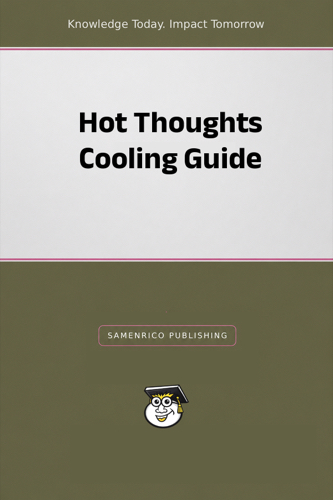
Hot Thoughts Cooling Guide eBook
Interrupt automatic angry interpretations before t
Interrupt automatic angry interpretations before they escalate into outbursts.
Formats
Free sample
Chapter 1: The 7-Second Window--You are about to learn something that will change the way you see every argument, every insult, every moment of rage you have ever had or ever will have. It is not a meditation technique. It is not a promise to “let go” or “forgive and forget.” It is a hard, measurable, neurological fact: from the moment a trigger occurs to the moment you feel the urge to explode, you have approximately seven seconds. Not ten. Not thirty.
Seven.In those seven seconds, your brain performs a series of operations that feel like a single, instantaneous event. Someone cuts you off in traffic. Your body tightens. Your face flushes. Your hand moves toward the horn.
It feels like it all happened at once. But neuroscience tells a different story. Anger is not a single event. It is a cascade. A chain reaction of perception, interpretation, and emotion that unfolds in milliseconds—but milliseconds you can learn to see, and once you can see them, you can interrupt them.This chapter is about that cascade.
It is about the anatomy of the moment before the explosion. By the time you finish reading these pages, you will understand exactly what happens inside your brain during those seven seconds, why willpower alone will never be enough to stop it, and why the single most important skill you will learn in this entire book is not how to calm down after you explode—but how to catch yourself before the cascade becomes irreversible.Let us begin with a story. Not a hypothetical. A real one.The Morning That Ended a Marriage James was a forty-two-year-old project manager who came to see a therapist not because he wanted to, but because his wife had given him an ultimatum. The night before, he had thrown a coffee mug against the kitchen wall.
It was not the first mug. It was not the first wall. His wife had taken the children to her mother’s house and left a note on the counter that said three words: “Get help or else.”When the therapist asked James to describe what happened, he said, “I just snapped. One second I was fine. The next, I was picking ceramic out of the drywall.”The therapist asked him to slow down.
Way down. “Describe the thirty seconds before the mug left your hand.”James frowned. “I don’t remember thirty seconds. It happened instantly.”“Try,” the therapist said.And so James tried. He closed his eyes.
He replayed the morning. His wife had asked him, while he was packing his briefcase, whether he had remembered to sign the permission slip for their son’s field trip. He had forgotten. She sighed. Not a loud sigh.
Not a dramatic sigh. Just a small exhale. And then—he said—something inside him just flipped.The therapist asked him to pause right there. “What did you think, in that millisecond after she sighed, before you felt the anger?”James was quiet for a long time. Then he said, “I thought she thinks I’m a failure.”Not “she’s annoyed about the permission slip.” Not “she’s tired.” Not “she’s frustrated with the situation.” She thinks I’m a failure.
That thought arrived without effort, without deliberation, without any evidence. It was not a conclusion he reached. It was an interpretation that happened to him. And in the time it took to have that thought—less than a second—his body had already begun to prepare for battle. His jaw clenched.
His shoulders rose. His breathing shallowed. By the time he opened his mouth, he was no longer James the husband. He was James the accused, defending his life against a charge of failure.The mug followed three seconds later.James’s story is not extreme. It is ordinary.
Every day, millions of people throw metaphorical mugs—or real ones—because of a sigh, a silence, a text message left on read, a tone of voice that may or may not be contempt. The tragedy is not that James got angry. The tragedy is that he believed the anger came out of nowhere. He believed he had no warning, no time, no choice.He was wrong.The Cognitive Cascade: How Anger Really Happens To understand why James was wrong—and why you have more power than you think—you need to understand the sequence that unfolds inside your brain every time you get angry. Neuroscientists call this sequence the cognitive-emotional cascade.
For our purposes, we will call it simply the cascade.The cascade has four stages. They happen so fast that they feel simultaneous, but they are not. Each stage is a distinct event that you can learn to recognize, and each stage is an opportunity to intervene.Stage One: Perception Something happens. A sound, a sight, a silence. A driver merges without signaling.
A coworker walks past without saying hello. A partner sighs. Your sensory organs register the event and send raw data to your brain. At this stage, there is no meaning attached to the event. It is just information.
A sigh is a sigh. A silence is a silence. Your brain has not yet decided whether this information is good, bad, or neutral.Stage Two: Automatic Interpretation This is the most important stage and the most invisible. Within milliseconds of perception, your brain labels the event. It assigns a meaning.
And here is the crucial point: this labeling happens outside of your conscious awareness. You do not choose the interpretation. It arrives, fully formed, based on your past experiences, your core beliefs, your attachment history, and your current stress level.For James, the sigh was interpreted as “she thinks I’m a failure.” For someone else, the same sigh might be interpreted as “she’s tired” or “she’s frustrated with the permission slip, not with me.” The raw event was identical. The interpretation was different. And that difference determined everything that followed.Stage Three: Emotional Activation Once the interpretation is made, your brain’s limbic system—specifically the amygdala—evaluates that interpretation for threat.
If the interpretation is neutral or positive, nothing happens. If the interpretation is negative, and especially if it involves social threat (disrespect, rejection, abandonment, humiliation), the amygdala sounds the alarm. It signals the hypothalamus, which activates the sympathetic nervous system. Adrenaline and cortisol flood your bloodstream. Your heart rate increases.
Your muscles tense. Your digestion slows. Your body is now in a state of readiness for combat.Stage Four: Action Urge The final stage is the urge to act. This is what most people call “feeling angry.” But here is a critical distinction that will matter throughout this book: the urge to act is not the same as the action itself. The urge is a physiological experience—a wave of pressure, heat, and tension.
The action is a behavior—yelling, throwing, storming out, slamming a door. Between the urge and the action, there is a gap. A small gap. A gap measured in milliseconds. But a gap nonetheless.James did not throw the mug at the exact same moment he felt the urge.
The urge came first. Then, a fraction of a second later, he reached for the mug. That fraction of a…
This is the end of the free sample. Get the eBook to keep going. Buy now
About this book
Details
- Author
- Hewitt Josette
- Publisher
- SamEnrico
- Language
- English
- Genre
- Non-Fiction, Self-Help
- Released
- 2026-06-08
- Pages (approx.)
- 122
- Available as
- eBook, Audiobook

Read better in the ZLOADR app
Your eBooks on your phone or tablet. Sign in with your SamEnrico account and start reading.
More by Hewitt Josette
 Task Batching Productivity HandbookHewitt Josette$11.99
 Memory Journey For DirectionsHewitt Josette$11.99
 Childrens Body Scan AdventureHewitt Josette$11.99
 Lagos To London Finance DreamHewitt Josette$11.99
 Notarbartolo Escape AttemptHewitt Josette$11.99
 Atomic Habits For EliminationHewitt Josette$11.99
 Habit Stacking GuideHewitt Josette$11.99
 The Van Gogh Vanishing: The Unsolved Heist of the 2004 Amsterdam TheftHewitt Josette$11.99
 The Symphony of the Sun: Joseph Bologne, Chevalier de Saint-Georges and the Birth of Classical BrillianceHewitt Josette$11.99
 How to Produce Navigational CompassesHewitt Josette$11.99
 How to Produce Agricultural GreenhousesHewitt Josette$11.99
 Growing Callirhoe (Poppy Mallow)Hewitt Josette$11.99
You may also like
 Hong Kong Handover 1997Dunn Johnnie$11.99
 Zumba For Postnatal Recovery CourseNeal Christian$11.99
 Zumba for BeginnersLadner Nikia$11.99
 YouTube Comment Mining GuideHumes Pandora$12.99
 Worry Box MeditationCarlin Rudy$11.99
 Workplace Stress MeditationNguyen Lynn$11.99
 Workplace Stress and Sleep RepairHawley Ivory$11.99
 Workplace Perfectionism CureDelaney Jeffry$11.99
 Workplace Injustice Anger GuideWallen Isabelle$11.99
 Work Addiction and Burnout LinkGreenwood Ester$11.99
 Women in Yoga and WellnessBeattie Galina$11.99
 Women in Stand Up ComedyChun Evangeline$11.99