
Non-FictionSelf-HelpThermal Bath
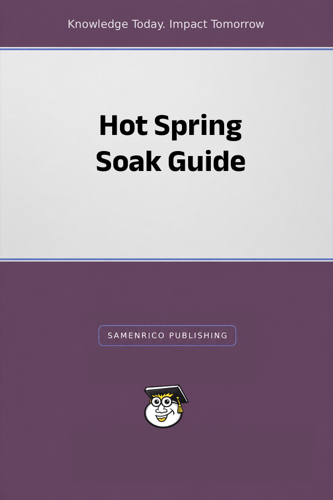
Hot Spring Soak Guide eBook
Submerges in geothermal waters, releasing muscle t
Submerges in geothermal waters, releasing muscle tension.
Formats
Free sample
Chapter 1: What Your Body Forgot--–- Sit still for a moment. Right where you are, holding this book or screen, pause. Do not adjust your posture. Do not stretch. Do not take a dramatic breath.
Just notice. Where do you feel tension? Not pain, necessarily—though you might feel that too—but the low-grade, background hum of muscles that are contracted when they do not need to be. Your jaw, perhaps, clenched lightly around nothing. Your shoulders, lifted a half-inch higher than they would be if you were lying down.
Your lower back, compressed from hours of sitting in a chair designed for someone else’s spine. Your neck, craned forward toward this page, holding your head—which weighs about as much as a bowling ball—in a position evolution never intended.This tension has a history. Not just your personal history of that awkward sleeping position three nights ago or the heavy bag you carried on your left shoulder yesterday, but a deeper history, written into the very architecture of your nervous system. Your body remembers things your mind has forgotten. It remembers the first time you braced yourself against a falling bicycle, the thousandth time you hunched over a desk, the way you held your breath during a tense conversation five years ago.
Muscles learn. They learn to stay contracted even after the threat is gone. They learn to anticipate pain by creating the conditions for it. This is not a design flaw. It is an adaptation, a clever strategy that kept your ancestors alive when they needed to spring into action at a moment’s notice.
But the strategy has become maladaptive. You are not being chased by a predator. You are sitting in a chair, reading a book about hot water, and your body is acting as if it needs to flee.What your body has forgotten is how to stop. Not how to sleep—sleep is different—but how to consciously, deliberately, joyfully release the tension that serves no purpose. The good news is that forgetting is reversible.
Your body can remember. But it does not remember through willpower or positive thinking or another mindfulness app. It remembers through sensation. Through heat. Through water.
Through the ancient, almost absurdly simple act of lowering yourself into a hot spring and staying there long enough for your nervous system to realize that it is safe to let go.The Archaeology of Tension To understand what happens in a hot spring, we need to understand what happens in your body long before you get there. Tension is not a single thing. It is a cascade of events, a chain reaction that begins in the brain and ends in the smallest fibers of your muscles.It starts with the amygdala, that almond-shaped cluster of neurons deep in your brain that serves as your smoke detector. The amygdala is constantly scanning your environment for threats. When it detects one—real or imagined, physical or social, immediate or distant—it sends a signal to the hypothalamus, which activates the sympathetic nervous system.
This is the fight-or-flight response. Your adrenal glands release cortisol and adrenaline. Your heart rate increases. Your blood pressure rises. And your muscles contract, preparing for action.In a healthy system, this response is temporary.
The threat passes, the parasympathetic nervous system (the rest-and-digest branch) takes over, and your muscles relax. But modern life presents a problem that evolution never anticipated: most of our threats are not physical, and they do not pass. The email from your boss sits in your inbox. The news cycle never stops. The mortgage payment recurs every month.
The social slight from three years ago still echoes. Your amygdala cannot tell the difference between a tiger and a deadline. It responds to both with the same biochemical cascade, and because the cascade never fully turns off, your muscles never fully relax.This is the archaeology of tension. Layer upon layer of uncompleted stress responses, buried under the sediment of daily life. The superficial layers are recent—yesterday’s argument, this morning’s traffic.
The deeper layers are older—the way you learned to hold your breath during childhood arguments, the posture you adopted to make yourself smaller in an intimidating room, the shoulder you raised to protect your face from something that never came. You cannot excavate these layers through force of will. You cannot think your way out of a posture you have been holding for decades. You have to go around the thinking mind, straight to the body. You have to give the body an experience so unmistakably safe that it has no choice but to release.That experience is immersion in geothermal water.The Difference Between Surface and Depth Here is something that surprised me when I first started researching the physiology of soaking: most of the heat you encounter in daily life does not penetrate very far.
A heating pad on your lower back warms the skin and the first few millimeters of muscle beneath it. A hot shower feels wonderful, but the water runs off too quickly to transfer significant heat to your core. A sauna heats the air, which heats your skin, which slowly warms your body—but the process is inefficient because air is a poor conductor of heat.Water is different. Water conducts heat approximately twenty-five times more efficiently than air. When you immerse yourself in a hot spring, the water transfers heat to your body so effectively that your core temperature can rise one or two degrees Fahrenheit within ten to fifteen minutes.
This is not uncomfortable. It is therapeutic. A controlled, temporary increase in core temperature triggers the release of heat shock proteins, which are molecules that help other proteins maintain their shape and function under stress. Heat shock proteins also have anti-inflammatory effects, reducing the production of cytokines that contribute to pain and tissue damage.But the real magic happens in your blood vessels. Heat causes vasodilation: the widening of blood vessels, particularly in the skin and extremities.
Your body does this to dissipate heat, to bring warm blood closer to the surface where it can cool down. The side effect is a dramatic increase in blood flow throughout your body, including to muscles that have been starved of oxygen due to chronic contraction. Ischemic muscles—muscles in a state of oxygen deprivation—are painful muscles. They hurt because they are essentially suffocating. When vasodilation finally delivers a flood of oxygen-rich blood, the pain signals begin to quiet.This is why a heating pad is not a substitute for a hot spring.
The heating pad warms a small area superficially. The hot spring warms your entire body from the inside out, reaching muscles that no external device could touch. The difference is not just quantitative but qualitative. Surface heat feels good. Deep, systemic heat heals.The Conversation Between Water and Nerves Your nervous system is not a passive recipient of sensory information.
It is an active interpreter, constantly asking questions about the data coming in from your skin, your muscles, your joints. Is this temperature safe? Is this pressure threatening? Is this movement allowed? The answers to these questions determine whether your muscles…
This is the end of the free sample. Get the eBook to keep going. Buy now
About this book
Details
- Author
- Nicholas Hyacinth
- Publisher
- SamEnrico
- Language
- English
- Genre
- Non-Fiction, Self-Help, Thermal Bath
- Released
- 2026-06-06
- Pages (approx.)
- 132
- Available as
- eBook, Audiobook

Read better in the ZLOADR app
Your eBooks on your phone or tablet. Sign in with your SamEnrico account and start reading.
More by Nicholas Hyacinth
 Senior Conversation ConfidenceNicholas Hyacinth$11.99
 Digital Communication for Remote BoardsNicholas Hyacinth$11.99
 Tennis Player's HypnosisNicholas Hyacinth$11.99
 Flow in EngineeringNicholas Hyacinth$11.99
 Cliffside Ocean ViewNicholas Hyacinth$11.99
 The Executive Deep WorkNicholas Hyacinth$11.99
 Affirmations for Morning RoutineNicholas Hyacinth$11.99
 The Last Wyrm of the Black ForestNicholas Hyacinth$11.99
 The Golden Calculators: Timbuktu's Mathematical MarvelsNicholas Hyacinth$11.99
 How to Produce Diaper OrganizersNicholas Hyacinth$11.99
 Vampire Bats: Blood-feederNicholas Hyacinth$11.99
 Business Credit for Technology StartupsNicholas Hyacinth$12.99
You may also like
 Hong Kong Handover 1997Dunn Johnnie$11.99
 Zumba For Postnatal Recovery CourseNeal Christian$11.99
 Zumba for BeginnersLadner Nikia$11.99
 YouTube Comment Mining GuideHumes Pandora$12.99
 Worry Box MeditationCarlin Rudy$11.99
 Workplace Stress MeditationNguyen Lynn$11.99
 Workplace Stress and Sleep RepairHawley Ivory$11.99
 Workplace Perfectionism CureDelaney Jeffry$11.99
 Workplace Injustice Anger GuideWallen Isabelle$11.99
 Work Addiction and Burnout LinkGreenwood Ester$11.99
 Women in Yoga and WellnessBeattie Galina$11.99
 Women in Stand Up ComedyChun Evangeline$11.99