
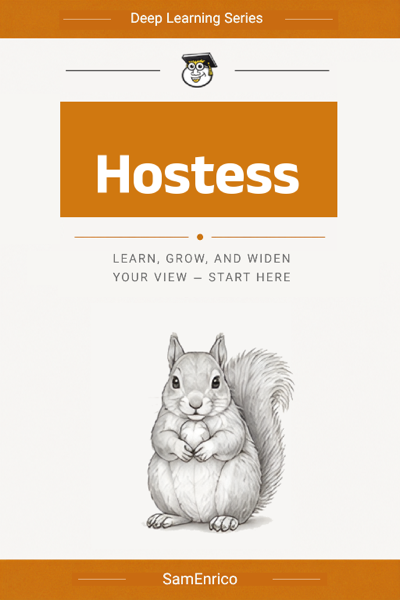
Hostess eBook
A Coursebook on Hostess
by Ashby Leigh
A Coursebook on Hostess
Formats
Free sample
Chapter 1: The Million-Dollar Smile--–- The first thing you need to understand about the hostess position is that it is not an entry-level job. It is not a placeholder for aspiring actresses waiting for their big break. It is not a punishment for servers who messed up one too many drink orders. And it is certainly not the lowest rung on the hospitality ladder, despite what the payroll department might suggest.The hostess is the highest-stakes position in the entire building. And she is almost always the lowest-paid person in the front of house.
This is not merely unfair. It is bad business.Let me tell you a story that will change how you see this role forever.In 2015, a young woman named Elena was working the hostess stand at Per Se, Thomas Keller’s legendary three-Michelin-starred restaurant in New York’s Time Warner Center. It was a Tuesday night in March, cold and wet, the kind of evening that makes New Yorkers question every life choice that led them to live in a city where the wind tunnels through Columbus Circle like a frozen razor.A woman walked in alone. No reservation. No coat check.
No luggage, no briefcase, no indication of who she was or why she was there. Just a woman in her late twenties, wearing a damp trench coat and the particular expression of someone who has been crying recently and is trying very hard to stop.The restaurant was fully booked. Elena knew this because she had memorized the reservation book that morning, as she did every morning. Every table was spoken for. Every cover had a name attached.
The polite thing to do, the efficient thing to do, the thing that most hostesses in most restaurants would have done, was to say: "I'm so sorry, but we don't have any availability this evening. May I help you make a reservation for another night?"Elena did not say that.Instead, she looked at the woman’s face. Not at her clothes, not at her shoes, not at her jewelry or lack thereof. She looked at her face, and she saw something she recognized: the particular hollowness of a day that has gone catastrophically wrong.So Elena asked a question that was not in the script. "Are you okay?"The woman’s composure cracked.
Her lip trembled. And then the story came out, in fragments between deep, shuddering breaths. Her wedding had been scheduled for that evening. The venue had been booked, the invitations sent, the dress hanging in her mother’s guest room for six months. And that morning, three hours before she was supposed to walk down the aisle, her fiancé had called it off.
Called it off. Over the phone. Like he was canceling a dentist appointment.She had nowhere to go. She couldn't face her family. She couldn't face her friends.
She couldn't sit in her empty apartment and stare at the wall. So she had walked, aimlessly, for hours, until she found herself here, in front of the most expensive restaurant she had ever seen, not because she could afford it but because she needed to be somewhere that wasn't her life.Elena listened. She did not interrupt. She did not offer platitudes. She did not say "everything happens for a reason," which is something people say when they have no idea what to say and want to make themselves feel better about their own helplessness.Then she walked to the chef’s pass.
She pulled the chef de cuisine aside and said: "I need a favor. A big one."Within ten minutes, the woman was seated at a two-top in the corner of the dining room — a table that had been reserved for a regular who, Elena had noticed earlier, had a history of canceling at the last minute. She was right. The regular never showed. The woman ate a seven-course tasting menu.
She drank a glass of champagne. She cried quietly into her napkin while the staff pretended not to notice, which is the highest form of hospitality there is: the art of seeing someone’s pain and giving them the privacy to feel it without shame.When she finished her meal — she ate everything, Elena later noted with approval — the woman asked for the check. Elena told her there was no check. The meal was compliments of the house.The woman cried again. Then she left.Four years later, Elena had moved on from Per Se.
She was working at a different restaurant, in a different city, when a reservation came through under a name she didn't recognize. A party of two, anniversary dinner, special requests noted: "Table in the corner, please. Quiet. And if possible, the same server who worked the tasting menu."Elena didn't think anything of it until the guests arrived. It was the woman.
The bride who never was. She was older now, calmer, wearing a ring on her left hand and a softness around her eyes that had not been there before. Next to her was a man who looked at her the way people look at something they cannot believe they get to keep.The woman recognized Elena immediately. She grabbed her hands and said: "I have come back to this restaurant every year on what was supposed to be my wedding day. I have brought friends, family, colleagues.
I have spent —" she paused to calculate, "— I think around forty-seven thousand dollars here since that night. And I will keep coming back for the rest of my life. Because you saw me when I was invisible. And you fed me when I was starving. Not for food.
For kindness."That is the power of a hostess. That is the million-dollar smile. Not the smile itself, but what it represents: the willingness to see a person when they are most desperate to be seen, and to act on that seeing with generosity and skill.Elena did not have a script for a crying woman on a canceled wedding night. She had something better. She had training in the fundamental principles of hospitality that apply to every guest, in every context, whether they are a heartbroken bride or a hungry businessman or a family trying to keep their toddler from throwing a bowl of pasta across the room.
She knew how to assess a situation, how to read a face, how to make a judgment call that would have made her managers nervous if they had known about it. And she knew that sometimes, the rules exist to be bent.This book will teach you how to do what Elena did. Not the specific actions — those depend on your venue, your budget, your management, and your guests — but the underlying architecture of thinking that allowed her to recognize an opportunity for radical hospitality and seize it.Here is the thesis that will guide everything that follows: The hostess is the most valuable marketing asset any restaurant or home has ever had. More valuable than a website redesign. More valuable than an Instagram account with a hundred thousand followers.
More valuable than a glowing review in a newspaper that nobody under forty reads anymore.Why? Because the hostess controls the…
This is the end of the free sample. Get the eBook to keep going. Buy now
About this book
Details
- Author
- Ashby Leigh
- Publisher
- SamEnrico
- Language
- English
- Genre
- Non-Fiction, Informative, Educational
- Released
- 2026-05-23
- Pages (approx.)
- 137
- Available as
- eBook, Audiobook

Read better in the ZLOADR app
Your eBooks on your phone or tablet. Sign in with your SamEnrico account and start reading.
More by Ashby Leigh
 Samoan New Zealander Return To Apia GuideAshby Leigh$11.99
 Pre Surgery Breath Calming GuideAshby Leigh$11.99
 Metta for Divorce RecoveryAshby Leigh$11.99
 Ivory Coast Houphouet BoignyAshby Leigh$11.99
 The Minority Imposter Experience GuideAshby Leigh$11.99
 Silicon Bloodlines: The Untold Legacy of Ada Lovelace’s Digital EmpireAshby Leigh$11.99
 Understanding Moore–federman SyndromeAshby Leigh$17.99
 Localization Prep For DocsAshby Leigh$12.99
 IKEA Flat Pack GuideAshby Leigh$12.99
 How to Become a Nondestructive TesterAshby Leigh$11.99