
Non-FictionBiographyNegotiator
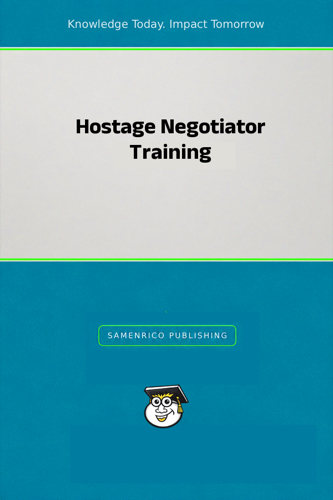
Hostage Negotiator Training eBook
Professional negotiator shares lessons from hostag
Professional negotiator shares lessons from hostage crises.
Formats
Free sample
Chapter 1: The First Ninety Seconds...--–- The sound of the gun’s safety clicking off is unmistakable. It is a small, metallic sound—precise and final. In the Bangkok hotel room, that sound echoed through a cheap microphone and into the earpiece of a negotiator sitting in a van three blocks away. The year was 1994. The hostage was a 26-year-old aid worker named Sarah.
The hostage taker was a former soldier, armed with a stolen Beretta and a belief that killing a foreigner would secure his brother’s release from a political prison. The negotiator had ninety seconds—maybe less—to say something that would stop the execution. He had trained for twenty years. None of that training mattered in that moment because his own heart was pounding so loudly he could not hear the translator. His hands were shaking.
His mouth was dry. He opened his mouth and said the first thing that came to mind: “Please don’t hurt her.” The gun fired. Sarah survived—the bullet missed by inches—but the negotiator never forgot that failure. He had violated the first rule of hostage negotiation. He had not managed himself before trying to manage the crisis.This chapter is about that failure and how to prevent it.
Before any tactic, any phrase, any strategy, there is one non-negotiable requirement: you must stabilize your own nervous system. A negotiator in fight-or-flight cannot negotiate. A negotiator who cannot breathe cannot think. A negotiator who is terrified cannot project calm. The top ten best-selling books on hostage negotiation—from Gary Noesner’s Stalling for Time to George Kohlrieser’s Hostage at the Table—all agree on this foundational truth, even when they disagree on everything else.
The crisis begins inside you. If you lose that battle, you have already lost the negotiation.The Biology of Bad Decisions To understand why the first ninety seconds are so dangerous, you must understand what happens to the human body under extreme stress. When a perceived threat appears—a gun, a scream, a demand—the amygdala, an almond-shaped cluster of neurons deep in the brain, sounds an alarm. In less than a second, the hypothalamus activates the sympathetic nervous system. Adrenaline floods the bloodstream.
Heart rate spikes from 70 to 150 beats per minute. Breathing becomes shallow and rapid. Blood flows away from the prefrontal cortex—the part of the brain responsible for rational thought, impulse control, and long-term planning—and toward the limbs and large muscle groups. This is the fight-or-flight response, perfected over millions of years of evolution. It is excellent for running from a predator.
It is terrible for negotiating with one.The problem is that hostage negotiation requires precisely the cognitive functions that stress destroys. You need working memory to track multiple demands. You need impulse control to avoid reacting to provocations. You need empathy, which requires a calm prefrontal cortex to simulate another person’s mental state. And you need vocal control—a low, slow, steady tone that signals safety—which is impossible when your throat is tight with adrenaline.
In short, your biology is actively working against you. The negotiator in Bangkok did not fail because he lacked skill. He failed because his amygdala hijacked his brain, and he never recovered it.This is not a matter of willpower. You cannot “think” your way out of a biological cascade. But you can interrupt it.
The difference between a professional negotiator and an amateur is not the absence of fear—everyone feels fear. The difference is that the professional has practiced a specific set of physiological interventions that override the stress response. These interventions are not theoretical. They are mechanical. They are physical.
They work because they exploit a quirk of the nervous system: the body cannot be in a state of high arousal and low arousal at the same time. If you deliberately slow your breathing, your heart rate will follow. If you drop your vocal pitch, your vagus nerve will signal safety to your brain. If you ground your body, your mind will eventually ground as well.The Three Primal Responses and the Fourth Before we go further, we need a shared vocabulary for what happens under threat. Psychologists have long recognized three primal responses to danger: Fight, Flight, and Freeze.
Fight is aggression—yelling, blaming, threatening, attacking. Flight is escape—leaving the room, hanging up the phone, avoiding the conversation. Freeze is paralysis—silence, inaction, inability to speak or move. None of these work in negotiation. Fight escalates.
Flight abandons the hostage (or the deal, or the relationship). Freeze cedes all power to the other party. If you find yourself in any of these three states during a high-stakes conversation, you are not negotiating. You are reacting. And reactions can be predicted, exploited, and defeated.The professional negotiator must access a fourth state: Face.
To “face” a threat means to orient toward it with calm, deliberate presence. It is not aggression—you are not attacking. It is not submission—you are not retreating. It is not paralysis—you are fully present and choosing your responses. Facing is what a parent does when a child has a meltdown.
It is what a surgeon does when a patient crashes. It is what a hostage negotiator does when a gun is pressed against a temple. Facing means turning toward the difficulty, breathing into it, and saying, “I am here. I am not leaving. We will get through this.”The word “Face” was chosen deliberately in the Bangkok rule.
It is active, not passive. It requires courage, but not the courage of aggression. It requires the courage of presence. In the coming chapters, you will learn many tools—the Behavioral Change Stairway, labeling, calibrated questions, the No Sandwich. None of them will work if you cannot first access the Face state.
You cannot climb the stairs if you are running away. You cannot label an emotion if your own emotions are unlabeled. You cannot ask a calibrated question if your brain is frozen. Face is the prerequisite for everything else.Emotional Triage: A Three-Step Checklist for the First Ten Seconds The most dangerous moment in any crisis is the first ten seconds. In those ten seconds, your body will decide whether to fight, flee, freeze, or face.
You do not have time for a lengthy meditation or a therapeutic breathing exercise. You need a mechanical checklist—three simple actions that take less than ten seconds to complete. This checklist is called Emotional Triage, borrowed from emergency medicine where triage means sorting injuries by severity. Here, you are triaging your own nervous system.Step One: Pause. As soon as you perceive the threat—a demand, an ultimatum, a raised voice, a silence that feels dangerous—stop all movement.
Do not speak. Do not reach for a pen. Do not adjust your chair. Take exactly one breath, inhaling for four seconds and exhaling for four seconds. While you breathe, count to three silently in your head.
One. Two. Three. That is the entire pause. It takes three seconds.
In those three seconds, you have interrupted the fight-or-flight cascade. You have not stopped it—but you have inserted a tiny gap between stimulus and response.…
This is the end of the free sample. Get the eBook to keep going. Buy now
About this book
Details
- Author
- Webber Tomoko
- Publisher
- SamEnrico
- Language
- English
- Genre
- Non-Fiction, Biography, Negotiator
- Released
- 2026-06-09
- Pages (approx.)
- 148
- Available as
- eBook, Audiobook

Read better in the ZLOADR app
Your eBooks on your phone or tablet. Sign in with your SamEnrico account and start reading.
More by Webber Tomoko
 Media Interview Anxiety ProtocolWebber Tomoko$11.99
 The Parent Shame Resilience GuideWebber Tomoko$11.99
 Sleep Deep for Higher HGHWebber Tomoko$11.99
 AI Audio Cleanup for DialogueWebber Tomoko$11.99
 The Forgotten Desert Scientists: Burke and Wills' Middle Eastern MysteryWebber Tomoko$11.99
 Gold Rush Greed: The Secret Deals That Built the Panama CanalWebber Tomoko$11.99
 How to Become a Dialysis TechnicianWebber Tomoko$11.99
 Roblox Remote Studio InternWebber Tomoko$12.99
 Executive Summary Feedback Collection SheetWebber Tomoko$12.99
 Understanding Brachydactyly Mesomelia Mental Retardation Heart DefectsWebber Tomoko$17.99
 Director of ImplementationWebber Tomoko$11.99
You may also like
 Hong Kong Handover 1997Dunn Johnnie$11.99
 Zumba For Postnatal Recovery CourseNeal Christian$11.99
 Zumba for BeginnersLadner Nikia$11.99
 YouTube Comment Mining GuideHumes Pandora$12.99
 Worry Box MeditationCarlin Rudy$11.99
 Workplace Stress MeditationNguyen Lynn$11.99
 Workplace Stress and Sleep RepairHawley Ivory$11.99
 Workplace Perfectionism CureDelaney Jeffry$11.99
 Workplace Injustice Anger GuideWallen Isabelle$11.99
 Work Addiction and Burnout LinkGreenwood Ester$11.99
 Women in Yoga and WellnessBeattie Galina$11.99
 Women in Stand Up ComedyChun Evangeline$11.99