
Non-FictionBiographyLessons Learned
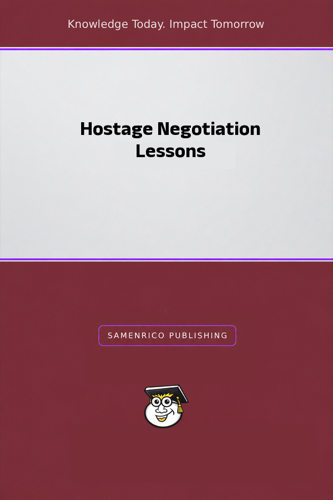
Hostage Negotiation Lessons eBook
What survivors wish negotiators knew.
by Gipson Mila
What survivors wish negotiators knew.
Formats
Free sample
Chapter 1: The Blank Slate...–- The gun was not the worst part.That is what every survivor says, eventually, when they are ready to talk. The gun is fast. The gun is clean. The gun makes a decision that the brain does not have to process because the body has already moved—hands up, breath stopped, eyes wide. No, the gun was not the worst part.
The worst part came thirty seconds later, when the negotiator’s voice crackled through a phone or a bullhorn or a wall, and the survivor realized two things simultaneously: first, that someone on the outside was trying to help, and second, that the survivor could not understand a single word being said.This is the cognitive fog. It is not fear, though fear is present. It is not panic, though panic may follow. It is something more fundamental and more terrifying: the temporary shutdown of the brain’s ability to process language, memory, and complex thought. The hostage becomes, for a period of minutes or even hours, a pair of lungs, a heartbeat, and a prayer.
Everything else—every negotiation tactic, every carefully crafted message, every request for information—falls into a void where words become noise and instructions become impossible.If you are a negotiator, you need to understand this not as a failure of the hostage but as a biological inevitability. And if you are a survivor reading this book, you need to know that what happened to your brain in those first minutes was not weakness. It was survival architecture millions of years in the making.This chapter dismantles the most dangerous assumption in hostage negotiation: that the captive is a rational, observing partner who can process information, remember details, and follow instructions during a crisis. Drawing from Thomas Strentz’s crisis intervention model, Mickey Bergman’s accounts of high-stress entries in In the Shadows, and the lived testimony of survivors across dozens of incidents, we will walk through the neurobiology of the cognitive fog, its timeline, its consequences, and the protocols that negotiators must adopt to work with it rather than against it.The Neurobiology of Forgetting Your Own Name Let us begin with a simple fact: the human brain did not evolve for hostage situations. It evolved for saber-toothed tigers, falling branches, and sudden threats that required an immediate, full-body response with no time for reflection.
This response is called the amygdala hijack, a term coined by psychologist Daniel Goleman to describe what happens when the brain’s fear detector (the amygdala) overrides the brain’s thinking center (the prefrontal cortex).Here is what that looks like in real time.A weapon is raised. The eyes send a signal to the thalamus, which acts as a switching station. The thalamus sends that signal along two pathways. The fast pathway goes directly to the amygdala, bypassing the cortex entirely. This takes milliseconds.
The amygdala responds with a cascade of hormones: adrenaline, cortisol, norepinephrine. The heart races. The muscles tense. The pupils dilate. The body prepares to fight, flee, or freeze.
The slow pathway goes to the cortex, where the brain processes the visual information, recognizes it as a gun, and concludes that this is, in fact, a threat. That takes several hundred milliseconds.By the time the cortex catches up, the body has already reacted. This is why you can jump out of the way of a car before you consciously register that it is swerving toward you. The fast pathway saved your life. But in a hostage situation, that same fast pathway creates a problem: the amygdala, once activated, stays activated.
It continues to pump stress hormones. It continues to override the cortex. And the cortex—the part of the brain responsible for language comprehension, working memory, planning, and rational decision-making—goes offline.A survivor named Maria, held at gunpoint in a Bogotá bank robbery in 2003, described it this way: “The negotiator kept asking me to count the number of men I could see. I could see three. I knew I could see three.
But when I opened my mouth, no number came out. I tried to say ‘three’ and my mouth made a sound like air leaving a tire. I tried again. Nothing. The negotiator thought I was being uncooperative.
The truth was that the part of my brain that connects seeing to speaking had simply stopped working.”Another survivor, an aid worker kidnapped in Somalia for 93 days, described the first hour of captivity: “They asked me my name. I have had the same name for forty-seven years. I say it every day. In that moment, I could not find it. It was like my name had been erased from a chalkboard.
I knew I had a name. I knew that I knew it. But I could not reach it. The captor thought I was being defiant. He hit me.
I still could not remember my name.”This is not unusual. It is universal. Research on acute stress response shows that working memory capacity drops by more than 50 percent within seconds of a threat. The brain prioritizes survival over reflection. It does not care about the negotiator’s questions.
It does not care about tactical intelligence. It cares about keeping the heart beating and the lungs breathing. Everything else is, from the brain’s perspective, optional.The Timeline of the Fog The cognitive fog does not last forever. But its duration is longer than most negotiators assume and longer than most training manuals acknowledge. Based on survivor testimony and clinical research on acute stress disorder, we can map the fog onto a rough timeline.Minutes 0 to 5: The Impact Window.
The threat occurs. The amygdala hijacks the brain. The survivor experiences sensory distortion—sounds become muffled, colors may wash out, time may slow or speed up. Short-term memory is effectively zero. The survivor cannot form new memories reliably.
Instructions given during this window will not be remembered. Questions asked during this window will not be answered accurately, if they are answered at all.Minutes 5 to 15: The Static Window. The initial surge of adrenaline begins to stabilize, but the brain remains in high-alert mode. The survivor may be able to respond to simple, one-word prompts (“Breathe,” “Still,” “Quiet”) but not to multi-step instructions (“Tell me how many windows are in the room and what color the walls are”). Language comprehension improves from zero to partial.
The survivor may understand isolated words but not full sentences. Memory remains unreliable.Minutes 15 to 30: The Recovery Window. For many survivors, this is when the fog begins to lift. The survivor can understand simple sentences. They can respond with one- or two-word answers.
They can follow a single instruction if it is repeated and simple (“Put your hands where I can see them”). However, complex reasoning remains impaired. The survivor cannot perform mental math, recall sequences, or describe spatial layouts accurately. Stress hormones remain elevated, and the survivor may still be in a state of heightened startle response.Minutes 30 to 60: The Partial Function Window. This is the window described in later chapters of this book.
The survivor regains enough cognitive function to attempt signaling, to follow basic instructions, and to engage in simple back-and-forth communication.…
This is the end of the free sample. Get the eBook to keep going. Buy now
About this book
Details
- Author
- Gipson Mila
- Publisher
- SamEnrico
- Language
- English
- Genre
- Non-Fiction, Biography, Lessons Learned
- Released
- 2026-06-10
- Pages (approx.)
- 148
- Available as
- eBook, Audiobook

Read better in the ZLOADR app
Your eBooks on your phone or tablet. Sign in with your SamEnrico account and start reading.
More by Gipson Mila
 Psychoeducation for Explosive ParentsGipson Mila$11.99
 The Beit Yosef CompilerGipson Mila$11.99
 Growth Hormone Deficiency DiagnosisGipson Mila$11.99
 Panic Disorder Comorbidity CourseGipson Mila$11.99
 The Hypnos Code: Decoding the Ancient Dream Oracle of DelphiGipson Mila$11.99
 Love Letters from the Front: The Secret Correspondence of Vera Brittain and Roland LeightonGipson Mila$11.99
 Understanding Brachydactyly Type BGipson Mila$17.99
 Fishing GuideGipson Mila$11.99
 10 Ways to Use Cinnamomum Citriodorum (Recipe Book)Gipson Mila$11.99
 Headless Commerce Five Year ForecastGipson Mila$12.99
 Asian Coding Education LandscapeGipson Mila$12.99
You may also like
 Hong Kong Handover 1997Dunn Johnnie$11.99
 Zumba For Postnatal Recovery CourseNeal Christian$11.99
 Zumba for BeginnersLadner Nikia$11.99
 YouTube Comment Mining GuideHumes Pandora$12.99
 Worry Box MeditationCarlin Rudy$11.99
 Workplace Stress MeditationNguyen Lynn$11.99
 Workplace Stress and Sleep RepairHawley Ivory$11.99
 Workplace Perfectionism CureDelaney Jeffry$11.99
 Workplace Injustice Anger GuideWallen Isabelle$11.99
 Work Addiction and Burnout LinkGreenwood Ester$11.99
 Women in Yoga and WellnessBeattie Galina$11.99
 Women in Stand Up ComedyChun Evangeline$11.99