
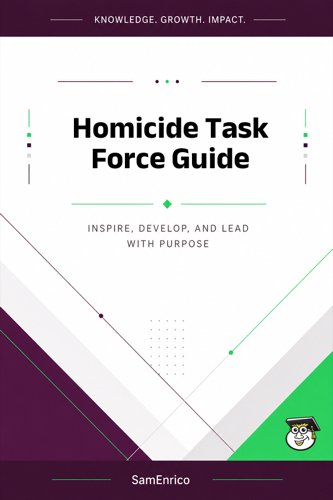
Non-FictionTrue CrimeTask Force
Homicide Task Force Guide eBook
Coordinate multi agency investigations for complex
by Burgess Neil
Coordinate multi agency investigations for complex murder cases.
Formats
Free sample
Chapter 1: The Silos Kill...--–- The call came in at 11:47 on a Tuesday night. A state trooper in Rhode Island had found a body slumped behind the wheel of a sedan on an off-ramp, two bullet holes in the driver's side window, the engine still running. The victim was a 34-year-old father of three. No witnesses. No casings found at the scene.
The trooper dutifully logged the evidence, notified his sergeant, and began the slow, methodical work of a solo investigation. Thirty miles away, almost exactly one hour later, a detective in Massachusetts was called to a similar scene: a body in a car, bullet holes, engine running. Two different agencies. Two different crime scenes. Two different sets of detectives.
One killer. For eleven days, these two teams worked in complete ignorance of each other. They interviewed different witnesses, collected different pieces of ballistic evidence, and chased different suspects. The killer, meanwhile, drove home, slept in his own bed, and watched the local news report on "isolated incidents" with a quiet sense of invincibility. He was caught only when a chance conversation between a Rhode Island evidence technician and a Massachusetts firearms examiner—both attending the same training seminar—revealed the match.
By then, he had killed two more people.This is not an outlier. This is the standard failure mode of homicide investigation in the 21st century. The romanticized image of the lone detective—the trench-coated genius who solves cases through intuition, grit, and a near-mystical connection to the crime scene—is not merely outdated. It is lethally dangerous. In the era of cross-jurisdictional serial offenders, decentralized gang networks, digital evidence that spans continents, and criminals who understand that county lines are not barriers but opportunities, the old way of doing business guarantees one thing: killers will slip through the cracks.The problem is not a lack of talent, dedication, or courage.
American law enforcement is filled with extraordinary investigators who work exhausting hours under impossible conditions. The problem is structural. It is the architecture of the investigation itself. Specifically, it is the information silo—the institutionalized practice of keeping intelligence within a single agency, a single precinct, or even a single detective's notebook, under the misguided belief that this protects the integrity of the case. In reality, the silo is the killer's best friend.The Anatomy of a Silo An information silo is any system—whether technological, organizational, or cultural—that prevents the free flow of intelligence between the people who need it.
In homicide investigation, silos take three distinct forms.First, jurisdictional silos. These are the most visible and the most deadly. A murder occurs on a county line, or a killer strikes in one city and dumps the body in another, or a suspect drives across state lines after a shooting. In each case, multiple agencies claim jurisdiction, and multiple agencies withhold information because they are competing for the same conviction, the same headlines, or the same overtime budget. The Providence/Brookline case described above is a textbook example: two agencies with overlapping geographic responsibility, neither legally required to share information, both assuming that their case was isolated.
The jurisdictional silo is reinforced by good intentions: detectives are taught to protect their investigation from contamination, to keep details close to the vest, to avoid "tipping off" other agencies. But what they are actually protecting is the killer.Second, hierarchical silos. These exist within a single agency. A patrol officer finds evidence but doesn't tell the detective because "that's not my job." A detective learns something but doesn't tell the analyst because "they're just civilians." A sergeant filters information before passing it to the lieutenant because "the commander doesn't need to be bothered with details." Each layer of command strips away nuance, buries leads, and introduces delay. By the time information reaches the people who could act on it, it is often weeks old, context-free, and useless.Third, disciplinary silos.
These are the most insidious because they are built into the professional identities of law enforcement officers. Homicide detectives look down on patrol officers as unsophisticated. Analysts are dismissed as "paper pushers." Forensic technicians are treated as evidence-collection robots rather than as partners in interpretation. Prosecutors are brought in only at the end of the investigation, after all the crucial decisions have already been made. Each discipline operates in its own silo, speaking its own jargon, protecting its own turf, and missing the connections that only emerge when different perspectives collide.The Cost of the Silo The cost of siloed investigation is measured in bodies.
Serial offenders understand the geometry of American policing better than most police commanders do. They know that a killing in one county may never be compared to a killing in the next county over. They know that a gun used in a robbery in one state may sit in an evidence locker for months before anyone thinks to check it against a homicide in another state. They know that the right to remain silent applies to police agencies as much as to suspects.Consider the case of the I-95 corridor shooter, a composite based on multiple real-world investigations that this book will return to throughout. A single gunman shot drivers on a highway that crossed three states, four counties, and six separate police agencies.
The first three murders were investigated separately. Each agency assumed they were dealing with a local crime: a road rage incident, a drug deal gone wrong, a domestic dispute. Each agency collected ballistic evidence but submitted it to different labs with different backlogs. The killer, meanwhile, drove 90 miles down the highway and shot another victim in a jurisdiction that had never heard of the first three. It took a federal task force—operating under the principles this book will teach—to connect the dots.
By then, the body count had reached seven.The silo does not only enable serial killers. It also degrades routine homicide investigations. In any given year, approximately 40% of homicides in the United States go unsolved. That is not a reflection of the difficulty of the work. It is a reflection of the system.
Most unsolved homicides are not complex puzzles requiring genius-level insight. They are failures of coordination: evidence that was never compared, witnesses who were never interviewed because another agency interviewed them first and didn't share, suspects who were never identified because their names appeared in three different databases that didn't talk to each other.The Cell Structure: An Alternative The solution to the silo is not better technology, though technology helps. The solution is not more training, though training is essential. The solution is a fundamental reorganization of how homicide investigations are structured: the replacement of the Line structure with the Cell structure.The Line structure is what most agencies use by default. It is hierarchical, vertical, and slow.
Information flows up the chain of command and down again. A patrol officer reports to a sergeant, who reports to a lieutenant, who reports to a captain, who assigns a detective, who reports back up through the same chain. Every step introduces delay, filtering, and the opportunity for error. The Line structure works well for routine administrative matters. It is catastrophically bad…
This is the end of the free sample. Get the eBook to keep going. Buy now
About this book
Details
- Author
- Burgess Neil
- Publisher
- SamEnrico
- Language
- English
- Genre
- Non-Fiction, True Crime, Task Force
- Released
- 2026-06-06
- Pages (approx.)
- 144
- Available as
- eBook, Audiobook

Read better in the ZLOADR app
Your eBooks on your phone or tablet. Sign in with your SamEnrico account and start reading.
More by Burgess Neil
 Primate Nonverbal SimilaritiesBurgess Neil$11.99
 Amazon Prime Shopping AddictionBurgess Neil$11.99
 Global Diamond MarketBurgess Neil$11.99
 Withings Sleep AnalyzerBurgess Neil$11.99
 Atomic Habits For PrioritizationBurgess Neil$11.99
 Body Scan for Insomnia CureBurgess Neil$11.99
 Phonetic Mnemonic SystemBurgess Neil$11.99
 Shadows Over the Sahara: The Secret War for Libya’s OilBurgess Neil$11.99
 Silk and Shadows: The Secret Diplomacy of Marco Polo’s Lost LettersBurgess Neil$11.99
 How to Produce Nap MatsBurgess Neil$11.99
 How to Produce Acrylic FiberBurgess Neil$11.99
 US Business Insurance for Foreign LLCsBurgess Neil$12.99
You may also like
 Hong Kong Handover 1997Dunn Johnnie$11.99
 Zumba For Postnatal Recovery CourseNeal Christian$11.99
 Zumba for BeginnersLadner Nikia$11.99
 YouTube Comment Mining GuideHumes Pandora$12.99
 Worry Box MeditationCarlin Rudy$11.99
 Workplace Stress MeditationNguyen Lynn$11.99
 Workplace Stress and Sleep RepairHawley Ivory$11.99
 Workplace Perfectionism CureDelaney Jeffry$11.99
 Workplace Injustice Anger GuideWallen Isabelle$11.99
 Work Addiction and Burnout LinkGreenwood Ester$11.99
 Women in Yoga and WellnessBeattie Galina$11.99
 Women in Stand Up ComedyChun Evangeline$11.99