
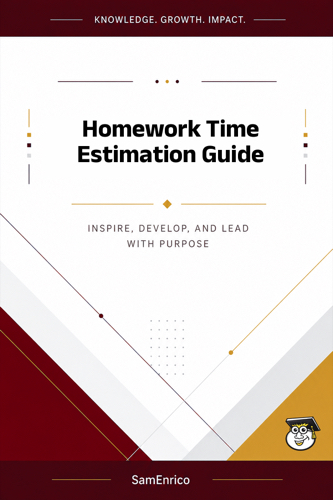
Non-FictionSelf-HelpPlanning Skills
Homework Time Estimation Guide eBook
Teaches students to realistically predict how long
Teaches students to realistically predict how long assignments will take.
Formats
Free sample
Chapter 1: The Planning Fallacy--–- You are about to discover something that will change how you see every homework assignment, every deadline, and every evening you have ever spent frustrated at your desk. But first, I need you to do something uncomfortable. I need you to remember a specific night. Not a good night. Not a night when everything went right.
I need you to remember the worst homework night you have had in the past month.Picture it. What time did you sit down? What was the first assignment? How long did you think it would take? Now trace the arc of the evening.
When did you first realize you were behind schedule? What did that feel like in your body? A tightness in your chest? A heaviness in your eyes? A voice in your head saying, “Not again.” Now fast forward to the end.
What time did you finally close your books? How much of what you planned to do actually got done? And what did you tell yourself as you turned off the light? “I need to start earlier tomorrow.” “I should have focused more.” “I am just bad at this.”That last one is the most dangerous sentence a student can say. Not because it is always false, but because it is always final.
“I am just bad at this” closes the door on improvement. It turns a skill into an identity. And once something becomes your identity, you stop trying to change it. Why would you? You are just bad at time.
That is who you are.You are about to learn that you are not bad at time. You are human. And humans are wired to be wrong about the future in a specific, predictable, and correctable way. The name for that wiring is the planning fallacy, and once you understand it, you will never look at a homework assignment the same way again.The Invention of a Very Expensive Mistake In 1977, two psychologists named Daniel Kahneman and Amos Tversky published a paper that would eventually help win Kahneman a Nobel Prize. They had been studying why people make systematically bad predictions about the future, even when those predictions mattered enormously.
They looked at political forecasts, military operations, construction projects, and business plans. In every domain, they found the same pattern: people consistently underestimated how long things would take, how much they would cost, and how much could go wrong.The most famous example came from outside their research. In 1959, construction began on the Sydney Opera House in Australia. The architects estimated it would take four years and cost $7 million. It took fourteen years and cost $102 million.
In 1995, Denver International Airport began construction with an estimated completion date of 1998 and a budget of $1.7 billion. It opened in 2005 at a cost of $4.8 billion. In 2004, the Scottish Parliament building was supposed to cost $40 million and open in two years. It opened in 2013 at a cost of $1.1 billion.These are not stories about incompetence. These are stories about the planning fallacy.
The same cognitive bias that makes a government spend a billion dollars more than expected is the same cognitive bias that makes you spend two extra hours on your history paper. The scale is different. The mechanism is identical.Kahneman and Tversky gave the planning fallacy a formal definition: the tendency to overestimate the benefits and underestimate the costs of future actions, while simultaneously ignoring relevant base rates from past experience. Let me translate that into student language. You overestimate how much you will get done and underestimate how long it will take.
And you do this while ignoring every single time you have been wrong before.The most disturbing finding was this: even when researchers showed people their own past predictions and asked them to recall how long those tasks actually took, people still ignored that information. They looked at the evidence of their own failures and said, essentially, “That was then. This is different.” The illusion of unique circumstances is almost impossible to shake. You believe your future self will be more focused, more efficient, and more fortunate than your past self. But your future self is your past self, plus a few hours.
Nothing magical changes between 7:00 PM today and 7:00 PM tomorrow.Why Your Brain Refuses to Learn from Experience Let me ask you a question. How many times have you done math homework? Hundreds? Thousands? And yet, somehow, you still underestimate how long it takes.
How is that possible? If you have done something a thousand times, should you not know exactly how long it takes?The answer reveals something strange about memory. Your brain does not store every experience equally. It stores memories that are emotionally intense, surprising, or novel. A math homework session where everything goes smoothly is not emotionally intense.
It is not surprising. It is not novel. Your brain barely registers it. It moves directly from short-term memory to oblivion. But a math homework session where you get stuck on a problem for twenty minutes?
That is emotionally intense. That is surprising (you did not expect to get stuck). Your brain flags it, strengthens it, and makes it available for future recall.This is called availability bias. Your brain uses the most available, most vivid memories to make predictions about the future. But the most available memories are not the most common.
They are the most unusual. So when you predict how long math homework will take, your brain does not search through all thousand sessions. It searches through the ones that stand out. And the ones that stand out are the sessions where you finished early (surprising and positive) or finished extremely late (surprising and negative). The sessions where you finished exactly on time?
Forgettable. Your brain has already deleted them.This creates a systematic distortion. If you have had five sessions where you finished early and five where you finished late, your brain will remember the early finishes more vividly because they felt good, and the late finishes more vividly because they felt bad. But it will not remember the fifty sessions in the middle where you were close to your estimate. When you then predict the next session, your brain pulls up an early finish and a late finish and averages them.
But the true average is much closer to the middle sessions you have forgotten. Your prediction is anchored to the extremes, not the reality.This is why experience alone does not improve your estimates. You need a system that bypasses your brain’s flawed memory. You need to write things down. You need to look at the actual data, not the vivid stories your brain tells you.
That is what Chapter 8 will give you: a 7-day diagnostic log that replaces your memory with measurement. But first, you need to understand the hidden architecture of every estimate you have ever made.The Ten Hidden Assumptions That Ruin Every Prediction Every time you estimate a homework assignment, you make a set of assumptions. You do not state them out loud. You do not write them down. But they are there, silently inflating your confidence and deflating your accuracy.
Here are the ten assumptions you make every single time you estimate.One: You assume you will start immediately. You picture…
This is the end of the free sample. Get the eBook to keep going. Buy now
About this book
Details
- Author
- Scanlon Eleonora
- Publisher
- SamEnrico
- Language
- English
- Genre
- Non-Fiction, Self-Help, Planning Skills
- Released
- 2026-06-05
- Pages (approx.)
- 119
- Available as
- eBook, Audiobook

Read better in the ZLOADR app
Your eBooks on your phone or tablet. Sign in with your SamEnrico account and start reading.
More by Scanlon Eleonora
 The Camping AbductionScanlon Eleonora$11.99
 Gaming Addiction and DepressionScanlon Eleonora$11.99
 Group Therapy Participation GuideScanlon Eleonora$11.99
 The Anxiety Spiral InterruptScanlon Eleonora$11.99
 Driving Phobia Post AccidentScanlon Eleonora$11.99
 CEO Stress Mastery GuideScanlon Eleonora$11.99
 The Uber Internal Files ExposureScanlon Eleonora$11.99
 The Firebird and the Trickster’s Heart: A Love Spun from Lies and LightScanlon Eleonora$11.99
 Silk & Shadows: The Spy Who Saved ConstantinopleScanlon Eleonora$11.99
 The Mineral Guide to AlumScanlon Eleonora$11.99
 Lean Canvas Vs Business Model CanvasScanlon Eleonora$12.99
 Australian National UniversityScanlon Eleonora$12.99
You may also like
 Hong Kong Handover 1997Dunn Johnnie$11.99
 Zumba For Postnatal Recovery CourseNeal Christian$11.99
 Zumba for BeginnersLadner Nikia$11.99
 YouTube Comment Mining GuideHumes Pandora$12.99
 Worry Box MeditationCarlin Rudy$11.99
 Workplace Stress MeditationNguyen Lynn$11.99
 Workplace Stress and Sleep RepairHawley Ivory$11.99
 Workplace Perfectionism CureDelaney Jeffry$11.99
 Workplace Injustice Anger GuideWallen Isabelle$11.99
 Work Addiction and Burnout LinkGreenwood Ester$11.99
 Women in Yoga and WellnessBeattie Galina$11.99
 Women in Stand Up ComedyChun Evangeline$11.99