
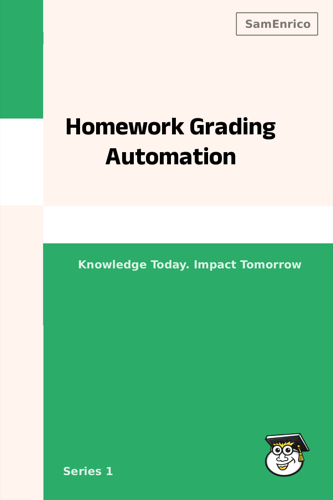
Non-FictionAI OperatorHomework Automation
Homework Grading Automation eBook
Set up workflows that auto-grade and return studen
by Weis Micaela
Set up workflows that auto-grade and return student homework with feedback.
Formats
Free sample
Chapter 1: The Grading Trap--–- It was 11:47 on a Sunday night, and Sarah Martinez, a 9th-grade algebra teacher with fourteen years of classroom experience, had just finished grading the last of 147 homework papers. She had started at 7:00 PM on Friday. Sixty-four of those papers were identical problem sets on linear equations. She had written "Please show your work" forty-one times. She had written "Check your negative signs" fifty-three times.
She had written "Good start, but you forgot to distribute the coefficient" thirty-eight times. Her hand ached. Her eyes burned. And tomorrow, she would hand the papers back, and most of her students would glance at the grade, ignore the comments, and shove the paper into the abyss of their backpacks.Sarah Martinez is not a fictional character. She is every secondary teacher who has ever spent a weekend drowning in papers while the rest of the world assumed that grading was a simple, even pleasant, part of the job.
She is the science teacher who stayed until 6:00 PM on a Friday to finish lab reports. She is the English teacher who brought home 120 essays and cried in her car before driving home because she knew she would spend her entire Sunday reading about the same five themes in The Great Gatsby.The problem is not Sarah. The problem is not that teachers are inefficient or lack dedication. The problem is that the system of homework grading that dominates education today was designed for a world that no longer exists—a world before email, before learning management systems, before artificial intelligence, before the internet made information instantaneous. And that system is breaking the people who are supposed to deliver it.The Silent Crisis in Every Grading Pile Let us begin with a simple question that most educational books avoid: Why do we grade homework at all?
The answer seems obvious—to measure learning, to provide feedback, to hold students accountable, to assign grades that reflect mastery. But underneath that obvious answer lies a darker truth. Much of what teachers call "grading" is actually clerical work disguised as pedagogy.Consider what actually happens when a teacher grades a traditional homework assignment. The students complete twenty math problems. The teacher checks each problem, marks correct or incorrect, perhaps writes a brief comment on a few, tallies the score, records it in the gradebook, and returns the paper.
The entire transaction takes between one and five minutes per student, depending on the complexity of the work. For a class of thirty students, that is thirty to one hundred fifty minutes. For five classes, that is two and a half to twelve and a half hours.Now ask yourself: What learning occurred during those hours? The teacher learned which problems were difficult, but a simple scan of the papers would have revealed that in minutes, not hours. The student learned a grade, but rarely the reasoning behind it.
The feedback—the comments the teacher painstakingly wrote—arrived one to seven days after the work was completed, long after the cognitive moment when it might have changed behavior.Ken O’Connor, whose research on grading practices has shaped a generation of educators, puts it bluntly: "Grades are broken. They communicate almost nothing of value about what a student actually knows or can do." In his landmark book How to Grade for Learning, O’Connor documents what researchers have known for decades—that traditional point-based grading punishes mistakes made during the learning process, conflates behavior with mastery, and provides feedback so delayed that it becomes instructionally useless.The data on teacher burnout is equally alarming. A 2022 survey by the RAND Corporation found that K-12 teachers work an average of fifty-four hours per week, with grading and lesson planning consuming the majority of time outside of direct instruction. Of those fifty-four hours, teachers reported that roughly fifteen hours were spent on grading—tasks that they described as "repetitive," "mind-numbing," and "the part of the job that makes me want to quit." The same survey found that teachers who spend more than ten hours per week on grading are three times more likely to report symptoms of burnout than teachers who spend five hours or less.Let those numbers land. Three times more likely to experience burnout.
Not because of difficult students, not because of low pay, not because of administrative pressure—but because of the sheer, grinding volume of grading.The False Trade-Off That Defines Teaching Every teacher knows the secret calculus that happens every evening and every weekend. If I grade these papers, I will have no time to plan tomorrow's lesson. If I plan an engaging lesson, I will have to let the grading slide. If I give feedback on every paper, I will have no life outside of school. If I protect my personal time, I will be a bad teacher.This is the false trade-off that defines modern teaching.
It is false because the choice itself should not exist. The fact that teachers must choose between grading and planning—between feedback and family—is not a sign of teacher dedication. It is a sign of system failure.The problem is compounded by the nature of the grading task itself. Most homework grading is not intellectually demanding. It does not require a teaching credential.
It does not require pedagogical expertise. It requires pattern recognition—spotting the same error across multiple papers—and repetitive action—writing the same comment over and over again. These are precisely the tasks that computers have been able to do for decades. Yet the vast majority of teachers still perform them manually, by hand, with a red pen and a stack of papers.The reason is not technological. The technology exists.
Platforms like Gradescope, zy Books, and even basic learning management systems have automated grading capabilities that could eliminate eighty to ninety percent of the repetitive work that consumes teacher time. The reason is cultural. Education has a deep, unexamined belief that grading must be done by a human to be meaningful—that automation somehow cheapens the act of assessment.This belief is wrong. Automation does not dehumanize grading. It does the opposite.
By removing the clerical burden, automation allows teachers to do what only humans can do: provide empathetic, nuanced, context-aware feedback on the work that actually matters.The Thesis That Changes Everything This book advances a single, provable thesis: Automation should be used for formative assessment, not summative scoring. Let us break down what that means.Formative assessment is assessment for learning. It is low-stakes, frequent, and designed to provide immediate feedback that the student can use to improve. Formative assessment asks: "Where are you now, and what do you need to do next?" It is diagnostic. It is supportive.
It is the kind of assessment that actually improves learning outcomes, as decades of research by Paul Black and Dylan Wiliam have demonstrated.Summative scoring is assessment of learning. It is high-stakes, infrequent, and designed to produce a final judgment. Summative scoring asks: "What grade do you deserve?" It is evaluative. It is conclusive. It is necessary for transcripts and report cards, but it does almost nothing to improve learning in the moment.Traditional homework grading tries to be both formative…
This is the end of the free sample. Get the eBook to keep going. Buy now
About this book
Details
- Author
- Weis Micaela
- Publisher
- SamEnrico
- Language
- English
- Genre
- Non-Fiction, AI Operator, Homework Automation
- Released
- 2026-06-06
- Pages (approx.)
- 137
- Available as
- eBook, Audiobook

Read better in the ZLOADR app
Your eBooks on your phone or tablet. Sign in with your SamEnrico account and start reading.
More by Weis Micaela
 Attempt Survivor Parent Guilt MemoirWeis Micaela$11.99
 Ice Cream Phobia Brain Freeze PlanWeis Micaela$11.99
 French Resistance Mobile BrothelsWeis Micaela$11.99
 Stress and Sciatica Flare ConnectionWeis Micaela$11.99
 Donatello: The Sculptor Who Defined the RenaissanceWeis Micaela$11.99
 Strategic Time Blocking HandbookWeis Micaela$12.99
 Remote Review For Low PerformersWeis Micaela$12.99
 Understanding MastocytosisWeis Micaela$17.99
 How to Become a Tube CleanerWeis Micaela$11.99
 Overnight Security OfficerWeis Micaela$11.99
You may also like
 Hong Kong Handover 1997Dunn Johnnie$11.99
 Zumba For Postnatal Recovery CourseNeal Christian$11.99
 Zumba for BeginnersLadner Nikia$11.99
 YouTube Comment Mining GuideHumes Pandora$12.99
 Worry Box MeditationCarlin Rudy$11.99
 Workplace Stress MeditationNguyen Lynn$11.99
 Workplace Stress and Sleep RepairHawley Ivory$11.99
 Workplace Perfectionism CureDelaney Jeffry$11.99
 Workplace Injustice Anger GuideWallen Isabelle$11.99
 Work Addiction and Burnout LinkGreenwood Ester$11.99
 Women in Yoga and WellnessBeattie Galina$11.99
 Women in Stand Up ComedyChun Evangeline$11.99