
Non-FictionSelf-HelpAdjustment
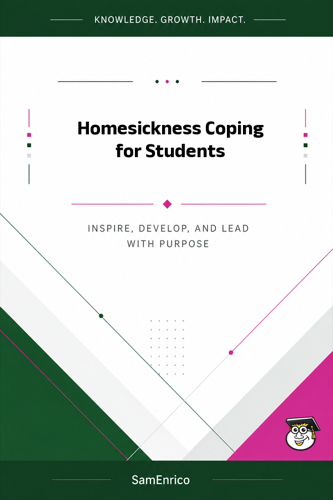
Homesickness Coping for Students
Build new support systems while staying connected
Build new support systems while staying connected to family without guilt.
Formats
About this book
Free sample
Chapter 1: The Homesickness Loop--–- The first time you feel it, you might not even have a name for it. You are sitting in your dorm room, or a noisy dining hall, or a library carrel at 11 p.m., and suddenly your chest tightens. Your throat closes. A slideshow of home flickers behind your eyes: your mom’s laugh, your dog jumping on the bed, the smell of Sunday morning coffee, the particular way the light falls through your bedroom window. You blink hard.
You tell yourself to stop being ridiculous. Everyone else seems fine. Everyone else is laughing, studying, walking in groups, posting happy photos. What is wrong with you?Nothing is wrong with you. You are experiencing the homesickness loop, and your brain is doing exactly what evolution designed it to do: keep you close to safety.
The problem is that safety is now five hundred miles away, and your brain hasn’t gotten the memo.This chapter is the foundation for everything that follows. Before you can build new support systems (Chapter 5), set strategic contact rules (Chapter 4), or create your personal Roots & Wings Contract (Chapter 10), you must understand what is happening inside your skull. Because here is the truth that most homesickness advice gets wrong: this is not a character flaw. It is not immaturity. It is not a sign that you are not ready for college.
It is neurobiology, and once you understand the mechanics of the loop, you can break it.The Neuroscience of Separation: Why Your Brain Thinks You Are in Danger Let us begin with a simple fact: human beings are attachment animals. We do not birth fully independent offspring. For the first several years of life, a child who wanders away from a caregiver is in genuine, life-threatening danger. Evolution solved this problem by hardwiring a proximity-seeking system into the mammalian brain. When you are close to your attachment figures (usually parents or primary caregivers), your brain releases calming neurochemicals like oxytocin and serotonin.
When you are separated, your brain sounds an alarm.That alarm is not metaphorical. It is physiological.Research in attachment theory, pioneered…
This is the end of the free sample. Get the eBook to keep going. Buy now
Contents
- Chapter 1
- Chapter 2
- Chapter 3
- Chapter 4
- Chapter 5
- Chapter 6
- Chapter 7
- Chapter 8
- Chapter 9
- Chapter 10
- Chapter 11
- Chapter 12
Details
- Author
- Carey Shaquana
- Publisher
- SamEnrico
- Language
- English
- Genre
- Non-Fiction, Self-Help, Adjustment
- Released
- 2026-06-06
- Pages (approx.)
- 142
- Available as
- eBook, Audiobook

Read better in the ZLOADR app
Your eBooks on your phone or tablet. Sign in with your SamEnrico account and start reading.
More by Carey Shaquana
 Number Chunking Memory SystemCarey Shaquana$11.99
 Sugar Addiction Recovery Meal Prep GuideCarey Shaquana$11.99
 Personal Ing For Success for ExtrovertsCarey Shaquana$11.99
 Cortisol and Teeth Grinding GuideCarey Shaquana$11.99
 The Silk Road Heist: When Gold Turned to DustCarey Shaquana$11.99
 The Blackout Tapes: The Night America Stood StillCarey Shaquana$11.99
 Extrusion Operator HelperCarey Shaquana$11.99
 Understanding Elective MutismCarey Shaquana$17.99
 Swedish Logistics DirectoryCarey Shaquana$12.99
 1099 Filing Service GuideCarey Shaquana$12.99
 How to Become a Rack Loader ICarey Shaquana$11.99
You may also like
 Hong Kong Handover 1997Dunn Johnnie$11.99
 Zumba For Postnatal Recovery CourseNeal Christian$11.99
 Zumba for BeginnersLadner Nikia$11.99
 YouTube Comment Mining GuideHumes Pandora$12.99
 Worry Box MeditationCarlin Rudy$11.99
 Workplace Stress MeditationNguyen Lynn$11.99
 Workplace Stress and Sleep RepairHawley Ivory$11.99
 Workplace Perfectionism CureDelaney Jeffry$11.99
 Workplace Injustice Anger GuideWallen Isabelle$11.99
 Work Addiction and Burnout LinkGreenwood Ester$11.99
 Women in Yoga and WellnessBeattie Galina$11.99
 Women in Stand Up ComedyChun Evangeline$11.99