
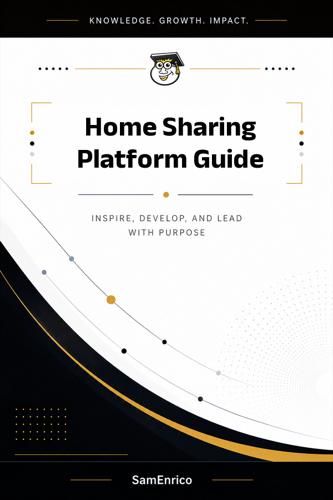
Non-FictionBusiness BriefSharing Economy
Home Sharing Platform Guide eBook
Uses Silvernest and similar apps to find compatibl
by Ligon Bess
Uses Silvernest and similar apps to find compatible housemates.
Formats
Free sample
Chapter 1: The Empty Rooms Epidemic--–- The average American home has three bedrooms. The average American household contains 2.5 people. Do the math, and you will discover a staggering fact: millions of bedrooms sit empty every single night while millions of people struggle to afford a place to sleep. This is not a housing crisis. It is a housing inefficiency crisis.
And the solution does not require building a single new building.Let that sink in for a moment. We have been told for decades that the only answer to high housing costs is more construction, more apartments, more density. And yes, supply matters. But there is another supply we have been ignoring completely: the empty rooms already inside homes we have already built, already heated, already insured, already mortgaged. Every night, in every city and town across the country, a senior citizen eats dinner alone in a four-bedroom house while a young teacher two blocks away wonders how she will make rent.
A single mother works two jobs to pay for an apartment she barely sees while a retiree three miles away worries about the cost of lawn care. A remote worker stares at the same four walls of his home office while an international student pays exorbitant dorm fees.These two groups share nothing except proximity. But they could share everything.This book is about how to close that gap. It is about the rise of home sharing platforms—Silvernest, Roomi, Pad Split, Kuvu, and others—that function like dating apps for housing. They match homeowners with empty space to renters who need a place to live, using algorithms that go far beyond “how many bedrooms” to ask deeper questions: What time do you wake up?
Do you prefer a quiet house or a social one? Are you looking for a roommate or a friend? These platforms have facilitated tens of thousands of successful matches, generating hundreds of millions of dollars in rental income while reducing loneliness, providing affordable housing, and keeping seniors in their homes longer.But here is the problem that this book solves: most people still get it wrong.They post a listing that says “Room for rent, $800/month, utilities included” and wonder why they attract applicants who disappear after two months. They skip the background check to save twenty dollars and end up with a housemate who stops paying rent. They rely on a handshake instead of a written agreement and discover that a verbal promise is not enforceable in any court.
They treat home sharing like a transaction—find a body, collect a check—and then wonder why it feels like a job instead of a solution.This book exists because home sharing is not a transaction. It is a relationship. And like any relationship, it requires intention, boundaries, communication, and a little bit of luck. But luck can be engineered. The platforms have built the tools.
The law has created the framework. Millions of successful home sharers have proven the model. The only missing piece is a guide that walks you through every step—from the first moment you consider opening your home (or answering a listing) to the day you part ways, years later, having saved money, made a friend, or simply survived a difficult season of life.That guide is in your hands.The Historical Pivot You Haven’t Noticed To understand why home sharing platforms have exploded in the past decade, you have to look at three simultaneous trends that no one predicted would converge.First, the American home has gotten larger even as households have gotten smaller. In 1970, the average new home had about 1,500 square feet and housed 3.1 people. By 2020, the average new home had grown to over 2,500 square feet while the average household size had shrunk to 2.5 people.
That means more square footage per person than at any time in history—and most of that space is unused for sixteen hours a day. The master bedroom sits empty while you work. The guest room sits empty while you sleep. The basement sits empty while you watch television in the living room. We have built a nation of half-empty homes.Second, housing costs have outpaced wages for forty years.
In 1985, the median rent consumed about 25 percent of the median renter’s income. Today, that number is over 35 percent—and for low-income renters, it exceeds 50 percent. Young adults delay marriage, delay children, delay homeownership, not because they don’t want those things but because they cannot afford the rent long enough to save for a down payment. They need a solution that does not require a six-figure salary or a family inheritance. They need a room they can afford.Third, loneliness has become a public health crisis.
The US Surgeon General declared loneliness an epidemic in 2023, citing research that social isolation increases the risk of premature death by nearly 30 percent. Seniors are particularly vulnerable: a quarter of adults over 65 are socially isolated. But young adults are not far behind. Remote work, while freeing in many ways, has stripped millions of people of the casual social contact that used to happen in offices, break rooms, and after-work drinks. People are not just housing-insecure.
They are connection-insecure.Home sharing platforms sit at the intersection of all three trends. They fill empty space. They lower housing costs. They create connection. In one transaction, a senior homeowner gets $800 a month and someone to talk to at breakfast.
A young renter gets an affordable room and a built-in mentor. A single parent gets help with childcare. A remote worker gets out of their home office and into a shared living room.This is not a niche solution for desperate people. This is a mainstream strategy for smart people.The Ecosystem: A Map of Your Options Before you do anything else, you need to understand the landscape. Home sharing platforms are not all the same.
They differ in who they serve, how they make money, what they screen for, and what happens when things go wrong.Silvernest launched in 2015 with a specific mission: help seniors age in place by matching them with younger renters. The average Silvernest homeowner is 65 years old. The average renter is 40. About 30 percent of their matches are intergenerational. The platform offers background checks, lease templates, rent collection, and a network of 17,000 attorneys for legal questions.
Fees are paid primarily by homeowners via subscription plans or per-match fees. Silvernest is best for homeowners over 50 who want a long-term, compatible housemate and are willing to pay for premium matching and support.Roomi takes a different approach. It is designed for urban renters—typically under 35—who need to find a roommate quickly. The platform emphasizes location, budget, and lifestyle preferences over long-term compatibility. Listings often include phrases like “looking for someone to grab drinks with” or “must love dogs.” Roomi offers background checks and identity verification but less robust legal support.
Fees are lower, but so is the intensity of screening. Roomi is best for young professionals in cities who need a room within thirty days and prioritize social fit over legal protection.Pad Split is the workforce housing solution. Instead of matching one homeowner with one renter, Pad Split works with property owners to convert…
This is the end of the free sample. Get the eBook to keep going. Buy now
About this book
Details
- Author
- Ligon Bess
- Publisher
- SamEnrico
- Language
- English
- Genre
- Non-Fiction, Business Brief, Sharing Economy
- Released
- 2026-06-06
- Pages (approx.)
- 155
- Available as
- eBook, Audiobook

Read better in the ZLOADR app
Your eBooks on your phone or tablet. Sign in with your SamEnrico account and start reading.
More by Ligon Bess
 Opioid Induced HypogonadismLigon Bess$11.99
 NVC For Imposter SyndromeLigon Bess$11.99
 Franchising Your Local Brand Across Borders Territorial RestrictionsLigon Bess$11.99
 Stimulant and RelationshipsLigon Bess$11.99
 Mindfulness Based Relapse Prevention for AlcoholLigon Bess$11.99
 Short Answer Exam GuideLigon Bess$11.99
 Anabolic Steroid ReversalLigon Bess$11.99
 The Opium Wars' Poisoned Legacy: The Triads' Deadly Medical ConspiracyLigon Bess$11.99
 The Counterfeit Kings of Berlin: The Great Prohibition ScandalLigon Bess$11.99
 How to Produce Colored Exterior StainLigon Bess$11.99
 How to Produce GrommetsLigon Bess$11.99
 Nigeria VAT Filing Deadlines WorkbookLigon Bess$12.99
You may also like
 Hong Kong Handover 1997Dunn Johnnie$11.99
 Zumba For Postnatal Recovery CourseNeal Christian$11.99
 Zumba for BeginnersLadner Nikia$11.99
 YouTube Comment Mining GuideHumes Pandora$12.99
 Worry Box MeditationCarlin Rudy$11.99
 Workplace Stress MeditationNguyen Lynn$11.99
 Workplace Stress and Sleep RepairHawley Ivory$11.99
 Workplace Perfectionism CureDelaney Jeffry$11.99
 Workplace Injustice Anger GuideWallen Isabelle$11.99
 Work Addiction and Burnout LinkGreenwood Ester$11.99
 Women in Yoga and WellnessBeattie Galina$11.99
 Women in Stand Up ComedyChun Evangeline$11.99