
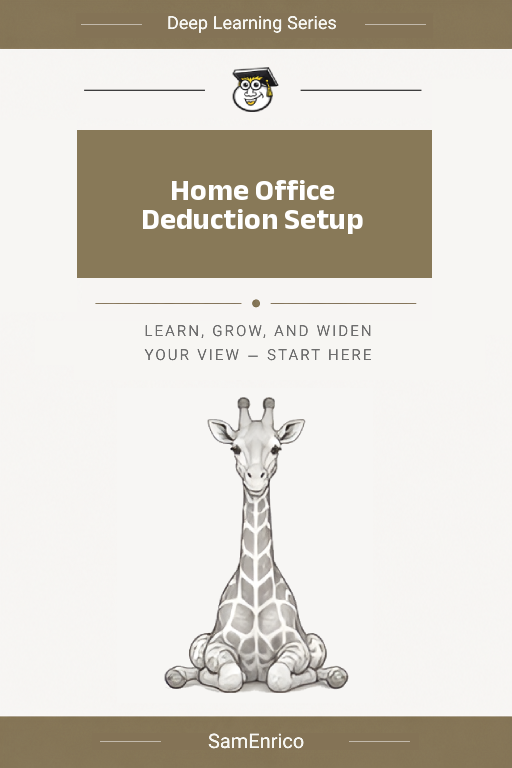
Non-FictionFirst 30 DaysTax Deductions
Home Office Deduction Setup eBook
Measure exclusive business use space in home and c
Measure exclusive business use space in home and calculate simplified or regular IRS deduction.
Formats
Free sample
Chapter 1: The Three Gates--–- You are leaving money on the table right now. Not because you are bad with taxes. Not because you are dishonest. But because the IRS has built a maze around the home office deduction, and most people stop at the first wall.The truth is simpler than you think. Before you measure a single square foot, before you calculate a single percentage, before you decide between the Simplified Method and the Actual Expense Method, you must answer three questions.
The IRS calls them tests. I call them gates. You must pass through all three, or nothing else in this book matters.This chapter is not about math. It is about permission. It is about understanding what the IRS is actually looking for when they review your return.
And it is about avoiding the single most common reason deductions get denied: qualification failures.I have reviewed hundreds of tax audits over the years. The pattern is unmistakable. The IRS rarely challenges the math on a home office deduction. They challenge whether you had the right to take the deduction at all. And when they find a taxpayer who never should have claimed the deduction in the first place, they do not just disallow it.
They look at every other line on your return with fresh suspicion.So let us walk through the three gates together. By the end of this chapter, you will know with absolute certainty whether you qualify. And if you do not, you will save yourself years of audit risk. If you do, you will have the confidence to move forward with every tool in this book.Gate One: Exclusive Use The first gate is the one most people fail. It is also the simplest to understand, though not always the simplest to execute.Exclusive use means exactly what it sounds like.
The space you are claiming as a home office must be used only for your business. Not mostly. Not primarily. Exclusively.Let me give you an example that will sound familiar. A freelance graphic designer sets up a desk in the corner of her living room.
She does all her client work there. She keeps her files there. She spends twenty hours a week at that desk. But at night, her teenage son sits at the same desk to do his homework. On weekends, her husband uses the same desk to pay bills.That is not exclusive use.
The IRS will disallow that deduction every single time.Now consider the same designer. She buys a folding screen from a home goods store for forty dollars. She sets up her desk in the same corner of the living room. But now, when she finishes work, she closes the folding screen around the desk. Her son does his homework at the kitchen table.
Her husband pays bills on the couch with a laptop. The desk behind the screen is touched by no one except her, for business purposes only.That is exclusive use. The folding screen creates a physical boundary. It signals to anyone in the household that this space is off limits. And it signals to the IRS that you understand the rule and have taken steps to comply.The exclusive use rule applies to entire rooms and to portions of rooms.
You do not need a dedicated room with four walls and a door, though that is certainly easier to document. You can claim a designated corner of a basement, a section of a bedroom, even a closet, provided that space is used exclusively for business.But here is where it gets tricky. What about a bookshelf that spans the boundary between your office space and your living space? What about a desk drawer that contains both business files and personal receipts? What about a filing cabinet where the top drawer holds client contracts and the bottom drawer holds your children's school records?The IRS looks at the entire space.
If any part of the claimed area contains personal items or is used for personal activities, the deduction is at risk. The safe approach is to draw a clear line, literally and figuratively. Use room dividers, separate furniture, or different wall colors to delineate the business zone. Keep personal items out of that zone entirely. If you cannot commit to that level of separation, you should not claim the deduction.There are two major exceptions to the exclusive use rule, which we will cover in depth in Chapter 2.
Daycare providers and inventory-based businesses have special rules. For everyone else, exclusive use is non-negotiable.Now let me address a question I hear constantly. What about walking through the space to get to another room? If your home office is a spare bedroom, and you walk through that bedroom to reach a back deck, is that considered personal use?The IRS has ruled on this. Incidental passage through a home office to reach another part of the house does not violate exclusive use, provided you do not linger, sit down, or engage in any personal activity while passing through.
The key word is incidental. If you walk through the office three times a day to let the dog out, you are fine. If you sit in the office to watch television while waiting for the dog to come back inside, you have violated exclusive use.The best practice is to avoid any ambiguity. If you can arrange your home so that the office is not a thoroughfare, do it. If you cannot, document the fact that you only pass through and never stop.
A simple log or a photograph showing the clear path can be useful audit evidence.One more nuance. What if you use the space for business five days a week but your spouse uses it for personal purposes on weekends? That is still a violation. Exclusive use applies to all hours of all days. There is no time-sharing provision for home offices outside of the daycare exception.I know this sounds strict.
It is. The IRS intentionally made the exclusive use rule difficult to satisfy because they do not want every taxpayer with a laptop claiming a home office deduction. But difficult is not impossible. Millions of taxpayers successfully claim this deduction every year by following the rule as written.The secret is intentionality. You must design your space with exclusivity in mind.
You must train your household to respect the boundary. And you must be honest with yourself about whether you are truly using the space only for business.If you cannot honestly say yes to exclusive use, stop here. Do not proceed to Gate Two. Do not read the rest of this book hoping for a loophole. There is no magic trick that turns a shared family desk into a deductible home office.
Save yourself the audit risk and move on.But if you can say yes, if you have a space that is truly dedicated to your business and nothing else, then congratulations. You have passed the first gate. Let us move to the second.Gate Two: Regular Use The second gate is easier to understand but harder to measure. Regular use means you cannot claim a home office…
This is the end of the free sample. Get the eBook to keep going. Buy now
About this book
Details
- Author
- Unger Evelyne
- Publisher
- SamEnrico
- Language
- English
- Genre
- Non-Fiction, First 30 Days, Tax Deductions
- Released
- 2026-06-01
- Pages (approx.)
- 147
- Available as
- eBook, Audiobook

Read better in the ZLOADR app
Your eBooks on your phone or tablet. Sign in with your SamEnrico account and start reading.
More by Unger Evelyne
 Turkey Green Energy Support GuideUnger Evelyne$11.99
 The Sleep Coach Consultation GuideUnger Evelyne$11.99
 Group Ideation Techniques HandbookUnger Evelyne$11.99
 Calorie Tracking SimplifiedUnger Evelyne$11.99
 Workplace Stress Reduction for PerfectionistsUnger Evelyne$11.99
 Silicon Bloodlines: The Untold Rivalry of the Dorsey BrothersUnger Evelyne$11.99
 Into the Ice: The Intrepid Explorers of Antarctica's Hidden DepthsUnger Evelyne$11.99
 How to Become a Cabana AttendantUnger Evelyne$11.99
 Understanding Chromosome 3, Monosomy 3q21 23Unger Evelyne$17.99
 Quora Question Validation GuideUnger Evelyne$12.99
 Logistics AnalysisUnger Evelyne$11.99
You may also like
 Hong Kong Handover 1997Dunn Johnnie$11.99
 Zumba For Postnatal Recovery CourseNeal Christian$11.99
 Zumba for BeginnersLadner Nikia$11.99
 YouTube Comment Mining GuideHumes Pandora$12.99
 Worry Box MeditationCarlin Rudy$11.99
 Workplace Stress MeditationNguyen Lynn$11.99
 Workplace Stress and Sleep RepairHawley Ivory$11.99
 Workplace Perfectionism CureDelaney Jeffry$11.99
 Workplace Injustice Anger GuideWallen Isabelle$11.99
 Work Addiction and Burnout LinkGreenwood Ester$11.99
 Women in Yoga and WellnessBeattie Galina$11.99
 Women in Stand Up ComedyChun Evangeline$11.99