
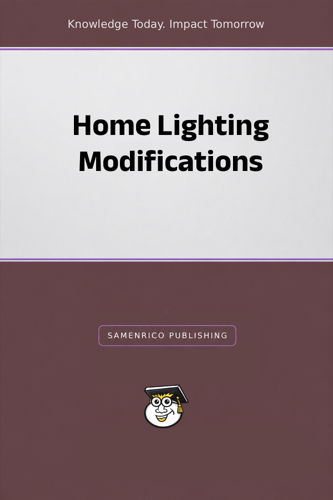
Non-FictionHealth & WellnessHome Adaptation
Home Lighting Modifications eBook
Teaches reducing glare and increasing illumination
by Mchugh Alena
Teaches reducing glare and increasing illumination for low vision.
Formats
Free sample
Chapter 1: The Double Burden...–- Margaret was seventy-two years old when she fell in her own kitchen. She had simply reached for a can of soup on the counter, but the overhead light cast her own shadow directly across the label. She couldn't read the words. She leaned closer. Her hand missed the can by six inches, struck a glass instead, and sent shards across the floor.
Margaret was not clumsy. Margaret had low vision. And like millions of others, she had been told a lie: that if a room is dark, you just add more light.The truth is far more complicated, and far more urgent. Every year, one in four adults over the age of sixty-five experiences a fall, and the majority of those falls happen at home, in familiar spaces, under lighting that someone thought was perfectly adequate. The culprit is rarely darkness alone.
More often, it is a failure to understand how aging eyes actually see—and how they stop seeing. This chapter dismantles the most common and dangerous assumption in home lighting: that more light is always better. In its place, we will build a new framework based on what low vision experts call the task-centric home, where illumination is intentional, targeted, and designed around the specific activities of daily living.The Myth of Simple Brightness When a person begins to struggle with vision—whether from cataracts, macular degeneration, glaucoma, or diabetic retinopathy—the first instinct is almost always the same. They buy brighter bulbs. They add floor lamps.
They replace 40-watt fixtures with 100-watt equivalents. And for a brief period, it seems to work. The room feels brighter. The edges of furniture appear sharper. But then something strange happens.
The person begins squinting. They complain of headaches. They turn their face away from lamps that used to help them read. They start avoiding certain rooms altogether, retreating to a single chair by a window where the light is different, softer, somehow more bearable.What these individuals are experiencing is not a failure of brightness but a collision between two opposing biological needs. The aging eye requires dramatically more light to see fine detail than the young eye does—up to three times more for a sixty-year-old, and as much as ten times more for an eighty-year-old.
At the same time, the aging eye becomes exquisitely sensitive to glare, the very byproduct of all that extra illumination. This is what we call the double burden, and it is the central paradox of low vision lighting. You cannot solve one problem without addressing the other, yet most commercial lighting solutions address neither.Consider the typical living room. A single ceiling fixture with a bare bulb throws light in all directions. Some of that light bounces off walls and furniture, creating useful illumination.
But much of it travels directly toward the eyes of anyone seated below. For a young person, this is merely annoying. For an older adult with early cataracts, that direct light scatters inside the lens, creating a haze that washes out contrast and makes faces unrecognizable. The very fixture designed to help them see is actively blinding them. And so they turn it off, retreating into semidarkness that brings its own set of hazards: misjudged steps, unseen obstacles, and the constant fear of falling.The Physiology of Failing Light To understand why the double burden exists, we must look inside the eye itself.
The human lens is a remarkable structure—clear, flexible, and capable of changing shape to focus on objects at varying distances. But it is also vulnerable. Starting around age forty, the lens begins to yellow. This is not a disease; it is a normal, predictable part of aging. The proteins within the lens undergo chemical changes, cross-linking into structures that absorb more light, particularly in the blue and violet wavelengths.
By age sixty, the average lens transmits only about sixty percent of the light that enters the eye. By age seventy, that number drops to forty percent. By eighty, it can be as low as twenty percent.This yellowing has two profound effects. First, it reduces the absolute amount of light reaching the retina, which is why older adults consistently report that rooms feel darker than they did in youth. Second, it changes the quality of that light.
Blue light, which is essential for tasks requiring fine detail discrimination, is preferentially absorbed. The world literally looks yellower, warmer, and less distinct. This is why a person with advanced lens yellowing might mistake a navy sock for a black one, or fail to see the difference between a green pepper and a yellow one on a cutting board.But lens yellowing is only half the story. The retina itself changes with age. The macula, the small central area responsible for sharp, detailed vision, contains cone cells that are densely packed and highly metabolically active.
These cells require large amounts of oxygen and are therefore vulnerable to oxidative stress. Over time, the pigment layer beneath the macula thins, and the cone cells begin to die. This is age-related macular degeneration, or AMD, the leading cause of severe vision loss in adults over sixty.AMD does not affect peripheral vision, at least not in its early stages. Instead, it creates a blind spot in the center of the visual field. A person with AMD can see a door frame but not the doorknob.
They can see a staircase but not the edge of each step. They can see a person's body but not their facial expression. For these individuals, the double burden is particularly cruel. They need extremely bright, focused light directed into their remaining peripheral vision to perform tasks like reading or sewing. But that same light, if positioned incorrectly, creates glare that scatters across the damaged macula, making central vision even less useful.The Contrast Sensitivity Crisis Brightness is not the same as visibility.
This is perhaps the most important concept in this entire book, and it deserves a moment of your full attention. Brightness is a measurement of raw lumens—the total amount of light emitted by a source. Visibility is a measure of how well you can perform a task under that light. The two are related, but the relationship is not linear, and for people with low vision, it is often inverted.Consider a concrete example. A person with healthy vision walks into a room with a single 100-watt incandescent bulb in a ceiling fixture.
The room feels adequately lit. They can read a newspaper, navigate around furniture, and distinguish a black cat from a dark rug. Now take that same person and give them early-stage glaucoma, a condition that damages the optic nerve and reduces contrast sensitivity. The same room, with the same bulb, now feels dim and dangerous. The newspaper's gray text on off-white paper blurs into a single tone.
The black cat blends into the dark rug. The edges of furniture dissolve into the floor.The natural response is to add more light. And indeed, if we increase the bulb to 200 watts, the person with glaucoma will see better. But only up to a point. Past that point, the glare from the bare bulb—now twice as…
This is the end of the free sample. Get the eBook to keep going. Buy now
About this book
Details
- Author
- Mchugh Alena
- Publisher
- SamEnrico
- Language
- English
- Genre
- Non-Fiction, Health & Wellness, Home Adaptation
- Released
- 2026-06-06
- Pages (approx.)
- 146
- Available as
- eBook, Audiobook

Read better in the ZLOADR app
Your eBooks on your phone or tablet. Sign in with your SamEnrico account and start reading.
More by Mchugh Alena
 Christmas Morning SilenceMchugh Alena$11.99
 Santa Bill McReynoldsMchugh Alena$11.99
 Self Hypnosis for Fear of DyingMchugh Alena$11.99
 Self Esteem After BullyingMchugh Alena$11.99
 The Ghana Startup GuideMchugh Alena$11.99
 Haemophilus Influenzae Type B VaccineMchugh Alena$11.99
 High Conflict Divorce RecoveryMchugh Alena$11.99
 The Kidnapping of Charles Lindbergh Jr.: The Birth of Modern Ransom NegotiationsMchugh Alena$11.99
 Sun Chasers: The Forgotten Solar Revolution of Ancient EgyptMchugh Alena$11.99
 How to Produce Serveware AccessoriesMchugh Alena$11.99
 How to Produce Foam BlocksMchugh Alena$11.99
 A Collector's Handbook to the Berkeley Sports Se492Mchugh Alena$11.99
You may also like
 Hong Kong Handover 1997Dunn Johnnie$11.99
 Zumba For Postnatal Recovery CourseNeal Christian$11.99
 Zumba for BeginnersLadner Nikia$11.99
 YouTube Comment Mining GuideHumes Pandora$12.99
 Worry Box MeditationCarlin Rudy$11.99
 Workplace Stress MeditationNguyen Lynn$11.99
 Workplace Stress and Sleep RepairHawley Ivory$11.99
 Workplace Perfectionism CureDelaney Jeffry$11.99
 Workplace Injustice Anger GuideWallen Isabelle$11.99
 Work Addiction and Burnout LinkGreenwood Ester$11.99
 Women in Yoga and WellnessBeattie Galina$11.99
 Women in Stand Up ComedyChun Evangeline$11.99