
Non-FictionBiographyTraditions
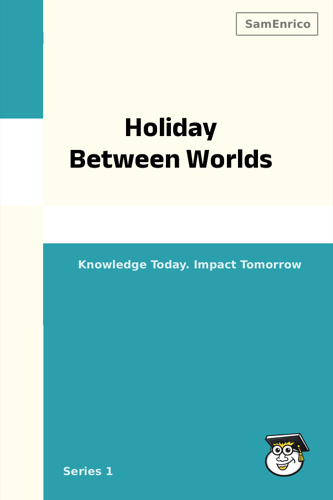
Holiday Between Worlds eBook
Celebrate both cultural festivals while belonging
Celebrate both cultural festivals while belonging fully to neither.
Formats
Free sample
Chapter 1: The Geography of Almost--You are standing in a grocery store aisle, and you are crying over a can of cranberry sauce.Not because of the cranberry sauce itself. The cranberry sauce is fine. It is jiggly and red and tastes vaguely of metal and sugar, the way cranberry sauce has always tasted. No, you are crying because you have just realized something that has been true for your entire life but which you have never before had the language to name. You are standing between two worlds, and neither world wants to claim you.Your mother’s Thanksgiving—the one you grew up with, the turkey and the stuffing and the green bean casserole—does not feel like yours.
Not really. You are too ethnic for that table. You brought mooncakes last year and your aunt asked if you were “doing something weird again.” Your father’s Thanksgiving—the one you barely remember, the one with the rice cakes and the seaweed soup and the ancestors you cannot name—does not feel like yours either. You are too Westernized for that table. You do not speak the language.
You do not know the prayers. You are almost Korean, almost American, almost Jewish, almost Mexican, almost everything and fully nothing.This is the geography of almost. And this chapter is the map.The Before Picture: Why You Are Reading This Book Let me tell you what you came here looking for. You came here because you are tired. Tired of explaining yourself at every holiday gathering.
Tired of the questions that position you as a curiosity rather than a participant. “But where are you really from?” “So do you celebrate Christmas or Hanukkah?” “Which one feels more like home?” As if home is a单选题. As if you have to pick.You came here because you have tried every strategy you can think of. You have tried choosing one culture over the other, only to feel like a traitor to the side you left behind. You have tried celebrating both, only to collapse from exhaustion on January second.
You have tried pretending the holidays don’t matter to you, only to feel a hollow ache when you see photos of other people’s tables on social media. You have tried everything, and nothing has worked.And you came here because you suspect—correctly—that the problem is not you. The problem is that every holiday guide you have ever picked up assumes something that is not true for you. It assumes you belong fully to one tradition. It assumes your family is all in one place.
It assumes your cultural identity is simple, clean, and inherited rather than built. Those guides were not written for you. This one was.Before we go any further, I need you to understand something crucial. This book does not assume that all readers are the same. Some of you are reading this because you actively celebrate multiple cultures and feel torn between them.
Some of you are reading this because you have lost access to one or more of your heritage cultures and are trying to find your way back. And some of you are reading this because you have no strong attachment to any culture but feel like you should and don’t know where to start. All three paths are valid. All three paths are welcome here. Throughout this book, I will signal which exercises and concepts apply most directly to each path.
For now, just know that wherever you are starting from, you belong in these pages.The Three Lies You Have Been Told About Holidays Before we can build something new, we have to clear away the wreckage of what we were taught. There are three lies about holidays that bicultural people absorb like secondhand smoke, and they are making you miserable.Lie Number One: The Lie of Purity.This is the belief that a “real” holiday requires a single, unbroken cultural tradition. You cannot celebrate Lunar New Year and Christmas, according to this lie, because that would be “confusing.” You cannot light a menorah inside a Christmas tree’s glow because that would be “inauthentic.” The Lie of Purity says that the only legitimate holiday is the one that comes from a single source, unchanged, unquestioned, and unblended.Here is the truth the Lie of Purity does not want you to know: every holiday you have ever celebrated is already a blend. Christmas trees were pagan. Easter eggs were Persian.
The Thanksgiving story you were taught in elementary school is a myth built on erasure. There is no pure holiday. There never was. The only difference between you and the person who claims “pure” traditions is that they have forgotten their own history of blending.Lie Number Two: The Lie of Performance.This is the belief that you must explain yourself to belong. If someone asks you “Where are you really from?” the Lie of Performance says you owe them a story.
If your abuela criticizes your tamales, the Lie of Performance says you should defend yourself. If your coworkers want to know “what Diwali is all about,” the Lie of Performance says you are the designated educator.Here is the truth: you are not a museum exhibit. You are not a cultural ambassador. You are a person at a party, a person at a table, a person trying to eat a meal without being interrogated. The Lie of Performance exhausts you because it turns every holiday into a job.
And you were not hired for that job. You never applied. (We will spend a great deal of time in Chapter 3 giving you the tools to stop performing.)Lie Number Three: The Lie of Either/Or.This is the belief that you have to choose. Choose your mother’s culture or your father’s. Choose the holiday that “counts” and abandon the one that doesn’t.
Choose one table, one language, one way of belonging—or spend the rest of your life as a ghost at both.Here is the truth that will change everything: you do not have to choose between cultures. That is a false binary, a trap designed by people who cannot imagine living in the hyphen. What you do have to do—and this is important, so pay attention—is choose among traditions. Those are different things. Choosing between cultures means rejecting one identity entirely.
Choosing among traditions means looking at your specific, messy, beautiful collection of inherited and invented practices and deciding which ones to keep, which ones to modify, and which ones to release. That is not betrayal. That is curation. And curation is the work of this entire book.The Concept You Have Been Waiting For: Liminality There is a word from anthropology that is going to become your best friend. The word is liminality.
It comes from the Latin word limen, which means “threshold.” In anthropology, liminality refers to the middle phase of a ritual—the phase where you are neither here nor there, neither one thing nor the other. You have left your old identity behind, but you have not yet entered your new one. You are in the space between.For most…
This is the end of the free sample. Get the eBook to keep going. Buy now
About this book
Details
- Author
- Alderman Hobert
- Publisher
- SamEnrico
- Language
- English
- Genre
- Non-Fiction, Biography, Traditions
- Released
- 2026-06-11
- Pages (approx.)
- 130
- Available as
- eBook, Audiobook

Read better in the ZLOADR app
Your eBooks on your phone or tablet. Sign in with your SamEnrico account and start reading.
More by Alderman Hobert
 Stress Confessions for CouplesAlderman Hobert$11.99
 Bob Dylan Greenwich VillageAlderman Hobert$11.99
 Trisha Yearwood How Do I LiveAlderman Hobert$11.99
 Dog Toy Subscription RetentionAlderman Hobert$11.99
 Sleep And Motor Skill MemoryAlderman Hobert$11.99
 Detox Anxiety ManagementAlderman Hobert$11.99
 Bangladesh Mental Health PlanAlderman Hobert$11.99
 Silent Codes: The Lost Language of the Indus ValleyAlderman Hobert$11.99
 Blood and Banknotes: How Prussia Bought Its EmpireAlderman Hobert$11.99
 How to Produce Shrink FilmAlderman Hobert$11.99
 How to Produce FormworkAlderman Hobert$11.99
 Transition Sentence Prompt GuideAlderman Hobert$12.99
You may also like
 Hong Kong Handover 1997Dunn Johnnie$11.99
 Zumba For Postnatal Recovery CourseNeal Christian$11.99
 Zumba for BeginnersLadner Nikia$11.99
 YouTube Comment Mining GuideHumes Pandora$12.99
 Worry Box MeditationCarlin Rudy$11.99
 Workplace Stress MeditationNguyen Lynn$11.99
 Workplace Stress and Sleep RepairHawley Ivory$11.99
 Workplace Perfectionism CureDelaney Jeffry$11.99
 Workplace Injustice Anger GuideWallen Isabelle$11.99
 Work Addiction and Burnout LinkGreenwood Ester$11.99
 Women in Yoga and WellnessBeattie Galina$11.99
 Women in Stand Up ComedyChun Evangeline$11.99