
Non-FictionBusiness BriefHOA Management
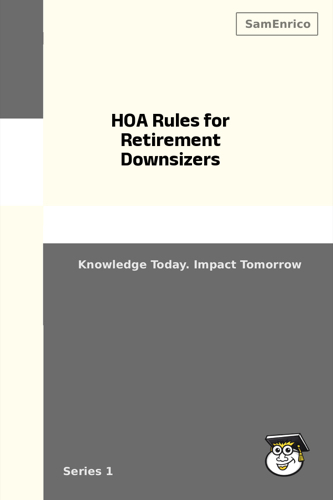
HOA Rules for Retirement Downsizers eBook
Deciphers HOA restrictions, fees, reserve funds, a
by Mize Delmer
Deciphers HOA restrictions, fees, reserve funds, and rental bans before buying into a community.
Formats
Free sample
Chapter 1: The Second Mortgage--–- When Margaret and Frank downsized from their four-bedroom colonial in the suburbs to a charming two-bedroom condo in a gated active-adult community, they thought they had finally won retirement. The community had a heated pool, a clubhouse with free coffee, and meticulously manicured grounds that Frank no longer had to mow. The monthly HOA fee was $245, which their real estate agent called “very reasonable for this area.” Margaret did the math: their Social Security checks totaled $4,200 per month. Their new mortgage was $1,100. Add $245 for the HOA, plus utilities and groceries, and they had a comfortable cushion.
They signed the papers, threw a “goodbye yard work” party, and moved in on a sunny Tuesday.Eighteen months later, Frank sat at the kitchen table with a letter in his trembling hands. The HOA board had announced a special assessment of $14,000 per unit for balcony repairs. The letter gave them forty-five days to pay. Margaret cried. Frank called the board president, who told him, “It’s in the governing documents.
You should have read them.” Frank hung up and looked at their savings account. They had $17,000 left—their entire emergency fund. They could pay the assessment, but then there would be nothing left for a new roof, a medical emergency, or the car repairs they knew were coming. They could refuse to pay, but the HOA would place a lien on their condo. If they still did not pay, the HOA could foreclose.
They were seventy-two years old, and they were trapped.This chapter exists because Margaret and Frank are not unusual. They are the rule. Every year, thousands of retirees walk into the same trap. They look at the pool, the paint colors, and the friendly neighbors. And they ignore the fine print until it is too late.
The goal of this chapter is to ensure that you are not one of them.The Great Retirement Illusion The lock-and-leave lifestyle is one of the most seductive promises in American real estate. After thirty or forty years of mowing lawns, cleaning gutters, painting siding, and shoveling snow, the idea of a community where someone else handles all of it feels like freedom. And for some retirees, in some communities, it is. But for many, the HOA becomes something far darker: a second mortgage that they never agreed to but cannot escape.Let us define that term clearly, because it will appear throughout this book. A second mortgage is traditionally a loan taken against the equity in your home.
But in the context of retirement downsizing, the Second Mortgage is something different. It is the creeping, compounding reality that HOA fees and special assessments consume such a large portion of your fixed income that they effectively function as a second house payment—one that can rise without your consent, one that you cannot refinance, and one that can lead to foreclosure if you fall behind.The numbers are staggering. According to the Foundation for Community Association Research, approximately 74 million Americans live in HOA-governed communities. The average monthly HOA fee for a condo in a major metropolitan area ranges from $300 to $700. But in high-cost regions like South Florida, the New York City suburbs, or coastal California, fees of $800 to $1,500 per month are common.
That is not a fee. That is a rent payment. And unlike a fixed-rate mortgage, which stays the same for thirty years, HOA fees have historically increased at an average rate of 4 to 6 percent annually. That is faster than Social Security Cost-of-Living Adjustments, which have averaged just 2.6 percent over the past two decades.This is the silent math that destroys retirement budgets. A retiree who buys into a community with a $350 monthly fee will, assuming a 5 percent annual increase, be paying $570 per month after ten years and $930 per month after twenty years.
Their Social Security, meanwhile, might have gone from $3,000 to $3,800 in the same period. The HOA fee consumes an ever-growing share of their income until, eventually, there is nothing left for groceries, medicine, or heat. This is not a hypothetical. It happens every day, in every state, in every type of community.Why Downsizers Are Uniquely Vulnerable Retirees who are downsizing face a perfect storm of psychological, emotional, and financial pressures that make them uniquely susceptible to HOA traps. Understanding these vulnerabilities is the first step to overcoming them.First, there is the exhaustion factor.
By the time most people decide to downsize, they have spent months or years sorting through belongings, selling a home, and managing the logistics of a move. They are tired. They want the process to be over. That exhaustion translates into a willingness to accept the first acceptable offer rather than doing the deep due diligence required to evaluate an HOA.Second, there is the amenity seduction. Developers and HOA boards know exactly what retirees want: pools, clubhouses, fitness centers, walking trails, and social activities.
These amenities are designed to create an emotional response. When you walk into a clubhouse with a fireplace and a library, when you see retirees playing cards or swimming laps, your brain releases dopamine. You feel like you are buying a lifestyle, not a contract. But the amenities are not free. You are paying for them every month, and you will continue paying for them even if you stop using them.
The heated pool that seemed so inviting on a sunny June afternoon will still cost you $200 per month in January when you are inside watching television.Third, there is the false trust bias. Retirees who are moving into age-restricted or active-adult communities often assume that because everyone is older, the governance must be reasonable. This is dangerously naive. In fact, some of the most dysfunctional HOAs are in retirement communities because they are run by busybody boards with too much time on their hands and a deep investment in the minutiae of rule enforcement. Age does not automatically produce wisdom in governance.
Sometimes it produces obsession.Fourth, there is the fixed-income math trap. Many downsizers sell a paid-off home and use the proceeds to buy a smaller home with little or no mortgage. They see that they will have no house payment, and they assume that an HOA fee of a few hundred dollars is trivial compared to the mortgage they used to pay. What they fail to calculate is that a mortgage eventually ends. An HOA fee never does.
And while a mortgage payment is fixed for thirty years, an HOA fee rises every year. A retiree who buys into a community at age sixty-seven with no mortgage but a $400 HOA fee will, by age eighty-two, be paying over $800 per month. That money must come from somewhere.Fifth, there is the advice gap. Most real estate agents are not trained to analyze HOA financials. Most home inspectors do not look at reserve studies.
Most attorneys review contracts but do not dig into meeting minutes. The retiree is left alone to make sense of hundreds of pages of legal and financial documents that even professionals find dense. And when they cannot understand them, they sign anyway, trusting that it will probably be fine.It will not probably be fine. It will be exactly what the documents…
This is the end of the free sample. Get the eBook to keep going. Buy now
About this book
Details
- Author
- Mize Delmer
- Publisher
- SamEnrico
- Language
- English
- Genre
- Non-Fiction, Business Brief, HOA Management
- Released
- 2026-06-10
- Pages (approx.)
- 136
- Available as
- eBook, Audiobook

Read better in the ZLOADR app
Your eBooks on your phone or tablet. Sign in with your SamEnrico account and start reading.
More by Mize Delmer
 The Foster Mother Who CaredMize Delmer$11.99
 Time Boxing TechniqueMize Delmer$11.99
 Remote Work Exercise ScheduleMize Delmer$11.99
 Memory Book CreationMize Delmer$11.99
 Remote Meeting Efficiency GuideMize Delmer$11.99
 Protest Small Talk GuideMize Delmer$11.99
 Personal Branding for Physical TherapistsMize Delmer$11.99
 The Poisoned Chalice: The Assassination of a Saudi PrinceMize Delmer$11.99
 The Broken Seas: How the Dutch Shattered the Spanish Armada's HeirsMize Delmer$11.99
 How to Produce Lint RollersMize Delmer$11.99
 How to Start a Coffee Business (Beginners Guide)Mize Delmer$11.99
 Warranty Disclaimer ClauseMize Delmer$12.99
You may also like
 Hong Kong Handover 1997Dunn Johnnie$11.99
 Zumba For Postnatal Recovery CourseNeal Christian$11.99
 Zumba for BeginnersLadner Nikia$11.99
 YouTube Comment Mining GuideHumes Pandora$12.99
 Worry Box MeditationCarlin Rudy$11.99
 Workplace Stress MeditationNguyen Lynn$11.99
 Workplace Stress and Sleep RepairHawley Ivory$11.99
 Workplace Perfectionism CureDelaney Jeffry$11.99
 Workplace Injustice Anger GuideWallen Isabelle$11.99
 Work Addiction and Burnout LinkGreenwood Ester$11.99
 Women in Yoga and WellnessBeattie Galina$11.99
 Women in Stand Up ComedyChun Evangeline$11.99