
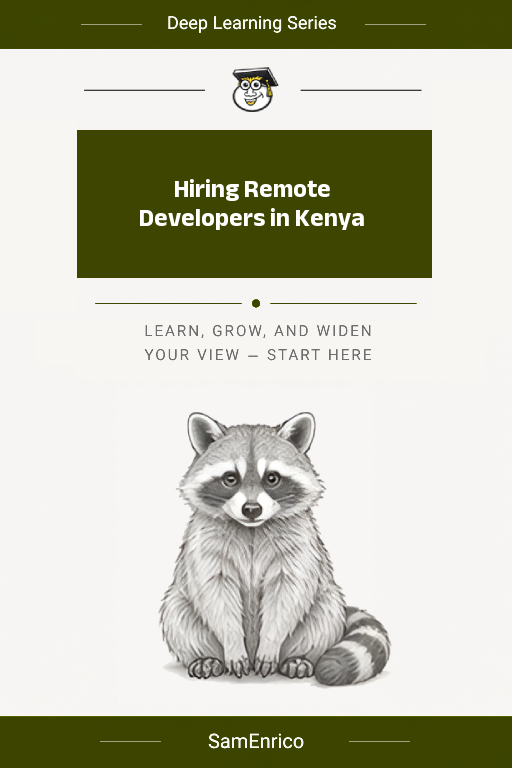
Non-FictionBusiness BriefGlobal Talent
Hiring Remote Developers in Kenya eBook
Build a compliant remote engineering team in Nairo
by Mcneal Soo
Build a compliant remote engineering team in Nairobi and beyond covering talent pools, salary benchmarks, and local labor laws.
Formats
Free sample
Chapter 1: The Invisible Goldmine--For three years, Marcus believed he had cracked the code on global hiring. His San Francisco-based fintech startup had raised $10 million in Series A funding, and like any responsible CTO, he needed to stretch every dollar. The answer, he had convinced himself, was outsourcing engineering to low-cost regions. He tried India – too saturated. He tried Eastern Europe – time zone nightmare.
Then a recruiter pitched him on Kenya. "English-speaking, tech-savvy, and half the price of Eastern Europe," the pitch deck promised. Marcus signed the contract within a week.Twelve months later, his company was hemorrhaging money. Not on salaries – those were indeed low. But on everything else.
A lawsuit from a former Kenyan developer who claimed constructive dismissal. Back taxes and penalties from the Kenya Revenue Authority that froze his company's M-Pesa account. A CTO who quit because the "Nairobi team has no loyalty and the code is a mess." By the time Marcus liquidated that entity, he had burned $2.8 million on legal fees, penalties, and replacement hiring. His board's verdict: "You didn't hire in Kenya. You committed accidental fraud."Marcus's mistake wasn't that he hired Kenyans.
His mistake was that he hired them without a system. He treated Kenya like a vending machine – insert dollars, receive code – and got exactly what he deserved: chaos, liability, and failure.This book exists because Marcus's story is not an exception. It is the rule. And it is completely avoidable.The Myth That Costs Millions Every week, somewhere in the world, a founder opens a spreadsheet and highlights Kenya as a line item. "Average developer salary: 3,000permonth,"theycalculate."Sameskillsasa3,000 per month," they calculate.
"Same skills as a 3,000permonth,"theycalculate."Sameskillsasa15,000 US developer. Let's hire five."This is the Cost Arbitrage Fallacy – the belief that Kenya is simply a cheaper version of Silicon Valley. It is wrong. Dangerously wrong.Kenya is not a discount bin. It is a different country with different laws, different cultural norms, different infrastructure realities, and a different relationship to work.
The companies that succeed in Kenya – and there are many – don't succeed because they pay less. They succeed because they understand what Kenya actually offers: high-agency engineering talent that thrives under ambiguity, but requires structure, respect, and compliance to perform.The companies that fail? They treat Kenya as a transaction. They pay poverty wages, misclassify employees as contractors, ignore labor laws, and then complain that "Kenyan developers are unreliable." The irony is that those same developers, when hired properly by competitors, become their most loyal and productive engineers.Consider two companies, both hiring in Nairobi in the same month of 2023.Company A (the Marcus approach): Hired six developers as "contractors" at $8 per hour. No written contracts.
No payroll taxes. No health insurance. No laptop stipend. Communication via Whats App only. The developers were given tickets and told to "ship code."Six months later: three developers had quit without notice.
One had filed a complaint with the Kenyan Ministry of Labour claiming employee benefits. The remaining two were still coding, but their quality had deteriorated. A post-mortem revealed they had been working two other remote jobs simultaneously because Company A offered no career growth, no benefits, and no loyalty. Company A spent 200,000onsalariesand200,000 on salaries and 200,000onsalariesand400,000 on fixing the resulting technical debt. They pulled out of Kenya within a year.Company B: Hired the same number of developers as employees, not contractors.
They paid 30% above local market rates – still 60% below US rates – but provided a written contract, statutory benefits (PAYE, NSSF, SHIF), a company laptop, an internet stipend, and Sacco membership. They hired a Local Chapter Lead in Nairobi to handle compliance and culture. They integrated the Kenyan team into sprint planning, code reviews, and product roadmap discussions.Six months later: all six developers were still there. Two had been promoted to team leads. The team had referred four additional high-quality engineers.
Code quality was indistinguishable from the US team. Company B's burn rate was 70% lower than if they had hired in San Francisco, and their retention rate was actually higher than their US team. They expanded to fifteen developers within eighteen months.The difference between Company A and Company B is not talent. The talent pool was identical. The difference is framework.
Company B had a system. Company A had assumptions.The Demographic Dividend You Cannot Ignore Kenya is young. Not "young" in the way that an aging Western country calls itself "young" because the average age is 38. Kenya is young – median age 20.7 years old, according to the 2019 census. That means half of Kenya's 55 million people are under twenty-one years old.This is not a statistic.
It is a labor market tsunami.Consider what it means to grow up in Kenya as a twenty-year-old today. You have never known a world without mobile money – M-Pesa launched in 2007, when you were two years old. You have never known a world without ubiquitous smartphones – the Android explosion hit Kenya in 2012, when you were seven. You have never known a world without remote work as a viable career path – the global shift accelerated in 2020, when you were a teenager.But you have also never known a world with reliable infrastructure. You have experienced:Power blackouts (load shedding) every week, sometimes multiple times per day Internet that cuts out during rainstorms or when a backhoe digs in the wrong place Delayed payments from employers who "forget" or "have cash flow issues"University curricula that teach Java 6 while the industry uses Python 3.11A job market where a degree guarantees nothing and self-taught skills guarantee everything This combination – digital nativity plus infrastructure adversity – produces a specific kind of engineer.
Not the kind who needs perfect requirements, stable APIs, and a hand-holding manager. The kind who has already debugged a production issue at 2am during a power outage using a mobile hotspot and a laptop running on battery backup. The kind who learned Kubernetes because the documentation was incomplete and they had to figure it out. The kind who says "I'll find a way" instead of "that's not possible."This is kujipanga – the Swahili word that roughly translates to "self-arrangement" or "resourcefulness." It is not a skill you can teach. It is a survival mechanism forged by necessity.
And it is the single most underrated quality in global engineering talent today.Western companies spend millions teaching "growth mindset" and "agile problem-solving." Kenyan developers arrive with it already installed.Nairobi vs. Lagos vs. Cape Town: A Strategic Comparison If you have searched for "remote developers Africa," you have probably seen the same three names: Nairobi, Lagos, and Cape Town. Each has strengths. But for most Western companies – particularly US-based startups – Nairobi is the optimal choice.
Here is why.Lagos, Nigeria: The largest talent pool on the continent. An estimated 80,000+ developers. Deep expertise in fintech (Paystack, Flutterwave alumni) and mobile (Android dominates). English is official, but Nigerian Pidgin and local accents can create communication friction. The bigger problem is infrastructure: Lagos traffic is legendary (a 10km commute can take 2 hours), power outages are severe, and the regulatory environment is unpredictable.
Nigeria's central bank has restricted foreign currency access multiple times in recent years, making it difficult to pay developers reliably. Time zone is UTC+1 –…
This is the end of the free sample. Get the eBook to keep going. Buy now
About this book
Details
- Author
- Mcneal Soo
- Publisher
- SamEnrico
- Language
- English
- Genre
- Non-Fiction, Business Brief, Global Talent
- Released
- 2026-05-29
- Pages (approx.)
- 146
- Available as
- eBook, Audiobook

Read better in the ZLOADR app
Your eBooks on your phone or tablet. Sign in with your SamEnrico account and start reading.
More by Mcneal Soo
 Emotion Exposure Therapy GuideMcneal Soo$11.99
 Fox News Empire BuildingMcneal Soo$11.99
 Baal Shem Tov The FounderMcneal Soo$11.99
 Prioritization for IT ProfessionalsMcneal Soo$11.99
 Tradition One to Twelve HandbookMcneal Soo$11.99
 Echoes of the First Dawn: The Prehistoric Dreamers of the AndesMcneal Soo$11.99
 Sylvanite MiningMcneal Soo$11.99
 Understanding Blepharophimosis Syndrome Ohdo TypeMcneal Soo$17.99
 Amazon FBM Versus FBA DecisionMcneal Soo$12.99
 How to Start a Poultry Packing Business (Beginners Guide)Mcneal Soo$11.99
You may also like
 Hong Kong Handover 1997Dunn Johnnie$11.99
 Zumba For Postnatal Recovery CourseNeal Christian$11.99
 Zumba for BeginnersLadner Nikia$11.99
 YouTube Comment Mining GuideHumes Pandora$12.99
 Worry Box MeditationCarlin Rudy$11.99
 Workplace Stress MeditationNguyen Lynn$11.99
 Workplace Stress and Sleep RepairHawley Ivory$11.99
 Workplace Perfectionism CureDelaney Jeffry$11.99
 Workplace Injustice Anger GuideWallen Isabelle$11.99
 Work Addiction and Burnout LinkGreenwood Ester$11.99
 Women in Yoga and WellnessBeattie Galina$11.99
 Women in Stand Up ComedyChun Evangeline$11.99