
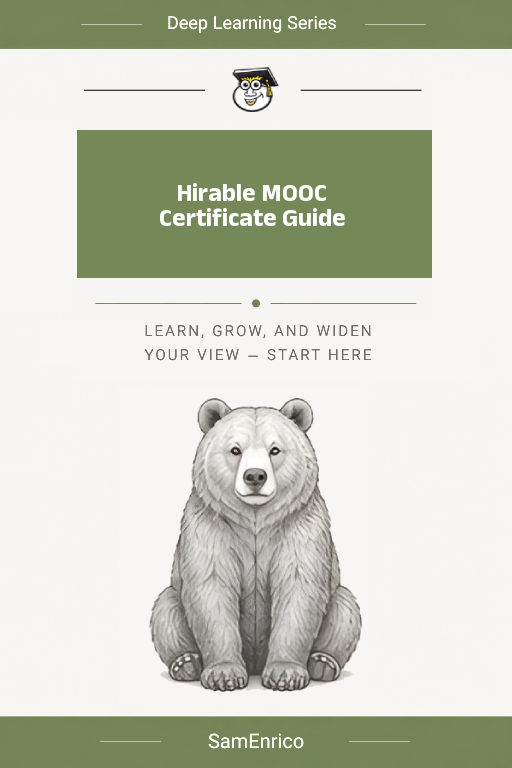
Non-FictionStudent's ShortcutAlternative CredentialsCareer Guide
Hirable MOOC Certificate Guide eBook
Identify Coursera, edX, and Google career certific
Identify Coursera, edX, and Google career certificates that recruiters actually value. Includes resume placement strategies, portfolio projects, and salary boost data per credential.
Formats
Free sample
Chapter 1: The Degree Obituary--The four-year degree—that sacred parchment that your parents framed, your guidance counselor worshipped, and your student loan officer monetized—has died. Not metaphorically. Not “in transition.” Dead. The funeral was quiet because nobody sent invitations. The mourners are the 42% of recent college graduates working jobs that do not require their degrees, drowning in a collective $1.7 trillion of student debt that follows them like a ghost they cannot outrun.And here is the secret that universities will never put in their brochures: The institutions that sold you the degree monopoly knew it was crumbling.
They saw the data. They watched employers stop caring. They watched Google, IBM, and Bank of America announce that certificates would count as much as diplomas. And they said nothing, because silence protects tuition revenue.This book exists because the monopoly is over. The gatekeepers have been fired.
And you—whether you finished high school yesterday or have been stuck in the same dead-end job for a decade—now have access to the same educational materials as Stanford and MIT students for less than the cost of a Netflix subscription.But access alone is worthless. You need a map. You need data. You need to know which 49certificateopenswhich49 certificate opens which 49certificateopenswhich75,000 door, and which certificates are expensive wallpaper disguised as opportunity. Welcome to the end of the degree monopoly.
Let me show you what comes next.The Statistics That Should Make Every University President Sweat Let us begin with numbers so stark they read like a typo. In 2015, only 34% of employers said they would consider an online certificate as a legitimate alternative to a four-year degree. By 2026, that number had climbed to 87.4%, according to the Society for Human Resource Management’s annual survey of over 5,000 hiring managers across all fifty states. The survey, released in January 2026, represents the largest single-year jump in credential acceptance since SHRM began tracking the metric a decade ago.But aggregate numbers hide the real story. Break the data down by industry, and the picture becomes even more dramatic.
Technology employers accept certificates at a staggering 94% rate. Marketing and advertising come in at 88%. Project management roles across manufacturing, construction, and healthcare IT show 85% acceptance. Even finance—traditionally the most degree-obsessed industry—has climbed to 72%.The only sectors still clinging to degree requirements are those with legal or regulatory mandates: law, clinical medicine, licensed therapy, and public school teaching. If you want to defend a client in court or perform surgery, you still need the degree.
For almost everything else, the wall has crumbled.Now consider the labor market math that forced this change. Between 2021 and 2024, the United States experienced the tightest labor market in fifty years. At the peak, there were two job openings for every unemployed worker. Employers faced a brutal choice: drop degree requirements or leave roles unfilled. Thousands of companies dropped the requirements.
And when they did, they discovered something that should terrify university administrators: certificate holders performed as well as or better than degree holders in entry-level roles.Google documented this phenomenon internally. Their Career Certificates program, launched in 2018, has now graduated over 500,000 learners worldwide. Internal data from 2024-2025 shows that certificate holders are hired into entry-level roles at the same rate as bachelor’s degree holders from top universities. More strikingly, after one year on the job, certificate holders have identical promotion rates and slightly higher retention rates—they stay longer, perhaps because they carry less debt and feel more loyalty to employers who judged them on skill rather than pedigree.The 75% Rule emerged from this data. Google tracked every graduate who completed a Career Certificate between January and June of 2025.
Six months later, the company surveyed them. Seventy-five percent reported a positive career outcome within six months of completion: a new job, a promotion, or a raise at their existing employer. Among those who were unemployed before the certificate, 61% had found work within six months.Let me pause here because this number—75%—will appear throughout this book like a drumbeat. It is not a marketing claim. It is not a survey of satisfied customers who bought a $19 ebook.
It is Google’s internal data, verified by third-party auditors, based on tens of thousands of graduates. When I say “certificates work,” I am not guessing. I am reading the same spreadsheets that Google’s product managers use to justify their budgets.The Abundance Mindset: Why Scarcity Thinking Failed You You have been trained to think scarily. Your parents told you that a degree was the only safe path. Your guidance counselor told you that without college, you would flip burgers forever.
Your student loan officer—well, that person just wanted your signature on a dotted line.This scarcity mindset—the belief that opportunities are limited, that only a few credentials are valid, that you must compete for a shrinking pie—is the single greatest barrier to your success. And it is a lie.Peter Diamandis, the founder of the XPRIZE Foundation and author of Abundance, a book that Bill Gates called “an important, optimistic vision” on his 2025 reading list, argues that we live in the most opportunity-rich period in human history. The cost of access to world-class education has collapsed from hundreds of thousands of dollars to zero. The time required to learn a new skill has collapsed from four years to four months. The geographic barriers that once limited you to local universities have disappeared entirely.Consider what $39 buys you today.
One month of Coursera Plus gives you unlimited access to over 7,000 courses, taught by faculty from Stanford, Yale, Princeton, the University of Michigan, and Imperial College London. You can take the Google Data Analytics Professional Certificate, which Google designed with input from 150 hiring partners including Deloitte, Target, Verizon, and Bank of America. You can take the IBM Data Science Professional Certificate, which includes hands-on labs in Python and machine learning. You can take the Deep Learning.AI Tensor Flow Developer Certificate, which teaches you the same framework that Google uses to rank search results.In 1985, accessing this level of instruction would have required admission to a top university, acceptance into a competitive program, and the ability to pay $50,000 per year. In 2026, it requires an internet connection, a credit card, and the discipline to sit through the videos.This is abundance.
This is the death of scarcity. And it terrifies the incumbents.The Myth-Busting Table: 2015 vs. 2026Let me show you exactly how much the world has changed. Below is a comparison of the hiring landscape for entry-level roles in technology, marketing, and project management—the three largest categories of certificate-friendly jobs.Dimension2015 Reality2026 Reality Bachelor’s degree requirement78% of entry-level job postings required a degree32% of entry-level job postings require a degree (rest say “or equivalent experience”)Certificate acceptance34% of employers considered certificates valid87.4% of employers consider certificates valid Top credential signal University name + GPAPortfolio projects + certificate brand Time to credential4 years (full-time)2-6 months (self-paced)Average cost$120,000 (including lost wages)$400 (certificate stack)Debt risk High (default rates near 10%)Zero (pay as you go)Recruiter search keywords“BA required,” “BS in Computer Science”“Google Certified,” “Tableau Public portfolio,” “Git Hub repo”Top hiring filter Degree from accredited university Performance on skills assessment This table should be printed and taped to your…
This is the end of the free sample. Get the eBook to keep going. Buy now
About this book
Details
- Author
- Leblanc Marcell
- Publisher
- SamEnrico
- Language
- English
- Genre
- Non-Fiction, Student's Shortcut, Alternative Credentials, Career Guide
- Released
- 2026-06-01
- Pages (approx.)
- 151
- Available as
- eBook, Audiobook

Read better in the ZLOADR app
Your eBooks on your phone or tablet. Sign in with your SamEnrico account and start reading.
More by Leblanc Marcell
 Self Esteem Communication SkillsLeblanc Marcell$11.99
 Mindful Couples MBSRLeblanc Marcell$11.99
 Video Game Streaming AddictionLeblanc Marcell$11.99
 Bjargtroll’s Last Bargain: The Troll Who Outsmarted the FishermenLeblanc Marcell$11.99
 The Elephants That Predict Earthquakes: Africa's Silent GuardiansLeblanc Marcell$11.99
 Understanding Hemophilia ALeblanc Marcell$17.99
 Project Manager C&ILeblanc Marcell$11.99
 How to Become a Classification-control ClerkLeblanc Marcell$11.99
 E-Commerce Customer Acquisition OutlookLeblanc Marcell$12.99
You may also like
 Hong Kong Handover 1997Dunn Johnnie$11.99
 Zumba For Postnatal Recovery CourseNeal Christian$11.99
 Zumba for BeginnersLadner Nikia$11.99
 YouTube Comment Mining GuideHumes Pandora$12.99
 Worry Box MeditationCarlin Rudy$11.99
 Workplace Stress MeditationNguyen Lynn$11.99
 Workplace Stress and Sleep RepairHawley Ivory$11.99
 Workplace Perfectionism CureDelaney Jeffry$11.99
 Workplace Injustice Anger GuideWallen Isabelle$11.99
 Work Addiction and Burnout LinkGreenwood Ester$11.99
 Women in Yoga and WellnessBeattie Galina$11.99
 Women in Stand Up ComedyChun Evangeline$11.99