
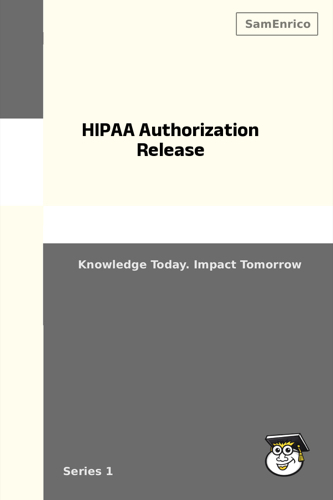
Non-FictionHealth & WellnessHIPAA
HIPAA Authorization Release eBook
Allow family access to medical records and provide
Allow family access to medical records and provider discussions.
Formats
Free sample
Chapter 1: The Silence Wall--–- The phone felt cold against Sarah’s ear. She had been holding it for seventeen minutes, listening to the same hospital hold music loop for the fifth time. Her father, a 78-year-old retired teacher with a kind face and worsening dementia, had been admitted to the emergency room three hours ago after a fall. A neighbor had called an ambulance. Sarah lived two states away.
She had dropped everything, thrown clothes into a bag, and was already on the highway when she dialed the hospital’s main number.Finally, a click. A woman’s voice, clipped and efficient: “Memorial Hospital, fourth floor nursing station.”“Hi,” Sarah said, gripping the steering wheel tighter. “My name is Sarah Collins. My father, Robert Collins, was brought in by ambulance a few hours ago. I’m trying to get an update on his condition.”A pause.
The sound of keyboards clicking in the background. Then the words that would change everything: “Ms. Collins, I’m sorry, but I can’t confirm or deny that Mr. Collins is a patient here.”Sarah blinked. “What?”“HIPAA regulations,” the nurse said, as if that single word explained everything.
“I cannot release any information without the patient’s written authorization.”“He has dementia,” Sarah said, her voice rising. “He can’t authorize anything right now. I’m his daughter. I’m his only family.”“I understand, ma’am. But without a signed authorization form on file, I cannot discuss his condition, his location, or even confirm that he’s here.”“Then just tell me if he’s alive.”The nurse’s voice softened slightly, but the answer did not.
“I can’t. You’ll need to speak to our privacy officer on Monday.”Monday. Her father was inside that building, right now, possibly bleeding, possibly confused, possibly alone—and Sarah could not even get a yes or no. She pulled her car to the side of the highway and wept.This is not a worst-case scenario. This is an everyday story.
It happens thousands of times across the United States every single week. Spouses are hung up on. Adult children are turned away at ICU doors. Loving partners who have shared decades of life together are told that blood, marriage, and devotion mean nothing without a piece of paper.And the shield that hospitals hide behind is a four-letter word: HIPAA.The Law That Was Supposed to Help The Health Insurance Portability and Accountability Act—HIPAA—was signed into law in 1996. Its original purposes were noble and necessary.
Before HIPAA, there were no federal standards protecting the privacy of medical records. Your health information could be faxed to the wrong number, sold to marketing companies, or discussed loudly in waiting rooms without any legal consequence. HIPAA created, for the first time, a national floor of privacy protections. It gave patients the right to see their own records, request corrections, and know who had accessed their information.That was the intention.What actually happened, in the decades that followed, was something else entirely. Hospitals, terrified of massive fines (up to $1.9 million per violation), built walls that the law never required.
They trained staff to say “HIPAA” as a reflexive denial, a magic word that ends conversations, a shield against anything that might create risk. They buried patient rights in fine print. They made it easier to say no than to say yes.And families—the very people who provide 80% of long-term care in America—were locked outside.The Anatomy of a Lockout To understand why Sarah’s call ended in tears, we have to understand the core legal mechanism that separates families from their loved ones. It is called the HIPAA Privacy Rule, codified at 45 CFR Part 160 and Subparts A and E of Part 164. Within that dense regulatory text lies a simple, brutal principle: A covered entity (a hospital, doctor, or health plan) may not use or disclose protected health information (PHI) without the patient’s written authorization.That word—“may not”—is absolute.
It does not say “should not” or “generally avoids.” It says “may not.” The penalty for violating this rule can reach $50,000 per violation, with an annual maximum of $1.5 million for identical violations. In extreme cases, criminal penalties can include prison time.Now, place yourself in the shoes of a hospital privacy officer. You have a staff of nurses who are overworked, underpaid, and not lawyers. You have a legal department that has warned you, repeatedly, that any unauthorized disclosure could trigger an investigation by the Office for Civil Rights (OCR). You have a compliance manual that runs hundreds of pages.
And you have a family member on the phone, desperate for information, with no paperwork on file.What do you do?If you are rational and risk-averse, you say no. You say HIPAA. You hang up. You protect the hospital. You let the family suffer.This is not malice.
This is the predictable outcome of a system that punishes disclosure and never punishes silence. No hospital has ever been fined for being too cautious. Hundreds of hospitals have been fined—millions of dollars—for unauthorized disclosures. The incentive structure is brutally clear: silence is safe. Speech is dangerous.The Minimum Necessary Trap There is another provision of the Privacy Rule that makes family access even harder: the Minimum Necessary Standard.
Under 45 CFR 164.502(b), when a covered entity makes a disclosure that is permitted (not required), it must make a “reasonable effort” to limit the information disclosed to the “minimum necessary” to accomplish the intended purpose.This sounds reasonable on paper. In practice, it becomes a cudgel.Consider a simple scenario: A daughter calls to ask if her mother’s surgery went well. The nurse has the chart open. The surgery was successful. The daughter is listed as the emergency contact.
Under a common-sense reading of the law, the nurse could say, “The surgery went fine and your mother is in recovery.”But the Minimum Necessary Standard introduces uncertainty. Was the daughter’s question specific enough? Does she need to know about the minor complication that was resolved? Does she need to know the exact blood pressure readings? The nurse, uncertain, defaults to the safest answer: silence.Some hospitals have institutionalized this fear.
They have created internal policies that forbid any disclosure—even to a patient’s spouse—without a signed, witnessed, notarized authorization form on file. They require separate forms for each visit, each hospitalization, each department. They make the process so burdensome that families simply give up.And that, more than any legal requirement, is the true barrier: exhaustion.Your Two Different Rights Before we go any further, we must make a distinction that will frame the rest of this book. It is a distinction that most families—and, frankly, most hospital staff—do not fully understand.Right of Access refers to a patient’s right to obtain a copy of their own medical records. This right is guaranteed by HIPAA and enforced by strict deadlines.
Under 45 CFR 164.524, a covered entity must respond to a patient’s request for access within 30 days (with a possible one-time 30-day extension). The patient can receive records in paper, electronic, or…
This is the end of the free sample. Get the eBook to keep going. Buy now
About this book
Details
- Author
- Linkous Lindsy
- Publisher
- SamEnrico
- Language
- English
- Genre
- Non-Fiction, Health & Wellness, HIPAA
- Released
- 2026-06-07
- Pages (approx.)
- 145
- Available as
- eBook, Audiobook

Read better in the ZLOADR app
Your eBooks on your phone or tablet. Sign in with your SamEnrico account and start reading.
More by Linkous Lindsy
 Medicine Ball HIIT GuideLinkous Lindsy$11.99
 Self Exclusion From Casinos GuideLinkous Lindsy$11.99
 Gambling Addiction And Housing LossLinkous Lindsy$11.99
 Cocaine and Crack Cocaine DifferencesLinkous Lindsy$11.99Cocaine and Crack Cocaine DifferencesLinkous Lindsy$11.99
 Teen Self Esteem PodcastLinkous Lindsy$11.99
 Journaling for Emotional HealthLinkous Lindsy$11.99
 Grief and Faith After Baby LossLinkous Lindsy$11.99
 Whispers in the Wind: The Navajo Skinwalker’s CurseLinkous Lindsy$11.99
 How to Produce Drums, Pails and BarrelsLinkous Lindsy$11.99
 A Collector's Handbook to the Renault 15Linkous Lindsy$11.99
 Polish Student Job GuideLinkous Lindsy$12.99
You may also like
 Hong Kong Handover 1997Dunn Johnnie$11.99
 Zumba For Postnatal Recovery CourseNeal Christian$11.99
 Zumba for BeginnersLadner Nikia$11.99
 YouTube Comment Mining GuideHumes Pandora$12.99
 Worry Box MeditationCarlin Rudy$11.99
 Workplace Stress MeditationNguyen Lynn$11.99
 Workplace Stress and Sleep RepairHawley Ivory$11.99
 Workplace Perfectionism CureDelaney Jeffry$11.99
 Workplace Injustice Anger GuideWallen Isabelle$11.99
 Work Addiction and Burnout LinkGreenwood Ester$11.99
 Women in Yoga and WellnessBeattie Galina$11.99
 Women in Stand Up ComedyChun Evangeline$11.99