
Non-FictionHealth & WellnessGroup Fitness
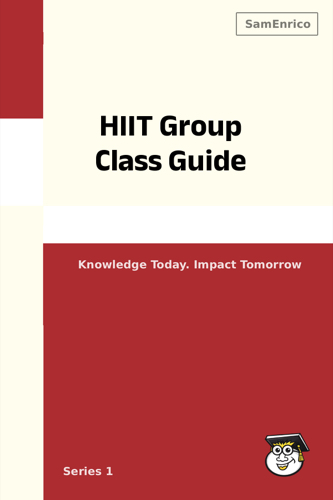
HIIT Group Class Guide eBook
Lead or join safe, motivating interval sessions wi
Lead or join safe, motivating interval sessions with proper timing and encouragement.
Formats
Free sample
Chapter 1: The Oxygen Lie--Every new HIIT instructor makes the same mistake. They believe that more work equals better results. They push their classes harder, shorten rest intervals, add more burpees, and watch proudly as participants collapse onto their mats, gasping for air. Then they post the sweaty aftermath on Instagram with the caption: “No days off.”This is not good coaching. This is hazard.The author learned this lesson the hard way during his third year of teaching.
He designed a “hero workout” – twenty minutes of 40-second sprints with only 10 seconds of rest between each. The class was packed. The energy was electric. Three minutes in, a woman in the front row turned pale, stood up too quickly, and collapsed face-first onto a medicine ball. She wasn’t unconscious, but she couldn’t see straight for twenty minutes.
Her blood pressure had dropped so rapidly that her brain briefly starved of oxygen. The author had created a workout so intense, so poorly structured, that his participants were literally fainting.That night, he realized something uncomfortable: most HIIT certifications teach exercise science, but almost none teach the physiology of recovery. They teach you how to push. They don’t teach you when to stop.This chapter fixes that. You will learn what actually happens inside the body during high-intensity intervals, why rest is not a reward but a biological requirement, and how to read the invisible signals your participants are sending you – without heart rate monitors, without expensive technology, and without putting anyone in danger.By the end of this chapter, you will never again design a workout that makes someone faint.
You will understand the difference between productive suffering and dangerous distress. And you will have a simple, equipment-free tool to gauge intensity in real time, even in a room of thirty people moving at different speeds.Welcome to the physiology of the HIIT class. It is not about how hard you can push. It is about how well you manage the space between pushes.The Three-Second Rule That Changes Everything Before we dive into EPOC, lactate thresholds, and heart rate recovery, let me give you the single most practical takeaway of this entire chapter. You can use it tomorrow.The Talk Test.Here is how it works: during any rest interval in your class, you should be able to look at any participant and ask, “How are you doing?” and they should be able to respond with a short sentence – not a single word, not a grunt, but a full sentence like “This is hard but I’m okay” or “I need a little more time.”If they cannot speak a short sentence, they are in the danger zone.
Their body is so deep in oxygen debt that their brain has begun to prioritize breathing over everything else – including decision-making, balance, and form. This is when injuries happen. This is when people faint. This is when knees cave, backs round, and shoulders impinge.The talk test is not a loose suggestion. It is a validated measure of exercise intensity, studied extensively in sports science literature.
Research published in the Journal of Sports Sciences found that the talk test correlates strongly with ventilatory threshold – the point at which breathing becomes unsustainable. In plain English: when someone can’t talk, they are one step away from breaking down.Here is how you use the talk test in a group setting:During the first rest interval of class, pick two or three participants at random and ask a question. “Sarah, how are those squats feeling?” “Marcus, are you finding the rhythm?”If they answer with a full sentence, keep the current work-rest ratio.If they answer with a single word (“Fine,” “Hard,” “Okay”), the rest interval is too short or the work interval is too long.If they cannot answer at all, stop the interval immediately. Move to active recovery.This is not a sign of weakness. It is a sign of smart coaching.
The best instructors in the world use the talk test because it requires no technology, works for every fitness level, and prevents the most common cause of HIIT injuries: pushing past the point of safe return.Now, let’s understand why the talk test works. To do that, we have to go inside the cell.EPOC: The Afterburn Myth (And Why It Matters)Every HIIT instructor has heard of EPOC. Excess Post-Exercise Oxygen Consumption. The “afterburn effect.” It is the reason HIIT is marketed as a fat-loss miracle: you burn calories during the workout, and then your body continues burning calories for hours afterward as it returns to homeostasis.Here is what most instructors get wrong about EPOC. They assume that more EPOC is always better.
They think that if a little intensity creates a little afterburn, a lot of intensity creates a lot of afterburn. This is technically true – but dangerously incomplete.EPOC is not free. It comes at a cost.When you push your participants into extreme oxygen debt, their bodies must work harder afterward to restore balance. They need to replenish ATP (the energy currency of the cell), clear lactate, re-oxygenate blood, and lower body temperature. This process burns calories.
It also creates fatigue, inflammation, and – if repeated too frequently – overtraining syndrome.The key insight is this: EPOC has diminishing returns. The difference in afterburn between a well-managed HIIT session (say, 40 seconds of work followed by 20 seconds of rest) and an extreme session (40 seconds of work followed by 10 seconds of rest) is relatively small. But the difference in injury risk, participant dropout, and class enjoyment is enormous.Consider the research. A study published in Medicine & Science in Sports & Exercise compared moderate-intensity continuous training to high-intensity interval training with varying rest periods. The researchers found that while shorter rest periods increased EPOC slightly, they also increased perceived exertion dramatically – and participants in the short-rest group reported significantly lower enjoyment and intention to continue training.In other words, the marginal calorie benefit of crushing your class is not worth the cost of them never coming back.So what should you actually do with EPOC as an instructor?
You should understand it as a byproduct of good training, not a goal of training. Your job is not to maximize afterburn. Your job is to create a sustainable, safe, effective workout that participants will attend again next week. The EPOC will take care of itself.Rest Intervals Are Not Breaks. They Are Training Tools.The single most common mistake new HIIT instructors make is treating rest intervals as dead time.
They glance at their stopwatch, count down from ten, and yell “Three, two, one, go!” without any understanding of what is actually happening in their participants’ bodies during those precious seconds of recovery.Rest intervals are not breaks. They are active physiological processes that determine whether the next work interval is productive or destructive.Let me explain what happens during a rest interval in a properly designed HIIT class.Seconds 0-5 (Immediate recovery): Your participant stops moving. Blood continues to flow rapidly through their muscles. Their heart rate is still near its peak. Oxygen debt is maximal.
In these first few seconds, the body begins to clear metabolic byproducts – primarily hydrogen ions that cause the burning…
This is the end of the free sample. Get the eBook to keep going. Buy now
About this book
Details
- Author
- Escobedo Deirdre
- Publisher
- SamEnrico
- Language
- English
- Genre
- Non-Fiction, Health & Wellness, Group Fitness
- Released
- 2026-06-09
- Pages (approx.)
- 144
- Available as
- eBook, Audiobook

Read better in the ZLOADR app
Your eBooks on your phone or tablet. Sign in with your SamEnrico account and start reading.
More by Escobedo Deirdre
 Workplace Empathy GuideEscobedo Deirdre$11.99
 Twelve Step Serenity Prayer GuideEscobedo Deirdre$11.99
 The OCD Mental Ritual GuideEscobedo Deirdre$11.99
 Oboist Reed Making ArtistryEscobedo Deirdre$11.99
 The Silk and Science Dynasty: How Black Geniuses Wove the Future of FashionEscobedo Deirdre$11.99
 The Breeder's Guide to Jacob SheepEscobedo Deirdre$11.99
 Design Tool Free to PaidEscobedo Deirdre$12.99
 Customer Support RetentionEscobedo Deirdre$12.99
 HGV DriverEscobedo Deirdre$11.99
 How to Start a Blood Processing Business (Beginners Guide)Escobedo Deirdre$11.99
You may also like
 Hong Kong Handover 1997Dunn Johnnie$11.99
 Zumba For Postnatal Recovery CourseNeal Christian$11.99
 Zumba for BeginnersLadner Nikia$11.99
 YouTube Comment Mining GuideHumes Pandora$12.99
 Worry Box MeditationCarlin Rudy$11.99
 Workplace Stress MeditationNguyen Lynn$11.99
 Workplace Stress and Sleep RepairHawley Ivory$11.99
 Workplace Perfectionism CureDelaney Jeffry$11.99
 Workplace Injustice Anger GuideWallen Isabelle$11.99
 Work Addiction and Burnout LinkGreenwood Ester$11.99
 Women in Yoga and WellnessBeattie Galina$11.99
 Women in Stand Up ComedyChun Evangeline$11.99