
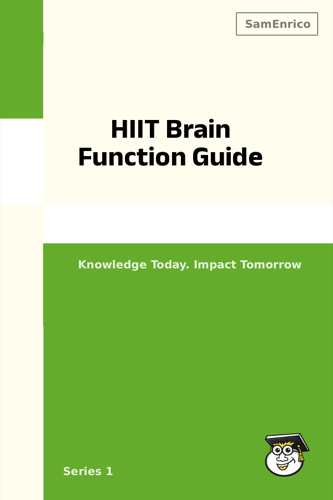
HIIT Brain Function Guide eBook
Improve BDNF, memory, and focus with regular high-
by Berlin Dino
Improve BDNF, memory, and focus with regular high-intensity interval training.
Formats
Free sample
Chapter 1: The Sedentary Betrayal--–- Every morning, you wake up, pour coffee, and sit in traffic. Then you sit at a desk. Then you sit through a meeting. Then you sit for lunch. Then you sit back at your desk.
Then you sit in traffic again. Then you sit for dinner. Then you sit on the couch. Then you lie down to sleep, only to repeat the same vertical paralysis tomorrow.Your body has done exactly what evolution asked of it: it conserved energy, avoided unnecessary risk, and kept you safe. But your brain has paid a quiet, invisible price for all that safety.
Somewhere in the last fifty thousand generations, you inherited a nervous system designed for pursuit, escape, and explosive action. And now you are feeding it a diet of stillness. The result is not just weight gain or cardiovascular decline. The result is a brain that has begun to atrophy precisely because you are not challenging it the way your ancestors did.This is not a metaphor. This is measurable biology.The Mismatch That Explains Your Fatigue Let us begin with a simple question that most exercise books never ask: Why does your brain need high-intensity movement at all?
The answer lies buried in the fossil record, in the bones of hunter-gatherers who walked or ran roughly nine to fifteen kilometers every single day of their adult lives. But here is the detail that popular fitness culture almost always ignores: those kilometers were not a steady, monotonous jog. They were a chaotic pattern of strolling, sprinting, climbing, carrying, dragging, and resting.Anthropologists who have studied the Hadza people of Tanzania—one of the last remaining hunter-gatherer populations—found that their physical activity is highly intermittent. They might walk casually for twenty minutes, then suddenly sprint to chase a dik-dik, then carry a forty-pound carcass for half a kilometer, then collapse in the shade. Their heart rate spikes above eighty percent of maximum several times per day, but only for brief bursts.
This is not exercise as we define it. This is survival.Your brain evolved inside that chaotic, high-intensity environment. And because evolution is ruthlessly economical, it built reward and repair systems that only activate when you reproduce those conditions. When you sprint, your brain releases dopamine to reinforce the behavior. When you carry something heavy under time pressure, your brain secretes Brain-Derived Neurotrophic Factor (BDNF) to protect neurons from the metabolic storm.
When you recover from an all-out effort, your brain flushes with endocannabinoids that reduce anxiety and elevate mood.But when you sit for ten hours straight—when your heart rate never exceeds one hundred beats per minute—your brain receives none of those signals. It interprets your stillness as a kind of evolutionary safety. And here is the cruel irony: safety signals to your brain are not benign. They are interpreted as redundancy. A brain that is not challenged begins to prune synapses, downregulate neuroplasticity, and shrink its hippocampus because it assumes you no longer need those expensive neural resources.This is the evolutionary mismatch theory in its starkest form.
Your genes are still expecting you to sprint after an antelope twice per day. Instead, you are scrolling Instagram with a heart rate of seventy-two. And your brain is quietly, efficiently dismantling itself in response.Why Jogging Won't Save You At this point, many readers will protest: But I exercise. I run three miles every other day. I walk my dog.
I go to spin class. These are not worthless activities. They are far better than nothing. But they are not sufficient to reverse the specific neural deficits caused by sedentary life.Let us look at the data. A 2016 meta-analysis published in Frontiers in Human Neuroscience examined twenty-seven studies comparing the cognitive effects of moderate-intensity continuous training (MICT) versus high-intensity interval training (HIIT).
The findings were unambiguous: HIIT produced significantly larger improvements in executive function, working memory, and processing speed compared to MICT, even when total energy expenditure was matched. In some studies, participants who performed HIIT for a total of twelve minutes per week (session time, not work time) showed greater hippocampal activation than those who jogged for one hundred and fifty minutes per week.Why? Because the brain responds to intensity, not duration. A forty-five-minute jog raises your heart rate to roughly sixty-five to seventy-five percent of its maximum. That is enough to improve cardiovascular health and modestly increase BDNF—by about twenty to thirty percent.
But a thirty-second sprint raises your heart rate to ninety percent or higher. That degree of metabolic stress triggers a vastly different molecular cascade. The lactate that floods your bloodstream, which was once dismissed as a waste product, actually signals your brain to produce BDNF at two hundred to three hundred percent above baseline. The norepinephrine surge sharpens your focus. The rapid p H change in your muscles forces your body to recruit more motor units, which in turn drives more neural activation in the motor cortex.In short, jogging whispers to your brain.
HIIT shouts. And a brain that has been sedated by modern life does not respond to whispers. It needs shouting.The Neuroscience of Stillness To understand what stillness does to your brain, you must first understand a protein called myostatin-related factor 2 (MSTN)—though we will focus on a more relevant player: BDNF. But before BDNF, consider the opposite mechanism: what happens when you stop moving.In animal studies, when rats are confined to small cages for several weeks, their hippocampal volume decreases by roughly fifteen to twenty percent. Their dendritic spines—the tiny protrusions on neurons that receive signals from other neurons—retract.
Their performance on memory tasks plummets. And when researchers measure BDNF levels in these sedentary rats, they find them reduced by nearly half compared to active controls.Now consider that human office workers spend an average of 9.7 hours per day sitting, according to the Sedentary Behavior Research Network. That is more time than most people spend sleeping. And while the human brain does not shrink as dramatically as a rat's brain in confinement, longitudinal imaging studies have shown that sedentary adults lose hippocampal volume at roughly twice the rate of active adults. Over ten years, that difference amounts to a structural age gap of seven to ten years.Worse, the effects are cumulative.
Each day of stillness does not reset the clock. The brain remembers. Chronic inactivity leads to a downregulation of the genes responsible for neuroplasticity—a process called synaptic pruning accelerated by disuse. The neurons that fire together wire together, but the neurons that never fire together eventually disconnect. If you never ask your hippocampus to encode a high-stakes memory while your heart is pounding, your hippocampus begins to assume that high-stakes memories are not worth the energy to encode.This is why sedentary people often describe a kind of mental fog that has no obvious cause.
They sleep adequately. They eat reasonably well. They have no diagnosed neurological condition. Yet their recall is slower, their focus is fragmented, and their mood is flat. The fog is not a mystery.
It is the predictable output of a brain that has been starved of the very signals it evolved to expect.The…
This is the end of the free sample. Get the eBook to keep going. Buy now
About this book
Details
- Author
- Berlin Dino
- Publisher
- SamEnrico
- Language
- English
- Genre
- Non-Fiction, Health & Wellness, Cognitive Health
- Released
- 2026-06-09
- Pages (approx.)
- 147
- Available as
- eBook, Audiobook

Read better in the ZLOADR app
Your eBooks on your phone or tablet. Sign in with your SamEnrico account and start reading.
More by Berlin Dino
 The English Feudalism GuideBerlin Dino$11.99
 Validation For BPD RelationshipsBerlin Dino$11.99
 The Triggered Parent GuideBerlin Dino$11.99
 Twelve Step Relapse PreventionBerlin Dino$11.99
 The Battle of the Hydaspes: Alexander's Last Stand in India (326 BC)Berlin Dino$11.99
 Switching Cost Analysis GuideBerlin Dino$12.99
 Free PR Tools for StartupsBerlin Dino$12.99
 How to Start a Bats Made of Ceramic Business (Beginners Guide)Berlin Dino$11.99
 The Breeder's Guide to Leghorn ChickensBerlin Dino$11.99
 Investment ConsultantBerlin Dino$11.99
You may also like
 Micronutrients For Brain Health GuideSheridan Juliane$11.99
 Brain Fog Menopause FixesJang Dillon$11.99
 Rosemary Oil Memory BoostSandlin Denice$11.99
 Keto Mental Clarity BenefitsDollar Ashlyn$11.99
 Brain Fog Clarity WorkbookBright Shirleen$11.99
 Brain Fog Clarity StrategiesConaway Tanna$11.99
 Blue Zone Lifelong Learning GuideConover Alexia$11.99
 Brain Fog Menopause GuideBruner Jessi$11.99
 Lifelong Learning GuideReeves Lena$11.99
 Hearing Loss and Dementia LinkMerriman Shantel$11.99
 Testosterone and Cognitive FunctionMerchant Ramonita$11.99
 Perimenopause Brain Fog Solutions GuideMoya Paris$11.99