
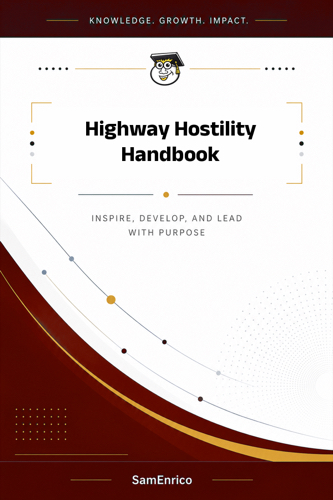
Non-FictionSelf-HelpTraffic Psychology
Highway Hostility Handbook eBook
Explains the psychology of road rage and gives tai
Explains the psychology of road rage and gives tailored strategies for highway altercations.
Formats
Free sample
Chapter 1: The Cockpit Fallacy...--–- The first time David realized he had a problem was not when he flipped off the minivan that cut him off. It was three seconds later, when the minivan’s driver—a woman who looked exactly like his own mother—rolled down her window and mouthed the words “I am so sorry. My baby is screaming.” David’s middle finger was still raised. His face was twisted in a snarl that had no place in a civilized society. And he had absolutely nothing to be angry about.
The woman had merged into his lane with barely two feet to spare. It was, by any objective measure, a dangerous move. But David had not reacted to the danger. He had reacted to the story he told himself about the danger. In his mind, she wasn’t a desperate mother wrestling a car seat.
She was a villain. An idiot. A person who had personally disrespected him. That story was a lie. And that lie—the Cockpit Fallacy—is why 80% of drivers admit to significant anger behind the wheel, and why road rage has become the single most common form of interpersonal violence in the developed world.The Cockpit Fallacy is the foundational psychological error that transforms ordinary, reasonable human beings into rage-filled monsters the moment they sit behind the wheel.
It is not anger itself. Anger is a normal, evolutionarily useful emotion. The Cockpit Fallacy is the cognitive distortion that takes that anger and aims it like a weapon at the wrong target, with the wrong intensity, for the wrong reasons. Understanding this fallacy is not optional for anyone who wants to survive the highway. It is the difference between arriving alive and becoming another statistic in the growing file of road rage fatalities.This chapter will dismantle the Cockpit Fallacy piece by piece.
First, we will explore the Fundamental Attribution Error—the psychological mechanism that causes us to judge ourselves by our circumstances and others by their character. Second, we will examine how speed transforms neutral acts into personal violations. Third, we will reveal why your brain treats a lane change the same way it treats a punch to the face. And finally, we will introduce the first tool for breaking the fallacy: the art of the alternative explanation.The Fundamental Attribution Error: Your Brain’s Favorite Shortcut Every human being walks through life with a double standard baked into their neural architecture. Psychologists call it the Fundamental Attribution Error (FAE), and it is one of the most reliably replicated findings in the history of social psychology.
Here is how it works. When you make a mistake, your brain automatically attributes that mistake to the situation. You cut someone off because the sun was in your eyes. You brake suddenly because the car in front of you braked first. You speed because you are late for a meeting that started ten minutes ago.
These are external, circumstantial, temporary explanations. They forgive you. They make your error understandable, even inevitable.When someone else makes the exact same mistake, your brain does something different. It attributes their error to their character. That driver who cut you off did so because they are an aggressive jerk.
That driver who braked suddenly did so because they are incompetent. That driver who is speeding did so because they think the rules do not apply to them. These are internal, permanent, moral explanations. They condemn the other person. They make their error not just a mistake but a character flaw.The Fundamental Attribution Error is not a bug in human cognition.
It is a feature. It evolved to protect us. If we believed every mistake we made was evidence of our own permanent moral failure, we would be paralyzed by shame and self-doubt. The error allows us to get up after falling down and try again. But on the highway, this protective mechanism becomes a weapon.
Because the highway strips away the information we need to make accurate attributions.Consider a typical surface street interaction. You are at a four-way stop. Another driver arrives at the same time, hesitates, then waves you through. You can see their face. You can see their hand gesture.
You can see the child in their back seat or the groceries sliding off their passenger seat. You have context. That context feeds your attribution system with accurate data, and you are far less likely to attribute their hesitation to malice.Now consider the same interaction on a highway at 70 miles per hour. You cannot see the other driver’s face. You cannot see their passengers.
You cannot see the coffee they just spilled on their lap or the GPS recalculating on their dashboard. All you see is a metal box doing something you do not like. Your attribution system, starved of contextual data, defaults to character. That metal box is not a person with circumstances. It is a jerk.
An idiot. A villain.This is the first layer of the Cockpit Fallacy. You are driving a metal box that hides your circumstances from others. They are driving metal boxes that hide their circumstances from you. But your brain does not apply the same charity to their metal box that it applies to your own.
You know your circumstances. You do not know theirs. So you forgive yourself and condemn them. And that double standard, repeated a hundred times per commute, is the emotional fuel that powers road rage.Speed Distorts Moral Judgment The second layer of the Cockpit Fallacy involves speed. Human beings did not evolve to travel at 70 miles per hour.
For the 300,000 years that Homo sapiens walked the earth, the fastest any human ever moved was approximately 25 miles per hour—the sprinting speed of an Olympic athlete, sustainable for perhaps thirty seconds. For the vast majority of human history, travel was measured in miles per day, not miles per hour. Your brain is a Stone Age organ trying to navigate a Space Age environment, and nowhere is that mismatch more apparent than on the highway.Speed does two things to your moral judgment. First, it compresses time. An interaction that would take ten seconds on a surface street—someone merging, someone braking, someone accelerating—takes two seconds at highway speeds.
Your brain does not have time to engage its slow, rational, deliberative systems. It defaults to its fast, reactive, emotional systems. The same neural pathways that evolved to help you dodge a predator are now being activated by a driver changing lanes.Second, and more importantly, speed amplifies perceived stakes. A minor mistake at 25 miles per hour results in a fender bender. The same mistake at 70 miles per hour results in a fatality.
Your brain knows this, not as an abstract statistic but as a visceral, embodied knowledge. When someone cuts you off at highway speed, your amygdala—the brain’s fear and threat detection center—activates as if you are about to die. Because, in a very real sense, you are. The margin for error at 70 miles per hour is measured in inches and milliseconds.But here is the cruel trick. The other driver’s mistake is almost never actually life-threatening.
The vast majority of highway incidents—estimates run as high as 95%—involve no actual risk of collision. The tailgater who rides…
This is the end of the free sample. Get the eBook to keep going. Buy now
About this book
Details
- Author
- Merrill Stephenie
- Publisher
- SamEnrico
- Language
- English
- Genre
- Non-Fiction, Self-Help, Traffic Psychology
- Released
- 2026-06-09
- Pages (approx.)
- 142
- Available as
- eBook, Audiobook

Read better in the ZLOADR app
Your eBooks on your phone or tablet. Sign in with your SamEnrico account and start reading.
More by Merrill Stephenie
 HRT Non Oral Routes Benefits GuideMerrill Stephenie$11.99
 The Sleeping Position Back GuideMerrill Stephenie$11.99
 Long Duration Storage GuideMerrill Stephenie$11.99
 Bloodline of the Sun King: The Forgotten HeirMerrill Stephenie$11.99
 How to Become a Tumbler TenderMerrill Stephenie$11.99
 NYC Pop Up TikTok StrategyMerrill Stephenie$12.99
 Paystack Transaction Dashboard GuideMerrill Stephenie$12.99
 SudokuMerrill Stephenie$11.99
 Understanding Periventricular Laminar HeterotopiaMerrill Stephenie$17.99
You may also like
 Hong Kong Handover 1997Dunn Johnnie$11.99
 Zumba For Postnatal Recovery CourseNeal Christian$11.99
 Zumba for BeginnersLadner Nikia$11.99
 YouTube Comment Mining GuideHumes Pandora$12.99
 Worry Box MeditationCarlin Rudy$11.99
 Workplace Stress MeditationNguyen Lynn$11.99
 Workplace Stress and Sleep RepairHawley Ivory$11.99
 Workplace Perfectionism CureDelaney Jeffry$11.99
 Workplace Injustice Anger GuideWallen Isabelle$11.99
 Work Addiction and Burnout LinkGreenwood Ester$11.99
 Women in Yoga and WellnessBeattie Galina$11.99
 Women in Stand Up ComedyChun Evangeline$11.99