
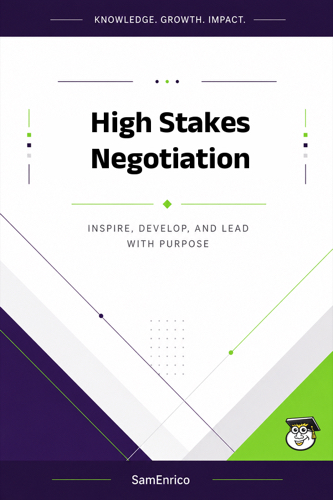
Non-FictionSelf-HelpHigh Finance
High Stakes Negotiation eBook
Control anxiety and project calm during million-do
Control anxiety and project calm during million-dollar deals.
Formats
Free sample
Chapter 1: The Biology of the Big Number--The conference room on the forty-seventh floor had floor-to-ceiling windows overlooking the Hudson River, a mahogany table that could seat twenty, and air so cold it raised goosebumps on your forearms. None of that mattered to Marcus. What mattered was the number sitting in front of him on a single sheet of paper: $47.3 million.He had spent six months preparing for this negotiation. He knew the other side's financials better than they did. He had run the models twelve times.
His BATNA was solid. His aspiration point was ambitious but defensible. He had practiced his opening statement in the mirror for three nights. By every rational measure, Marcus was ready.Then the head of the opposing team—a woman named Chen with gray-streaked hair and the calmest voice he had ever heard—leaned forward and said, "We're prepared to offer $41.2 million. Final.
Take it or leave it."Marcus felt his chest compress. His palms, dry a moment ago, became slick. His next breath caught somewhere between his throat and his lungs. He opened his mouth to speak, and what came out was not the carefully rehearsed counter-offer he had prepared. What came out was a single syllable: "Uh."Then silence.
Twelve seconds of silence that felt like twelve years.In those twelve seconds, Marcus's brain did something extraordinary and terrible. It decided that $47.3 million was not a business transaction but a threat to his survival. His heart rate spiked from seventy-two to one hundred thirty-four beats per minute. His prefrontal cortex—the part of his brain responsible for logic, strategy, and emotional regulation—went offline. And when he finally spoke again, he did not counter at $44 million as planned.
He said, "Let me think about it," and ended the call. He lost $3.1 million in value because his own body betrayed him.Marcus is not weak. He is not inexperienced. He is not stupid. Marcus is human.
And the human brain was not designed for million-dollar negotiations.The Old Brain vs. The New Brain To understand why Marcus froze—why you have frozen, why every negotiator has frozen—you need to understand a fundamental truth about your own anatomy. You do not have one brain. You have two.The first is the old brain, sometimes called the reptilian brain or the limbic system. It evolved hundreds of millions of years ago to keep you alive in a world of predators, starvation, and sudden death.
The old brain does not understand money. It does not understand contracts, equity, or compound interest. What the old brain understands is threat. When it detects a threat, it initiates a cascade of hormones designed for one purpose: survival. Your heart pumps faster to send blood to your muscles.
Your breathing quickens to oxygenate your blood. Your pupils dilate to take in more visual information. Your digestive system slows down to conserve energy. Your prefrontal cortex—the new brain, the thinking brain—is deprioritized. You do not need to solve complex problems when a tiger is chasing you.
You need to run.The problem is that the old brain cannot distinguish between a tiger and a $10 million ultimatum. Both trigger the same response. Both flood your system with cortisol and adrenaline. Both shut down the neural pathways you need most in a negotiation.The second brain is the new brain, specifically the prefrontal cortex. This is the part of your brain that evolved most recently, that separates humans from other animals, that allows you to delay gratification, consider long-term consequences, and regulate emotional impulses.
The prefrontal cortex is where your negotiation strategy lives. It is where you calculate counter-offers, read the other side's signals, and maintain composure under pressure.Here is the cruel biological joke: the old brain is faster. The amygdala, the old brain's threat-detection center, can activate the stress response in as little as 200 milliseconds. The prefrontal cortex takes 500 to 600 milliseconds to even begin processing the same information. By the time your thinking brain has identified the situation as a negotiation rather than a threat, your body is already flooded with stress hormones.
The hijack happens before you know it's happening.This is not a character flaw. This is not weakness. This is evolution.The Amygdala Hijack: Why Your Logic Goes Offline The term "amygdala hijack" was popularized by emotional intelligence researcher Daniel Goleman, but the phenomenon has been confirmed by countless brain imaging studies. Here is what happens, second by second.Second 0: You hear the number. $41.2 million.
Final.Second 0.2: Your auditory cortex processes the sound and sends it to the thalamus, the brain's relay station.Second 0.3: The thalamus sends the information along two pathways simultaneously. The fast pathway goes directly to the amygdala. The slow pathway goes to the sensory cortex, then to the prefrontal cortex, then to the amygdala.Second 0.4: The amygdala, operating on the fast pathway, makes a split-second judgment: threat or not threat? It compares the incoming information to your past experiences—every previous negotiation, every loss, every moment of embarrassment or failure. If it detects even a partial match with a past threat, it sounds the alarm.Second 0.5: The amygdala activates the hypothalamus, which activates the sympathetic nervous system.
Your adrenal glands release adrenaline and cortisol. Your heart rate begins to climb. Your breathing becomes shallow.Second 0.6 to 6.0: The stress hormones flood your system. Your prefrontal cortex—which has only now received the information via the slow pathway—tries to intervene, but it is fighting an uphill battle. Cortisol binds to receptors in the prefrontal cortex and temporarily impairs its function.
You can literally watch this happen in f MRI scans: the prefrontal cortex dims while the amygdala glows bright red.Second 6.0 and beyond: If the threat persists, your body moves into a sustained stress response. Your working memory degrades. Your ability to generate creative solutions collapses. Your vocal cords tighten, producing the "fear tremor" in your voice. Your face may flush or pale.
Your palms sweat. You are, for all practical purposes, operating without your highest cognitive functions.This is the amygdala hijack. And it happens in every high-stakes negotiation to every human being. The only difference between the negotiators who collapse and the negotiators who succeed is what happens in the six-second window between second 0.5 and second 6.5.The 6-Second Window: Your Only Chance Here is the most important number in this entire book: six seconds.Research from the University of Southern California's Brain and Creativity Institute has shown that the physiological stress response to a perceived threat takes approximately six seconds to reach the prefrontal cortex. From the moment the amygdala sounds the alarm to the moment your thinking brain begins to shut down, you have six seconds to intervene.Six seconds is not much time.
It is one deep breath. It is three heartbeats. It is the length of a single sentence. But six seconds is enough.During those six seconds, your body is preparing for fight-or-flight, but your prefrontal cortex is still online. Not for long—the cortisol flood is coming—but for six seconds, you have a choice.
You can let the hijack run its course, or you can interrupt it.The negotiators who succeed are not the ones who…
This is the end of the free sample. Get the eBook to keep going. Buy now
About this book
Details
- Author
- Cantrell Christene
- Publisher
- SamEnrico
- Language
- English
- Genre
- Non-Fiction, Self-Help, High Finance
- Released
- 2026-06-06
- Pages (approx.)
- 157
- Available as
- eBook, Audiobook

Read better in the ZLOADR app
Your eBooks on your phone or tablet. Sign in with your SamEnrico account and start reading.
More by Cantrell Christene
 Harvard Extension School Student SupportCantrell Christene$11.99
 The Highway Proximity GuideCantrell Christene$11.99
 Burnout Prevention for RetailCantrell Christene$11.99
 The Last Supper of Sergio Morales: A Death Row Meal in Mexico's Justice SystemCantrell Christene$11.99
 How to Become a Glazier ApprenticeCantrell Christene$11.99
 Archival Research Proposal GuideCantrell Christene$12.99
 Rocky Mountain Douglas-fir HarvestingCantrell Christene$11.99
 How to Produce Bicycle Handlebar Grips and DecorCantrell Christene$11.99
You may also like
 Hong Kong Handover 1997Dunn Johnnie$11.99
 Zumba For Postnatal Recovery CourseNeal Christian$11.99
 Zumba for BeginnersLadner Nikia$11.99
 YouTube Comment Mining GuideHumes Pandora$12.99
 Worry Box MeditationCarlin Rudy$11.99
 Workplace Stress MeditationNguyen Lynn$11.99
 Workplace Stress and Sleep RepairHawley Ivory$11.99
 Workplace Perfectionism CureDelaney Jeffry$11.99
 Workplace Injustice Anger GuideWallen Isabelle$11.99
 Work Addiction and Burnout LinkGreenwood Ester$11.99
 Women in Yoga and WellnessBeattie Galina$11.99
 Women in Stand Up ComedyChun Evangeline$11.99