
Non-FictionSelf-HelpHigh School
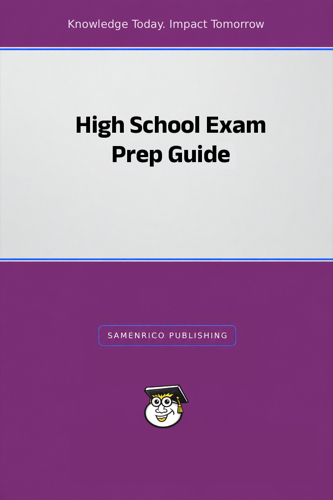
High School Exam Prep Guide eBook
Balance multiple subjects and prepare for SAT, ACT
by Smoot Fidela
Balance multiple subjects and prepare for SAT, ACT, or final exams systematically.
Formats
Free sample
Chapter 1: The Hidden Map--You are not lazy. You are not stupid. And you are definitely not the only student who has stared at a pile of textbooks, felt your chest tighten, and then opened Tik Tok instead of studying.That feeling—the paralysis that hits when you have three finals, an SAT date looming, and no idea where to start—is not a character flaw. It is a design flaw. Specifically, it is a flaw in how you have been taught to think about your workload.Every study guide, every teacher, every well-meaning parent has told you to “work harder” or “manage your time better.” But no one ever gave you a map.
They gave you a list of tasks and wished you luck.This chapter is that missing map.You are about to build something most high school students never possess: a single-page dashboard that shows you exactly what you are facing, what matters most, and what you can safely ignore. By the time you finish this chapter, the vague anxiety of “I have so much to do” will transform into a concrete list of actions. And that transformation—from overwhelm to clarity—is the single most important shift you will make in your entire exam preparation journey.Let us be honest about what typically happens. A student sits down to study. They open their math textbook, stare at a chapter, feel a wave of dread, close the book, and watch You Tube for an hour.
This is not procrastination born from laziness. This is procrastination born from uncertainty. The brain, when faced with an ambiguous threat (”study for finals”), defaults to avoidance. But when faced with a specific, manageable task (”complete problems 1–5 on page 47 of Chapter 6”), the brain engages.The Master Exam Inventory you will build in this chapter turns every ambiguous threat into a specific task. It is the difference between walking into a dark room and flipping on all the lights.Before you write down a single task or open a single textbook, you need to answer three fundamental questions.
First, what exams are actually coming? Not the ones you fear—the ones on the calendar. Second, which of those exams will dramatically affect your future (college admissions, GPA, class rank) and which are merely noisy distractions? Third, where is your current confidence level dangerously low versus comfortably high?Most students skip these questions entirely. They open a book and start reading, mistaking activity for progress.
Reading a chapter you already understand feels productive, but it produces zero improvement. Staring at a subject you are failing feels terrible, but that discomfort is the sign that real learning is possible. This chapter will teach you to stop hiding in your strengths and start facing your weaknesses—systematically, without panic, and with a clear plan.Let us begin.The Semester Map: Seeing the Full Terrain Close your eyes for a moment. Actually close them. Now imagine the next three months of your academic life.
What do you see? For most students, the answer is a blur of anxiety—tests floating in a fog, due dates half-remembered, a general sense that something important is coming but you cannot quite grasp it.Open your eyes. That blur is the enemy.The first tool you will build is called the Semester Map. It is a single calendar—digital or paper, whichever you will actually use—that plots every class, major final exam, SAT or ACT test date, and extracurricular commitment. Nothing is too small to include.
That ten-question quiz next Tuesday? Put it on the map. That club meeting that takes two hours every Thursday? Put it on the map. That family event three weekends from now that will eat an entire Saturday?
Put it on the map.Why include everything? Because your brain allocates mental energy to uncertainty. Every due date you have not written down sits in the background of your consciousness, quietly draining your focus. When you externalize that information—put it on paper or screen—your brain releases it. You stop worrying about forgetting because you have outsourced the remembering.Now color-code by subject and exam type.
Use red for any exam within 14 days. Use yellow for exams within 30 days. Use green for exams beyond 30 days. Use gray for non-academic commitments. This color system gives you an instant visual readout of your stress level.
If your calendar is mostly green and gray, you have time. If you see patches of yellow, you need to start planning. If red dominates, you are in crisis mode and need the strategies from Chapter 10 immediately.Here is what your Semester Map is not. It is not a to-do list. It is not a schedule.
It is not a set of goals. It is a terrain map—a picture of the battlefield before you plan your moves. You would not go hiking in unknown mountains without a topographical map. You would not drive across the country without a road map. Yet most students march into exam season with no map at all, then wonder why they get lost.Take thirty minutes right now to build your Semester Map.
Use Google Calendar, a physical wall calendar, a bullet journal, or the template in Appendix A. Include every exam date you can find—syllabus, school portal, teacher emails, standardized test registration confirmations. If a date is uncertain, make your best estimate and mark it with a question mark. An estimated date is infinitely better than no date.Once your map is complete, step back and look at it. You will likely feel two things simultaneously.
First, a slight rise in anxiety as you see everything gathered in one place. That is normal. Second, a surprising sense of relief. The fog has lifted. You can see the terrain.
And seeing it is the first step toward conquering it.High-Yield vs. Low-Yield: The Art of Strategic Neglect Here is a hard truth that no teacher will tell you and no parent wants to hear: you cannot do everything. There are simply not enough hours in the day to give every subject, every assignment, and every exam the attention you would ideally give it. Something will receive less than perfect effort. The only question is whether you choose what to neglect or whether neglect chooses you.This is where the concept of yield enters.
In investing, yield refers to the return you get for your effort. Studying for three hours is the effort. The yield is how many points your score improves. Some subjects and some exams offer massive yield for modest effort. Others offer tiny yield even for massive effort.
Your job is to identify the high-yield targets and pour your energy there.A high-yield subject has two characteristics. First, it appears on both a final exam and a standardized test. Algebra II concepts, for example, show up on your math final, the SAT Math section, and the ACT Math section. One study session on quadratic equations prepares you for three different exams. That is high yield.
Second, the subject has significant grade weight or college admissions impact. An AP final that determines whether you get college credit is high yield. A weekly vocabulary quiz worth…
This is the end of the free sample. Get the eBook to keep going. Buy now
About this book
Details
- Author
- Smoot Fidela
- Publisher
- SamEnrico
- Language
- English
- Genre
- Non-Fiction, Self-Help, High School
- Released
- 2026-06-10
- Pages (approx.)
- 147
- Available as
- eBook, Audiobook

Read better in the ZLOADR app
Your eBooks on your phone or tablet. Sign in with your SamEnrico account and start reading.
More by Smoot Fidela
 Disappointment In AdoptionSmoot Fidela$11.99
 Career Transition for Administrative AssistantsSmoot Fidela$11.99
 Higher Power Concept for SkepticsSmoot Fidela$11.99
 Marine Corps PilotSmoot Fidela$11.99
 Depression Psychomotor IssuesSmoot Fidela$11.99
 The Study Schedule BurnoutSmoot Fidela$11.99
 Scapegoat Child Recovery GuideSmoot Fidela$11.99
 Aircraft Carrier Radar DirectionSmoot Fidela$11.99
 Paddling the Nile: The Epic Kayak Journey That Mapped Africa's Greatest RiverSmoot Fidela$11.99
 The Last Great Polar Expedition: Shackleton's Epic Rescue MissionSmoot Fidela$11.99
 The Healers of Meroë: Surgeons of the Kushite KingdomSmoot Fidela$11.99
 Willow Oak HarvestingSmoot Fidela$11.99
You may also like
 Hong Kong Handover 1997Dunn Johnnie$11.99
 Zumba For Postnatal Recovery CourseNeal Christian$11.99
 Zumba for BeginnersLadner Nikia$11.99
 YouTube Comment Mining GuideHumes Pandora$12.99
 Worry Box MeditationCarlin Rudy$11.99
 Workplace Stress MeditationNguyen Lynn$11.99
 Workplace Stress and Sleep RepairHawley Ivory$11.99
 Workplace Perfectionism CureDelaney Jeffry$11.99
 Workplace Injustice Anger GuideWallen Isabelle$11.99
 Work Addiction and Burnout LinkGreenwood Ester$11.99
 Women in Yoga and WellnessBeattie Galina$11.99
 Women in Stand Up ComedyChun Evangeline$11.99