
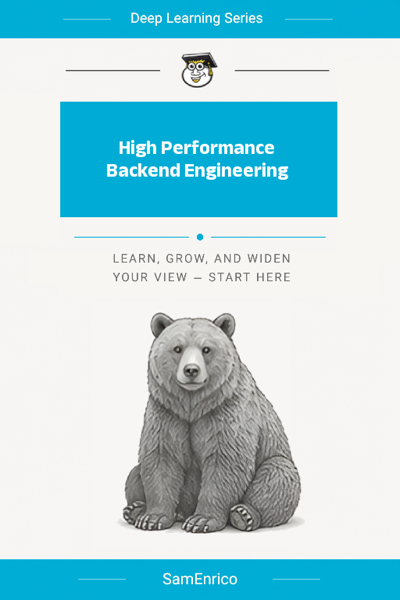
High Performance Backend Engineering Audiobook
A Coursebook on High Performance Backend Engineeri
by Labbe Ellie
A Coursebook on High Performance Backend Engineering
Formats
Free sample
Chapter 1: The Performance Illusion...--Most software engineers believe they know performance when they see it. A website loads instantly. An API returns data in milliseconds. A database query finishes before the user blinks. These are the visceral, undeniable signs of a “fast” system.
Yet this instinct, while not wrong, is dangerously incomplete. It is like judging a car solely by its top speed while ignoring its fuel efficiency, its reliability on a long journey, and whether it can carry a full family up a mountain. The car might win a drag race but fail as a vehicle for real life. Backend engineering is not about drag races. It is about the long, unglamorous haul of production traffic, where spikes arrive without warning, networks degrade, and every milligram of resource costs money.
This chapter tears down the naive definition of performance—low response time—and replaces it with a robust, multidimensional framework that will serve as the foundation for every optimization, trade-off, and architectural decision in this book. Welcome to the physiology of a high-performance system.1.1 The Four Dimensions of Performance We begin with a statement that will echo through every subsequent chapter: performance is not a single number. It is a set of four competing, interdependent attributes. Optimizing one often degrades another. A truly high-performance backend manages this tension explicitly, not accidentally.Latency: The User’s Reality Latency is the time elapsed between sending a request and receiving the complete response.
It is the dimension users feel most directly. However, latency is not monolithic. It comprises four distinct components:Network latency: The time photons or electrons take to travel across wires, fiber, or air. Light in fiber travels approximately 200 kilometers per millisecond. A request from New York to London (about 5,500 kilometers) has a minimum round-trip network latency of roughly 55 milliseconds, even before any software touches it.
This physical limit is non-negotiable.Queueing latency: The time a request spends waiting in line before being processed. When a server is busy, requests accumulate in buffers. Queueing latency is the primary driver of tail latency, which we will explore shortly.Processing latency: The time the CPU spends executing your code, from parsing the request to formatting the response. This is what most developers think of as “work.”Idle latency: The time the system spends waiting for something else to happen, such as a database query, a filesystem read, or a call to a downstream API. Idle…
This is the end of the free sample. Get the Audiobook to keep going. Buy now
About this book
Details
- Author
- Labbe Ellie
- Publisher
- SamEnrico
- Language
- English
- Genre
- Non-Fiction, Informative, Educational
- Released
- 2026-05-09
- Pages (approx.)
- 128
- Available as
- eBook, Audiobook

Listen in the VoxFlicks app
Audiobooks and audio dramas wherever you go. Sign in with your SamEnrico account and press play.
More by Labbe Ellie
 The Cloud Data Sovereignty OutlookLabbe Ellie$11.99
 Spontaneity for PerfectionistsLabbe Ellie$11.99
 Senate Majority Leader PowerLabbe Ellie$11.99
 Mountain Peak Calming VisualizationLabbe Ellie$11.99
 Shadows of the Second Seat: The Untold Power Plays of Vice PresidentsLabbe Ellie$11.99
 Understanding Rapadilino SyndromeLabbe Ellie$17.99
 Media Consumption GuideLabbe Ellie$12.99
 Non Resident LLC Tax TreatyLabbe Ellie$12.99
 How to Become a Pneumatic JacketerLabbe Ellie$11.99