
Non-FictionSelf-HelpProfessional Recovery
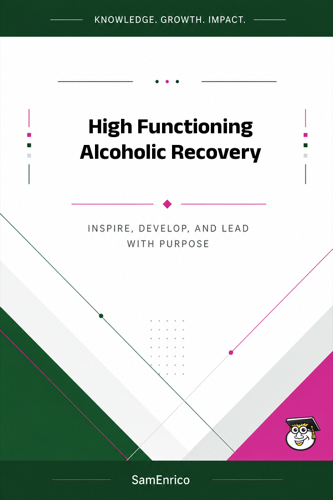
High Functioning Alcoholic Recovery eBook
Tailors recovery for professionals who maintain ca
Tailors recovery for professionals who maintain careers while struggling with alcohol.
Formats
Free sample
Chapter 1: The Falling Uphill--–- The conference room on the forty-seventh floor smelled of polished wood and expensive coffee, and Sarah had just closed the largest deal of her career. Her team applauded. Her managing partner shook her hand. The celebration champagne was already chilling in the next room. What no one in that room knew—what no one ever knew—was that Sarah had consumed eight shots of vodka before her 9:00 AM internal prep meeting, nursed a "coffee" that was mostly spirits through the four-hour negotiation, and was currently calculating how soon she could excuse herself to the bathroom to check whether the mini-bottle hidden in her laptop bag was still full.
She was thirty-seven years old, earned $740,000 the previous year, had never missed a deadline, and had not gone a single day without alcohol in nearly eight years. By every external metric, she was a success. By every internal metric, she was drowning.This is the paradox of the high-functioning alcoholic: you do not fall down. You fall up.The Most Dangerous Kind of Alcoholic When the average person imagines an alcoholic, they see a specific image. Perhaps it is the man on the park bench with a brown paper bag.
Perhaps it is the woman who has lost her children to foster care. Perhaps it is the DUI arrest, the job termination, the intervention staged by weeping relatives. These images are not inaccurate—they describe one end of the alcohol use disorder spectrum. But they are catastrophically incomplete. They leave out the alcoholic who is sitting in the corner office, the surgical suite, the courtroom, the cockpit.
They leave out the alcoholic who is, by every visible measure, thriving.The term "high-functioning alcoholic" (HFA) was not invented to minimize the severity of alcohol use disorder. It was invented to describe a specific and dangerous presentation of the disease: individuals who meet the clinical criteria for alcohol dependence or severe alcohol use disorder, yet maintain their jobs, relationships, and social standing—often for years or decades—without anyone suspecting the truth. According to the National Institute on Alcohol Abuse and Alcoholism, approximately 20% of the 17 million Americans with alcohol use disorder are high-functioning. That is nearly 3.5 million people who are actively drinking at harmful levels while appearing, from the outside, to have everything under control.The irony is devastating: the very traits that make someone a high achiever are the same traits that enable high-functioning alcoholism to go undetected for so long.The high-functioning alcoholic is typically intelligent, driven, perfectionistic, and highly skilled at impression management. These are the same qualities that earn promotions, close deals, and inspire teams.
But they are also the qualities that allow a person to calculate their blood alcohol content before a meeting, to craft plausible excuses for the glassy eyes or the missed phone call, to maintain two entirely separate realities—the public one and the private one—without ever letting the walls between them crumble. The HFA does not get caught because the HFA is very, very good at not getting caught. And that competence, tragically, is the enemy of recovery.Because as long as you are getting promoted, as long as you are hitting your numbers, as long as no one has confronted you—why would you stop? The external evidence suggests there is no problem. Your performance reviews are excellent.
Your income is rising. Your marriage is intact. Your children do not know. By every objective measure, you are fine.Except that you wake up at 2:00 AM with your heart pounding out of your chest, your mouth dry, your mind replaying fragments of the night before that you cannot fully remember. Except that you have started drinking earlier in the day, just to quiet the shaking hands.
Except that you have hidden bottles in three different locations—the office, the garage, the suitcase—so that you always have access. Except that you cannot imagine getting through a business trip, a client dinner, a holiday, a Monday, without alcohol.You are fine. But fine is a lie you are telling yourself.The Neuroscience of the Type A Reward System To understand why high achievers are uniquely vulnerable to alcohol problems, we have to look at the brain. Specifically, we have to look at the dopamine system—the neural circuitry that drives reward-seeking behavior, motivation, and pleasure.The Type A personality is characterized by several traits: competitiveness, urgency, aggression, time urgency, and a relentless drive for achievement. From a neurological perspective, these traits are associated with a highly reactive dopamine system.
When a Type A person achieves a goal—closes a deal, wins an argument, completes a project—their brain releases a surge of dopamine that feels intensely rewarding. This is the neurological basis of ambition: the brain rewards goal-directed behavior so that you will keep doing it.Alcohol also releases dopamine. A significant amount of dopamine. In fact, alcohol stimulates the nucleus accumbens—the brain's reward center—more reliably than almost any other natural or chemical reward. For the average person, alcohol is pleasant but not overwhelmingly compelling.
For the Type A person with a hypersensitive dopamine system, alcohol can feel like the solution to a problem they did not even know they had.Here is what happens inside the brain of the high-functioning alcoholic over time.Initially, alcohol provides a potent reward. After a long day of high-stakes decisions, the drink feels like a switch that turns off the noise. The dopamine surge is powerful, and the relief is immediate. The brain learns: alcohol equals reward.Over weeks and months of repeated drinking, the brain adapts. It downregulates its own dopamine production because it has come to expect the external supply from alcohol.
This is tolerance, and it is not just about needing more drinks to feel the same effect. It is about needing alcohol just to feel normal. The brain's natural reward system becomes blunted. Activities that used to feel satisfying—exercise, sex, a good meal, time with family—now feel flat or meaningless. Only alcohol restores the feeling of pleasure, and only temporarily.This is the trap.
The HFA does not drink because they are weak or because they lack willpower. They drink because their brain has been neurologically remodeled to require alcohol for basic reward functioning. And because they are successful, they have the resources to maintain this remodeling for a very long time. They can afford expensive alcohol. They have private offices where no one sees them drink.
They have the social capital to deflect suspicion. They have the cognitive skills to manage the logistics of secrecy.The very brain that made them successful is the brain that is now killing them.The Seven Professional Skills That Become Hiding Tools One of the hardest truths for high-functioning alcoholics to accept is that their professional strengths are not separate from their addiction. The same competencies that earn them bonuses are the competencies that protect their drinking. This is not a coincidence. The HFA has spent years—often decades—developing these skills in the service of career advancement.
They are masterful at them. And they have turned that mastery inward, applying it to the management of a secret.Below…
This is the end of the free sample. Get the eBook to keep going. Buy now
About this book
Details
- Author
- Milligan Abigail
- Publisher
- SamEnrico
- Language
- English
- Genre
- Non-Fiction, Self-Help, Professional Recovery
- Released
- 2026-06-09
- Pages (approx.)
- 152
- Available as
- eBook, Audiobook

Read better in the ZLOADR app
Your eBooks on your phone or tablet. Sign in with your SamEnrico account and start reading.
More by Milligan Abigail
 Post Hypnotic Suggestion for MotivationMilligan Abigail$11.99
 Memory Trigger RecoveryMilligan Abigail$11.99
 Alcohol Detox Supervision GuideMilligan Abigail$11.99
 The Quantum Leap: How Richard Feynman Redefined Science with a ChalkboardMilligan Abigail$11.99
 Best Online Banks for ForeignersMilligan Abigail$12.99
 How to Produce Clarinet Pegs and StandsMilligan Abigail$11.99
 SIPOC Diagram CreatorMilligan Abigail$11.99
 How to Become a Personnel RecruiterMilligan Abigail$11.99
You may also like
 Hong Kong Handover 1997Dunn Johnnie$11.99
 Zumba For Postnatal Recovery CourseNeal Christian$11.99
 Zumba for BeginnersLadner Nikia$11.99
 YouTube Comment Mining GuideHumes Pandora$12.99
 Worry Box MeditationCarlin Rudy$11.99
 Workplace Stress MeditationNguyen Lynn$11.99
 Workplace Stress and Sleep RepairHawley Ivory$11.99
 Workplace Perfectionism CureDelaney Jeffry$11.99
 Workplace Injustice Anger GuideWallen Isabelle$11.99
 Work Addiction and Burnout LinkGreenwood Ester$11.99
 Women in Yoga and WellnessBeattie Galina$11.99
 Women in Stand Up ComedyChun Evangeline$11.99