
Non-FictionSelf-HelpHierarchyOrganization
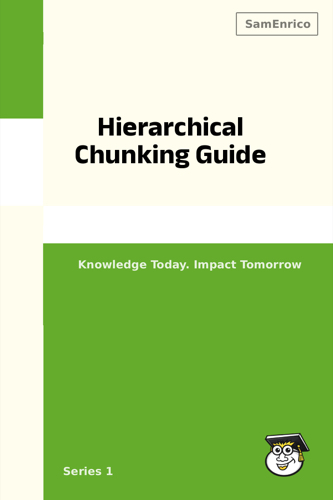
Hierarchical Chunking Guide eBook
Organize information into nested groups and subgro
Organize information into nested groups and subgroups for complex topics.
Formats
Free sample
Chapter 1: The Flatness Trap--–- You have forty-seven browser tabs open right now. Three of them are playing audio from sources you cannot identify. Your email inbox shows 1,284 unread messages, and somewhere in that pile is a receipt you need for an expense report due in two hours. Your to-do list has grown to ninety-three items, including “make a to-do list” because you forgot you already had one. Your phone just buzzed with a Slack message that begins, “Per my last email...” and you feel a specific kind of exhaustion that has no name but has become the background hum of your entire working life.This is not a moral failure.
You are not lazy, disorganized, or “bad with technology.” You are drowning in flat information, and your brain was never built for flatness.Welcome to the Flatness Trap. This chapter is your escape route.The Crisis of the Infinite List Let us name the enemy. Flat information is any presentation of data that lacks internal structure, hierarchy, or grouping. It comes in many forms: the linear list, the unbroken paragraph, the spreadsheet with forty columns and no clear relationship between them, the slide deck where every bullet is at the same level of importance, the email thread that has been replied to seventeen times without anyone trimming the footer. Flat information treats all items as equals.
It assumes that more is better and that completeness is the same as clarity.It is wrong.Consider the last time you opened a five-hundred-page PDF manual. You needed one piece of information—“What is the warranty period for the power cord?”—but the manual had no table of contents, no index, no chapters. It was a river of words from page one to page five hundred. You scrolled. You searched.
You used Ctrl+F sixteen times. You found the word “power” in forty-seven places, none of which were relevant. Thirty minutes later, you gave up and guessed. That is the Flatness Trap.Or consider the last time you received a spreadsheet with two thousand rows and no headers, no color coding, no grouping. Just numbers in cells, stretching to infinity in every direction.
You were supposed to “find the anomaly.” But where do you start? Row one? Row one thousand? Without structure, every cell is equally meaningless. That is the Flatness Trap.Or consider the last time you opened a project management tool and saw a single list of 173 tasks, each with a different assignee, different due date, different priority, and different status.
You were supposed to “know what to do next.” But the list was just a pile. You could sort it by due date, but then the high-priority tasks were scattered. You could filter by assignee, but then you lost context. You spent twenty minutes manipulating the list instead of doing the work. That is the Flatness Trap.Here is the truth that the productivity industry does not want you to hear: You cannot organize your way out of flat information by working harder.
You cannot “try harder” to remember a hundred-item list. You cannot “focus better” on a spreadsheet with no structure. You cannot “discipline yourself” to parse a five-hundred-page wall of text. The problem is not your effort. The problem is that flat information is cognitively incompatible with how your brain actually works.The Three- to Five-Item Limit Let us visit the most important fact in this entire book, a fact that will appear in every chapter because it is the foundation of everything else.
Your working memory—the mental scratchpad where you hold information while you manipulate it—can only hold approximately three to five distinct items at once for complex tasks.Let me say that again because it is easy to read and hard to accept: three to five items. Not fifty. Not twenty. Not even ten for most people when the information is meaningful and the task is demanding. Three to five.This number has a history.
In 1956, a cognitive psychologist named George Miller published a paper called “The Magical Number Seven, Plus or Minus Two.” He observed that people could hold between five and nine simple items (digits, letters, isolated words) in short-term memory. For decades, “7±2” was the rule of thumb.But modern research has refined Miller’s findings. When the items are complex—when they are ideas, tasks, relationships, or any meaningful information that requires manipulation—the limit drops. Nelson Cowan’s 2001 review of the literature, “The Magical Number 4 in Short-Term Memory,” concluded that for most real-world cognitive tasks, the limit is closer to four, plus or minus one. Other researchers have found similar results: three to five items is the sweet spot for fluent, low-effort processing.This book adopts the three-to-five rule as a conservative, beginner-friendly target.
Why three to five instead of four? Because the lower bound is safer. If you design for five, you can handle three. If you design for seven, you will fail for most people on most complex tasks. The three-to-five rule is not the absolute physiological limit—some people can hold six under ideal conditions—but it is the practical limit for reliable, stress-free information processing in messy real-world environments.Let me show you what this means in practice.Close your eyes for five seconds.
(Go ahead; I will wait.) Now, without looking, name the twelve months of the year. Easy, right? You have known them since elementary school. But you did not hold all twelve in working memory at once. You retrieved them from long-term memory using a chunking pattern: you remembered that the year is divided into four seasons of three months each.
Or you sang the months song. Or you grouped them by quarter. You did not hold twelve separate items; you held three or four groups, and each group expanded on demand. That is chunking.Now try something harder. Look at this sequence of letters for five seconds: F B I C I A N S A N A S A.
Close your eyes. How many can you remember? If you saw “FBI” as one chunk, “CIA” as another, “NSA” as another, and “NASA” as a fourth, you remembered all fourteen letters effortlessly because you compressed them into four meaningful chunks. If you saw fourteen separate letters, you remembered maybe five or six. The difference is not your memory ability.
The difference is chunking.This is the secret that memory champions and top performers use. They do not have better memories. They have better compression algorithms. They see patterns where others see noise. They group where others list.
They build hierarchies where others build piles.But grouping alone is not enough. You also need to nest those groups inside other groups. You need to know that “FBI” and “CIA” and “NSA” are all intelligence agencies, which is a higher-level group. And that intelligence agencies are part of the US government, which is an even higher-level group. And that the US government is part of North American political institutions, higher still.
Each level of nesting compresses more information. Each level allows you to operate at a higher level of abstraction without losing access to the details when you need them.That is hierarchical chunking.…
This is the end of the free sample. Get the eBook to keep going. Buy now
About this book
Details
- Author
- Magana Branden
- Publisher
- SamEnrico
- Language
- English
- Genre
- Non-Fiction, Self-Help, Hierarchy, Organization
- Released
- 2026-06-09
- Pages (approx.)
- 144
- Available as
- eBook, Audiobook

Read better in the ZLOADR app
Your eBooks on your phone or tablet. Sign in with your SamEnrico account and start reading.
More by Magana Branden
 Doctor as Teacher NaturopathyMagana Branden$11.99
 The Pierre Brossard CaseMagana Branden$11.99
 Pueblo Harvest Dance LeaderMagana Branden$11.99
 The Enlarged Prostate Medication GuideMagana Branden$11.99
 Sand and Steel: Israel's Lightning WarsMagana Branden$11.99
 Brazil Returns Management GuideMagana Branden$12.99
 Generational Tech Adoption GuideMagana Branden$12.99
 Program AnalystMagana Branden$11.99
 How to Start a Pewter Business (Beginners Guide)Magana Branden$11.99
You may also like
 Hong Kong Handover 1997Dunn Johnnie$11.99
 Zumba For Postnatal Recovery CourseNeal Christian$11.99
 Zumba for BeginnersLadner Nikia$11.99
 YouTube Comment Mining GuideHumes Pandora$12.99
 Worry Box MeditationCarlin Rudy$11.99
 Workplace Stress MeditationNguyen Lynn$11.99
 Workplace Stress and Sleep RepairHawley Ivory$11.99
 Workplace Perfectionism CureDelaney Jeffry$11.99
 Workplace Injustice Anger GuideWallen Isabelle$11.99
 Work Addiction and Burnout LinkGreenwood Ester$11.99
 Women in Yoga and WellnessBeattie Galina$11.99
 Women in Stand Up ComedyChun Evangeline$11.99