
Non-FictionHealth & Wellness / Neurology
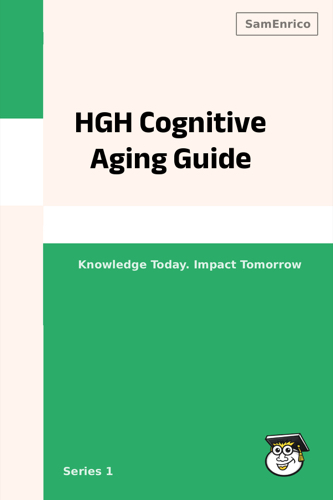
HGH Cognitive Aging Guide eBook
Investigates growth hormone's role in brain functi
Investigates growth hormone's role in brain function, memory, and neuroprotection.
Formats
Free sample
Chapter 1: The Shrinking Season--–- Margaret was sixty-three years old when she forgot her granddaughter’s name. Not for a moment—the kind where the word hovers on the tip of your tongue before surfacing with a sheepish laugh. She forgot it for an entire afternoon. She described the girl’s curly hair, her love for strawberry ice cream, even the birthmark behind her left ear. But the name—Amelia—had evaporated as though it had never existed.
Margaret laughed it off to her daughter, who did not laugh back. Over the following year, the small vanishings multiplied: the route to the grocery store she had driven for two decades, the punchline of a favorite joke, the feeling of having just taken her blood pressure medication (she had not). Her primary care doctor ran the standard battery—thyroid, vitamin B12, a cognitive screen that she passed by two points—and pronounced her “normal for her age.” But Margaret knew, in the way that only someone losing their own mind can know, that something was terribly wrong.What Margaret was experiencing, and what her doctor failed to recognize, was not normal aging. It was the leading edge of a silent epidemic that medicine has only begun to name: cognitive decline driven by the age-related collapse of a single, powerful hormone system—the somatotrophic axis. This book is the story of that system, its devastating silence as it fails, and the emerging science that offers a way to restore it.
But before we can understand the solution, we must first confront the scale of the problem. Your brain, right now, is shrinking. The question is not whether this is happening—it is—but how fast, and what you can do to slow it to a crawl.The Uncomfortable Truth About Your Aging Brain Let us begin with a number that should unsettle you: 0.5 to 2 percent. That is the percentage of brain volume the average human loses every year after age sixty. Before sixty, the loss is slower but still measurable—approximately 0.1 to 0.3 percent annually beginning as early as age thirty.
Over a lifetime, this adds up to a reduction of 10 to 15 percent of total brain mass by the eighth decade of life. The shrinkage is not uniform. The prefrontal cortex—seat of executive function, planning, and impulse control—atrophies faster than visual cortex. The hippocampus, a seahorse-shaped structure deep in the temporal lobe that serves as the brain’s memory switchboard, loses volume at an accelerated rate of 1 to 2 percent per year in late life. By the time a person reaches eighty, their hippocampus may be 20 to 30 percent smaller than it was at twenty.These numbers are not abstract statistics pulled from gerontology textbooks.
They are the biological reality of every person reading this sentence, including you. If you are over forty, your brain is already smaller than it was a decade ago. The neurons you lost will not regenerate on their own. The synaptic connections that have faded will not spontaneously strengthen. And the myelin sheaths that insulate your neural cables, allowing signals to travel at speeds of up to 120 meters per second, are thinning in precisely the regions you rely upon for remembering where you parked the car or why you walked into the kitchen.But here is the crucial distinction that most physicians fail to make, and that this book will drill into you until it becomes instinct: brain shrinkage itself is not the enemy.
The enemy is the rate of shrinkage and the specific pattern of loss that distinguishes normal cognitive aging from pathological decline. Normal cognitive aging—what used to be called "senility" before we knew better—produces a predictable set of changes: slower processing speed, mild forgetfulness for names and appointments, increased distractibility, and a slight decline in the ability to learn entirely new information (like a new software program or a foreign language). These changes are real, they are universal, and they are compatible with a full, independent life well into one’s nineties.Pathological decline is something else entirely. Mild Cognitive Impairment (MCI) represents an intermediate zone: objective memory deficits greater than expected for age, but without the functional impairment that defines dementia. Approximately 10 to 15 percent of people with MCI progress to Alzheimer’s disease each year, compared to 1 to 2 percent of the general elderly population.
Alzheimer’s itself is a horror show of amyloid plaques, tau tangles, and neuronal death that follows a brutal, predictable march through the cortex. But here is what the headlines do not tell you: a substantial fraction of age-related cognitive decline—perhaps the majority—is neither normal aging nor Alzheimer’s. It is a third category, one that medicine has only recently begun to take seriously: hormone-related cognitive decline, driven by deficiencies in the very systems that once kept your brain resilient, plastic, and protected.The Cortisol Connection That Changes Everything To understand why your brain shrinks faster than it should, you must first meet your brain’s worst enemy. Its name is cortisol. Cortisol is a glucocorticoid hormone produced by your adrenal glands in response to stress.
In small, acute doses, cortisol is essential: it mobilizes glucose for fight-or-flight, suppresses inflammation temporarily, and helps regulate metabolism. But chronic cortisol elevation—the kind produced by a high-pressure job, a toxic relationship, financial insecurity, or the simple, grinding wear of modern life—is a neurotoxin.The mechanism is exquisitely brutal. Cortisol easily crosses the blood-brain barrier, unlike many hormones. Once inside, it binds to glucocorticoid receptors that are densely concentrated in—you guessed it—the hippocampus. Cortisol’s primary effect in the hippocampus is to suppress the generation of new neurons (neurogenesis), to promote the retraction of dendrites (the branching projections that receive signals from other neurons), and to sensitize neurons to damage from excitotoxicity and oxidative stress.
In animal models, sustained cortisol elevation for just four to six weeks produces measurable hippocampal atrophy. In humans, elderly individuals with chronically elevated cortisol perform worse on memory tasks and have smaller hippocampal volumes on MRI, even after controlling for age, education, and cardiovascular risk factors.But here is the diabolical twist: cortisol and growth hormone (GH) are locked in a perpetual dance of mutual inhibition. Cortisol suppresses GH secretion at the level of the hypothalamus by increasing the release of somatostatin, the same inhibitory hormone that stops GH release at night. High cortisol also reduces the liver’s production of insulin-like growth factor-1 (IGF-1), the peripheral mediator of most of GH’s effects. Conversely, GH suppresses cortisol reactivity—people with higher GH levels bounce back from stress faster, with smaller cortisol spikes.
This means that chronic stress creates a vicious cycle: stress raises cortisol, cortisol lowers GH, low GH reduces your brain’s ability to repair itself, and a less resilient brain becomes more reactive to future stress, raising cortisol even further.The implications are staggering. If you are a middle-aged executive working sixty-hour weeks, sleeping poorly, and drinking coffee to compensate, you are not just “stressed.” You are actively, measurably shrinking your own hippocampus. And the standard medical response—a prescription for a selective serotonin reuptake inhibitor (SSRI) or a benzodiazepine—does nothing to interrupt this hormonal cascade. SSRIs may improve mood, but…
This is the end of the free sample. Get the eBook to keep going. Buy now
About this book
Details
- Author
- Mccurry Sharee
- Publisher
- SamEnrico
- Language
- English
- Genre
- Non-Fiction, Health & Wellness / Neurology
- Released
- 2026-06-06
- Pages (approx.)
- 157
- Available as
- eBook, Audiobook

Read better in the ZLOADR app
Your eBooks on your phone or tablet. Sign in with your SamEnrico account and start reading.
More by Mccurry Sharee
 The Silent Sitting PrimerMccurry Sharee$11.99
 Memory Palace Chunking GuideMccurry Sharee$11.99
 Self Care for Tired ParentsMccurry Sharee$11.99
 The Harmonic Scholars: How Black Mathematicians Revolutionized Music TheoryMccurry Sharee$11.99
 A Beginners Guide to Underwater orienteering (Volume 1)Mccurry Sharee$11.99
 How to Produce BraceletsMccurry Sharee$11.99
 Brazil Consumer Protection Law for DropshippersMccurry Sharee$12.99
 Corporate Business Development HeadMccurry Sharee$11.99
You may also like
 Hong Kong Handover 1997Dunn Johnnie$11.99
 Zumba For Postnatal Recovery CourseNeal Christian$11.99
 Zumba for BeginnersLadner Nikia$11.99
 YouTube Comment Mining GuideHumes Pandora$12.99
 Worry Box MeditationCarlin Rudy$11.99
 Workplace Stress MeditationNguyen Lynn$11.99
 Workplace Stress and Sleep RepairHawley Ivory$11.99
 Workplace Perfectionism CureDelaney Jeffry$11.99
 Workplace Injustice Anger GuideWallen Isabelle$11.99
 Work Addiction and Burnout LinkGreenwood Ester$11.99
 Women in Yoga and WellnessBeattie Galina$11.99
 Women in Stand Up ComedyChun Evangeline$11.99