
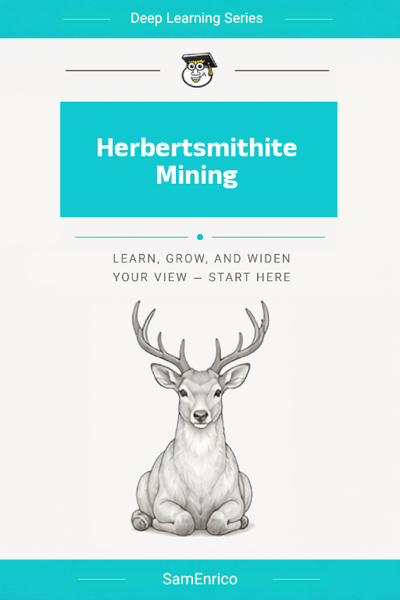
Herbertsmithite Mining
A Coursebook on Herbertsmithite Mining
A Coursebook on Herbertsmithite Mining
Formats
About this book
Free sample
Chapter 1: Stones That Think--–- In the arid expanses of Chile’s Atacama Desert, where rain falls perhaps once a decade and the landscape resembles the rust-red surface of Mars, a modest green mineral once lay unnoticed in the tailings of a copper mine. To the geologists who first cataloged it in 1972, it was merely a curiosity—a secondary copper hydroxychloride with an unusual zinc content, named after a museum curator. To the miners who excavated tons of ore from the Sierra Gorda district, it was worthless waste, discarded without a second glance. But four decades later, that same green speck would force physicists to rewrite the rules of magnetism, challenge our understanding of quantum matter, and open a pathway toward technologies that sound like science fiction: quantum spin liquids, fractionalized particles, and fault-tolerant quantum computers. This book is about how we mine that mineral—not for copper, not for zinc, but for something far more valuable: information hidden in the quantum fabric of reality.The journey from discarded rock to scientific treasure is not a story of alchemy but of insight—the recognition that certain arrangements of atoms can encode emergent properties that are not obvious from the chemical formula alone.
Herbertsmithite, with its deceptively simple composition Zn Cu₃(OH)₆Cl₂, turned out to be nature’s most perfect realization of a theoretical dream: a kagome lattice of magnetic spins that refuses to order, remaining in a liquid state down to the lowest temperatures ever achieved. Understanding how to identify, extract, synthesize, and ultimately harness this material is the subject of this coursebook. We call it “mining” because the process mirrors traditional extraction: prospecting for deposits, separating valuable components from gangue, refining raw material into usable form, and finally engineering it into devices. But instead of smelters and electrolytic cells, our tools are X-ray diffractometers, neutron spectrometers, and ultra-low-temperature refrigerators. Instead of producing copper wire or zinc ingots, we produce quantum entanglement, emergent gauge fields, and spinon Fermi surfaces.The Dual Meaning of Mining When most people hear the word “mining,” they picture underground tunnels, haul trucks, and processing mills—the gritty industrial work…
This is the end of the free sample. Get the eBook to keep going. Buy now
Contents
- Chapter 1
- Chapter 2
- Chapter 3
- Chapter 4
- Chapter 5
- Chapter 6
- Chapter 7
- Chapter 8
- Chapter 9
- Chapter 10
- Chapter 11
- Chapter 12
Details
- Author
- Fleck Mohammad
- Publisher
- SamEnrico
- Language
- English
- Genre
- Non-Fiction, Informative, Educational
- Released
- 2026-05-04
- Pages (approx.)
- 148
- Available as
- eBook, Audiobook

Read better in the ZLOADR app
Your eBooks on your phone or tablet. Sign in with your SamEnrico account and start reading.
More by Fleck Mohammad
 Relationship Management EQ GuideFleck Mohammad$11.99
 Chaplain on BattlefieldFleck Mohammad$11.99
 Step Four Resentment GridFleck Mohammad$11.99
 Canva Brand Identity for LinkedIn ProsFleck Mohammad$11.99
 Jan van der Heyden: The Firefighter Who Lit Up the WorldFleck Mohammad$11.99
 AI for Sentiment Analysis in SurveysFleck Mohammad$12.99
 Learn to Play the Banjo UkuleleFleck Mohammad$11.99
 How to Become a Garment FolderFleck Mohammad$11.99