
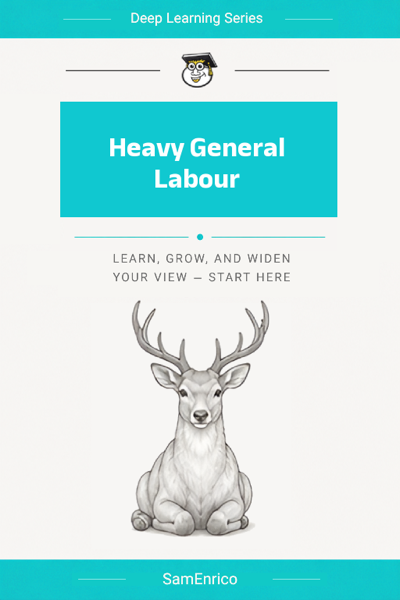
Non-FictionInformativeEducational
Heavy General Labour eBook
A Coursebook on Heavy General Labour
A Coursebook on Heavy General Labour
Formats
Free sample
Chapter 1: You Are Not a Mule--The first time a foreman called me a “pair of hands,” I almost thanked him. I was nineteen, green as fresh-cut lumber, and desperate to prove I belonged on a site where men spoke in grunts and hand signals. It took me three years and one blown L5 disc to realize he wasn’t complimenting me. He was reducing me to a tool. A mule doesn’t think.
A mule doesn’t refuse a load that’s too heavy. A mule doesn’t ask questions about safety or speak up when something feels wrong. And a mule, eventually, breaks.This book exists because you are not a mule. You are a professional. And the difference between a labourer who lasts thirty years and one who burns out in three isn’t muscle—it’s knowledge.
This chapter will show you what the modern general labourer actually does, why the old “unskilled” label is a lie, and how thinking like a professional will save your body, your career, and maybe your life.The Myth of “Unskilled Labour”Walk onto any construction site in North America and ask ten people what a general labourer does. Eight will say “lifting stuff.” One will say “cleaning up.” The tenth—usually the oldest, the one with the limp or the brace—will pause, look at you sideways, and say, “Everything nobody else wants to do.”That answer is closer to the truth than most foremen will admit. But it misses the point entirely.General labour is not unskilled. It is broadly skilled. A labourer might spend Monday morning mixing concrete by hand (chemistry + biomechanics), Monday afternoon flagging traffic (regulatory knowledge + communication), Tuesday digging a trench by shovel (soil classification + ergonomics), and Wednesday operating a skid steer to backfill that same trench (equipment proficiency + spatial awareness).
No single one of those tasks requires a decade of apprenticeship. But doing all of them safely, efficiently, and without destroying your body requires a toolkit of knowledge that most white-collar professionals never bother to acquire.The myth of unskilled labour persists for three reasons. First, the entry barrier is low—you don’t need a degree or a license to get hired as a labourer. Second, the work is physical, and our culture stupidly equates physical work with intellectual absence. Third, and most damning, many labourers believe the myth themselves.
They show up, keep their heads down, and never ask why a task is done a certain way or whether there’s a safer method. They become the mules the foreman expects.That ends now.The Four Sectors of Heavy General Labour Before you can become a professional, you need to know which game you’re playing. Heavy general labour spans four primary sectors. Each has different hazards, different equipment, and different career paths. Most labourers will work in two or three over their careers.Construction This is the sector most people picture when they hear “heavy labour.” Construction splits into residential (houses, townhomes, small apartments), commercial (offices, retail, hotels), and industrial (factories, power plants, refineries, bridges, dams).
The hazards vary wildly—residential labourers face falls from ladders and repetitive lifting injuries; industrial labourers face confined spaces, toxic chemicals, and heavy machinery interactions. Construction labourers typically work outdoors in all weather, on unstable ground, around moving equipment, and often at heights. The pace is driven by deadlines and weather windows. If you work construction, you will learn to read the sky, the site, and the men around you.Manufacturing Manufacturing labour is often overlooked in “heavy labour” discussions because the work happens indoors under roofs. Do not be fooled.
A foundry labourer lifting 50-pound casting molds for ten hours shifts total tonnage that dwarfs most construction sites. Manufacturing adds hazards that construction rarely sees: repetitive motion injuries from assembly lines, noise levels that damage hearing in months (not years), chemical exposures from solvents and coatings, and the unique danger of same-thing-every-day complacency. The benefit? Temperature control (mostly), predictable hours (mostly), and union representation in many sectors. The risk?
Your body will break down from repetition, not from single catastrophic events.Warehousing and Logistics E-commerce has exploded this sector. Warehousing labourers move boxes, operate pallet jacks and forklifts, load and unload trucks, and manage inventory systems. The hazards are ergonomic—repetitive lifting, pushing heavy carts, twisting while carrying—and equipment-related (forklift strikes, dock plate failures, trailer separation). Warehousing has the highest rate of musculoskeletal disorders of any sector. It also has the highest turnover.
Why? Because the work is monotonous, the productivity tracking is relentless (many warehouses track “touches per hour” down to the second), and the injury rate convinces people to leave before their bodies give out permanently. The professionals who stay learn to pace themselves, use equipment instead of their spines, and negotiate accommodations before they break.Environmental Remediation This is the smallest sector but the most technically demanding. Environmental labourers handle hazardous waste cleanup, asbestos abatement, mold remediation, spill response, and contaminated soil removal. The hazards are chemical and biological—you will wear respirators, Tyvek suits, and chemical-resistant gloves.
The work is often emergency-response (spills don’t wait for business hours) and emotionally draining (you are cleaning up other people’s messes, often after disasters). The pay is higher than other sectors. The health risks, if protocols are ignored, are catastrophic. Professionals in this sector never skip steps. Ever.Which sector is right for you?
Most people don’t get to choose—they take the first job that offers a paycheck. But knowing the landscape lets you identify transferable skills. A labourer who learns to operate a forklift in a warehouse can take that certification to a construction site. A construction labourer who gets an OSHA HAZWOPER certification (Hazardous Waste Operations and Emergency Response) can move into environmental work. Your sector is not your destiny.
Your knowledge is.The Five Pillars of a High-Value Labourer After interviewing dozens of site superintendents, safety directors, and veteran labourers who have survived twenty-plus years in the trades, five qualities emerge as the difference between the labourer who gets promoted and the labourer who gets replaced. I call these the Five Pillars. Master them, and you will never lack for work. Ignore them, and you will be looking for a new job by spring.Pillar One: Reliability Show up. Show up on time.
Show up fit for duty. These three sentences sound simple. They are not.“On time” on a construction site means fifteen minutes early. The foreman is drinking coffee at 6:45 for a 7:00 start. If you roll in at 7:00, you are late—the safety huddle already happened, the equipment has been assigned, and you are behind.
Repeat that three times, and you are known as “the late guy.” That label follows you to the next site and the next.“Fit for duty” means something more specific than “not hungover.” (Though not hungover is a good start.) Fit for duty means you slept at least five hours—preferably seven. It means you are not taking medication that impairs your coordination (read the labels). It means you have eaten something in the last four hours so your blood sugar isn’t tanking. It means you are mentally present, not distracted…
This is the end of the free sample. Get the eBook to keep going. Buy now
About this book
Details
- Author
- Russ Princess
- Publisher
- SamEnrico
- Language
- English
- Genre
- Non-Fiction, Informative, Educational
- Released
- 2026-05-08
- Pages (approx.)
- 149
- Available as
- eBook, Audiobook

Read better in the ZLOADR app
Your eBooks on your phone or tablet. Sign in with your SamEnrico account and start reading.
More by Russ Princess
 Guest Conductor Survival GuideRuss Princess$11.99
 HIIT Tracking Progress GuideRuss Princess$11.99
 Empathy In Relationships GuideRuss Princess$11.99
 Higher Power Concept ExplainedRuss Princess$11.99
 The OCD Just Right GuideRuss Princess$11.99
 Dior in Dallas: The Bold Bet That Made American Fashion GlobalRuss Princess$11.99
 Customer Education RetentionRuss Princess$12.99
 Analytics Free to PaidRuss Princess$12.99
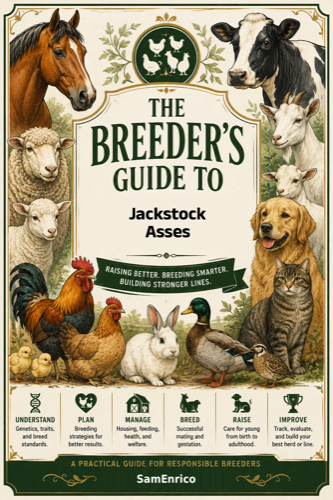 The Breeder's Guide to Jackstock AssesRuss Princess$11.99
 10 Ways to Use French Dressing (Recipe Book)Russ Princess$11.99
You may also like
 Hong Kong Handover 1997Dunn Johnnie$11.99
 Zumba For Postnatal Recovery CourseNeal Christian$11.99
 Zumba for BeginnersLadner Nikia$11.99
 YouTube Comment Mining GuideHumes Pandora$12.99
 Worry Box MeditationCarlin Rudy$11.99
 Workplace Stress MeditationNguyen Lynn$11.99
 Workplace Stress and Sleep RepairHawley Ivory$11.99
 Workplace Perfectionism CureDelaney Jeffry$11.99
 Workplace Injustice Anger GuideWallen Isabelle$11.99
 Work Addiction and Burnout LinkGreenwood Ester$11.99
 Women in Yoga and WellnessBeattie Galina$11.99
 Women in Stand Up ComedyChun Evangeline$11.99