
Heating Pad Visualization eBook
Use imagery to warm and soothe painful areas.
by Patten Adela
Use imagery to warm and soothe painful areas.
Formats
Free sample
Chapter 1: The Imagined Ember--–- Imagine, for a single moment, that you are holding a small, smooth stone in the palm of your hand. This is no ordinary stone. It has been resting in a sunbeam on a warm summer afternoon. As you close your fingers around it, you begin to feel a gentle, pervasive warmth seeping from the stone into your skin. The heat is not hot, not uncomfortable, but deeply pleasant—like the last few seconds of holding a warm mug of coffee.
Your muscles, perhaps without your conscious permission, relax slightly. Your breathing deepens. A small sigh escapes your lips.Now, open your eyes.You just experienced the foundational principle of this entire book. Without any external heat source, without a heating pad or a warm stone, your body responded to a mental image as if it were real. Your attention shifted.
Your expectations changed. And for a brief moment, you generated the sensation of warmth using nothing but the power of your own mind.If you felt nothing at all, that is perfectly fine. You have still begun the process. The neural pathways you will need are dormant in many people, simply waiting for the right kind of attention to awaken them. This chapter will show you why those pathways exist, how they work, and why you are already capable of far more than you probably believe.The Quiet Revolution in Pain Science For most of modern medical history, the relationship between mind and body has been understood through a lens of separation.
The body was a biological machine, governed by measurable chemical and physical laws. The mind was something else—an epiphenomenon, a ghost riding the machine but unable to influence its gears. This view, often called Cartesian dualism after the philosopher René Descartes, has been enormously useful for developing surgical techniques and pharmaceutical interventions. But it has also been profoundly misleading when it comes to understanding pain.Pain is not a simple signal traveling from an injured body part to a passive brain. Pain is a construction.
It is an output of the brain, not an input. Your brain takes in sensory data from your nerves, but it also considers context, past experience, emotional state, expectation, and a dozen other variables before deciding whether to create the experience we call pain.This is why two people with identical injuries can have wildly different pain experiences. This is why a soldier wounded in battle may feel no pain until the fighting stops. This is why a patient given a placebo can experience genuine relief. And this is why the techniques in this book—heating pad visualization—can work even when no physical heat is present.The man who changed how we understand all of this was a psychologist named Ronald Melzack.
In the 1960s, working with neurophysiologist Patrick Wall, Melzack proposed a revolutionary idea called the Gate Control Theory of Pain. The theory is surprisingly intuitive once you grasp it.Imagine your spinal cord as a busy intersection. Sensory nerves from all over your body converge here, each carrying different types of information: sharp pain, dull ache, light touch, pressure, warmth, cold. These signals all compete to reach your brain, but they cannot all pass through at once. There is a gatekeeper at the intersection.
When non-painful signals—like the sensation of warmth or gentle rubbing—arrive in sufficient quantity, they can effectively "close the gate" on pain signals. The pain signals are still there, but they are blocked from reaching your conscious awareness.This is why rubbing a bumped elbow makes it feel better. The pressure and movement signals arriving at your spinal cord outcompete the pain signals from the injury. This is why a warm bath soothes aching muscles. The widespread sensation of warmth floods the gate, leaving no room for pain.
And this is why—if you can learn to generate the sensation of warmth using your imagination—you can close the gate without any external heat source at all.Your Brain Does Not Know the Difference The most important fact you will learn in this book is this: your brain cannot fully distinguish between a vividly imagined experience and a real one.This claim sounds like pseudoscience, but it is among the most robust findings in modern neuroscience. When researchers place subjects in functional magnetic resonance imaging (f MRI) scanners and ask them to imagine a familiar scene—their childhood bedroom, the facade of their workplace, a favorite walking path—the same visual processing regions activate as when they actually see those scenes. When subjects are asked to imagine moving their fingers, the motor cortex activates as if the fingers were actually moving. When subjects imagine the sound of a violin, the auditory cortex activates as if the violin were playing.This phenomenon is not limited to the senses. When subjects imagine a fearful situation, their amygdala—the brain's fear center—activates.
When they imagine a loved one's face, the same reward circuits activate as during an actual reunion. The brain does not simply "represent" reality. In many important ways, it simulates reality, and the simulation uses the same neural hardware as the genuine article.This is why athletes use mental rehearsal. A basketball player who visualizes making free throws, over and over, in vivid sensory detail, improves nearly as much as a player who practices physically. The brain's motor pathways strengthen with imagined practice just as they do with real practice.
The same principle applies to thermal imagery. When you vividly imagine warmth—not just the idea of warmth, but the actual sensation of heat spreading through your tissues—your brain activates the same regions involved in processing real warmth from a heating pad.Neuroplasticity: How Your Brain Learns to Get Warmer If the brain treats imagined and real experiences similarly, why does generating warmth feel difficult at first? Why doesn't it happen automatically the moment you decide to imagine it?The answer lies in a concept called neuroplasticity. Your brain is not a static organ. It changes constantly in response to experience.
Every time you repeat a thought, a sensation, or a behavior, you strengthen the neural pathways that support it. This is how habits form. This is how skills develop. And this is how you will learn to generate warmth on demand.Think of the neural pathway responsible for thermal imagery as a path through a dense forest. The first time you try to walk it, the way is unclear.
Branches scratch at your face. Roots trip your feet. You lose the trail repeatedly. It takes enormous effort to make any progress at all. But each time you walk the path, you trample the undergrowth a little more.
The path becomes clearer. After a dozen walks, you have a dirt trail. After a hundred, it is a gravel road. After a thousand, it is a paved highway. Your thoughts travel along it effortlessly, automatically, without conscious direction.This is why the exercises in this book require practice.
Not because you lack some innate talent, but because your brain needs time to build the infrastructure. The people who succeed with heating pad visualization are not the ones who feel…
This is the end of the free sample. Get the eBook to keep going. Buy now
About this book
Details
- Author
- Patten Adela
- Publisher
- SamEnrico
- Language
- English
- Genre
- Non-Fiction, Self-Help
- Released
- 2026-06-07
- Pages (approx.)
- 151
- Available as
- eBook, Audiobook

Read better in the ZLOADR app
Your eBooks on your phone or tablet. Sign in with your SamEnrico account and start reading.
More by Patten Adela
 Mindfulness for Angry DriversPatten Adela$11.99
 Bonus Depreciation Business GuidePatten Adela$11.99
 The Non Artist Prototyping GuidePatten Adela$11.99
 Ayurvedic Beauty GuidePatten Adela$11.99
 Caregiver Employment StressPatten Adela$11.99
 Metta for a Foster ChildPatten Adela$11.99
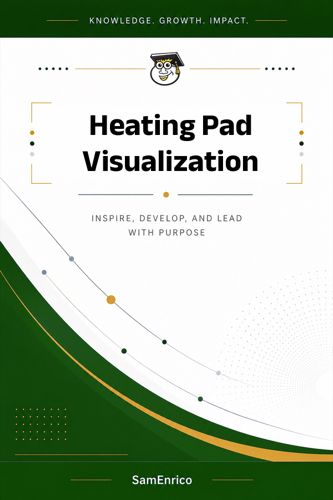 Heating Pad VisualizationPatten Adela$11.99
 Garden Dream SymbolismPatten Adela$11.99
 Harry Wu LaogaiPatten Adela$11.99
 The Healing Harmonies of Dr. Daniel Hale Williams: The Surgeon Who Orchestrated Medical MiraclesPatten Adela$11.99
 The Great Salmon War: Blood and Boundaries in the Pacific NorthwestPatten Adela$11.99
 The Crown and the Codebreaker: How a Future Queen Mastered WWII's Secret LanguagePatten Adela$11.99
You may also like
 Hong Kong Handover 1997Dunn Johnnie$11.99
 Zumba For Postnatal Recovery CourseNeal Christian$11.99
 Zumba for BeginnersLadner Nikia$11.99
 YouTube Comment Mining GuideHumes Pandora$12.99
 Worry Box MeditationCarlin Rudy$11.99
 Workplace Stress MeditationNguyen Lynn$11.99
 Workplace Stress and Sleep RepairHawley Ivory$11.99
 Workplace Perfectionism CureDelaney Jeffry$11.99
 Workplace Injustice Anger GuideWallen Isabelle$11.99
 Work Addiction and Burnout LinkGreenwood Ester$11.99
 Women in Yoga and WellnessBeattie Galina$11.99
 Women in Stand Up ComedyChun Evangeline$11.99