
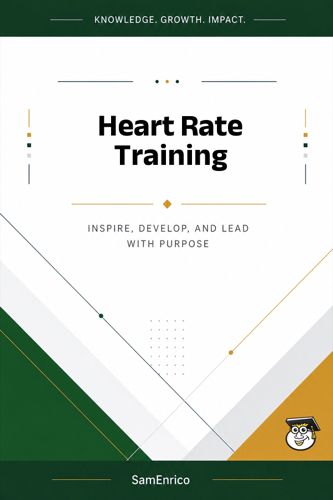
Non-FictionHealth & WellnessMonitoring
Heart Rate Training eBook
Teaches using zones for intensity management.
Teaches using zones for intensity management.
Formats
Free sample
Chapter 1: Beyond The Formula--–- The beep of the heart rate monitor cut through the early morning silence like a metronome gone mad. I was three miles into a ten-mile run, drenched in sweat despite the 45-degree temperature, and my watch read 168 beats per minute. According to every chart I had ever seen, I was supposed to be dead. Or at least dangerously close to my maximum. But here is the thing: I felt fine.
Not great, certainly not fresh, but fine. Conversational even. I could have told you the plot of the movie I watched the night before without gasping for air. That was the moment I realized everything I thought I knew about heart rate training was a lie.The numbers on my wrist did not match the feeling in my chest. The formulas I had trusted did not know my body.
And the zones I had been using for two years had been silently sabotaging every single workout. I was not alone. Every day, thousands of athletes lace up their shoes, strap on their monitors, and blindly trust the default settings on their devices without ever asking the most important question: Are these numbers actually mine?This chapter is an intervention. Before you read another word about zones, intervals, or periodization, you must first understand that the most common method of calculating heart rate training zones is not just inaccurate—it is actively harmful. The formula that comes pre-programmed into your watch, the one that pops up as soon as you enter your age, is a population average that fits almost no one.
Using it to guide your training is like using a map of New York City to navigate London. The streets look similar, but you will never reach your destination.We are going to tear down that false foundation and build a new one from the ground up. You will learn how to find your real numbers, how to use your resting heart rate as a daily truth-teller, and how to set zones that evolve with you as you get fitter. By the end of this chapter, you will have everything you need to replace guesswork with precision. Let us begin.The 220-Age Delusion Walk into any gym, open any fitness app, or buy any entry-level heart rate monitor, and you will encounter the same formula: 220 minus your age equals your maximum heart rate.
If you are forty years old, this formula tells you that your max is 180 beats per minute. If you are thirty, it is 190. If you are fifty, it is 170. The formula is clean, simple, and completely useless.The origin of this formula is surprisingly humble. In 1971, two researchers named William Haskell and Samuel Fox surveyed a small group of studies and noticed a rough correlation between age and maximum heart rate.
They proposed the equation 220 minus age as a rough population average, never intending it to be applied to individuals. Somewhere along the way, however, the caveats were lost, and the formula became gospel. It is now embedded in millions of devices, taught in certification courses, and repeated by well-meaning coaches who should know better.Here is what the formula does not know: your genetics, your training history, your resting heart rate, your medication use, your caffeine sensitivity, your sleep quality from the night before, or the temperature outside. These factors can shift your true maximum heart rate by fifteen to twenty beats per minute in either direction. For a forty-year-old athlete, that means their true max could be as low as 160 or as high as 200.
Training zones built on an estimate of 180 will be wrong by an entire zone or more.Consider two forty-year-old runners. Runner A has been training consistently for a decade, has a low resting heart rate, and comes from a family of endurance athletes. Runner B is new to exercise, carries excess stress, and has a genetic predisposition toward higher heart rates. The 220-minus-age formula gives both athletes the same maximum of 180. But Runner A might have a true max of 195, while Runner B might have a true max of 165.
If both athletes use the same zones, Runner A will spend their workouts undertrained—never pushing hard enough to stimulate adaptation—while Runner B will spend every session in a state of overreach, accumulating fatigue without reward.I have tested this formula on hundreds of athletes over the course of my career. Fewer than ten percent fall within five beats of the predicted value. The majority are off by ten to fifteen beats. And a significant minority are off by twenty beats or more. If you are reading this book, there is an excellent chance that the zones currently programmed into your watch are wrong for you.
That is not a criticism of your device. It is a limitation of the one-size-fits-all approach that the fitness industry has uncritically accepted for decades.The Lactate Threshold: Your True North If 220 minus age is a broken compass, then what should you use instead? The answer is lactate threshold heart rate, or LTHR for short. Unlike maximum heart rate, which is largely genetic and difficult to change through training, lactate threshold is highly trainable and directly predicts your performance in endurance events lasting longer than about thirty minutes.To understand lactate threshold, you need to understand what happens inside your muscles when you exercise. Your body produces a substance called lactate as a byproduct of breaking down glucose for energy.
At low intensities, your body clears lactate as quickly as it produces it. At higher intensities, production begins to outpace clearance, and lactate accumulates in your bloodstream. The heart rate at which this accumulation begins to accelerate exponentially is your lactate threshold.Think of it like a sink with the drain open. If you turn the faucet on low, the water drains as fast as it flows. If you turn the faucet on high, the sink eventually fills up.
Your lactate threshold is the faucet setting right before the sink starts to fill. Train below that threshold, and you can go for hours. Train above it, and fatigue forces you to stop within minutes.Here is why this matters for heart rate training. Your lactate threshold heart rate is the most practical and useful number you will ever find. Unlike maximum heart rate, which is a theoretical ceiling you might never actually hit in training, your LTHR is a number you can reach, hold, and work with.
It corresponds directly to the pace you can sustain for a hard thirty-minute to sixty-minute effort. It changes as you get fitter, giving you immediate feedback on whether your training is working. And it provides the anchor for all five training zones we will explore in later chapters.In the next section, I am going to give you a simple, brutal, and brutally effective field test to find your LTHR. You will need a heart rate monitor that records your average heart rate over specific time intervals. You will need a flat course free from traffic and interruptions.
And you will need the willingness to suffer for thirty minutes. This test is not comfortable. It is not supposed to be. But it…
This is the end of the free sample. Get the eBook to keep going. Buy now
About this book
Details
- Author
- Krebs Vernice
- Publisher
- SamEnrico
- Language
- English
- Genre
- Non-Fiction, Health & Wellness, Monitoring
- Released
- 2026-06-06
- Pages (approx.)
- 150
- Available as
- eBook, Audiobook

Read better in the ZLOADR app
Your eBooks on your phone or tablet. Sign in with your SamEnrico account and start reading.
More by Krebs Vernice
 The Foster Care Library CardKrebs Vernice$11.99
 Growth Hormone and Muscle PreservationKrebs Vernice$11.99
 Gig Platform Insurance GuideKrebs Vernice$11.99
 Mindfulness for WorryKrebs Vernice$11.99
 Essential Travel Authorization KitKrebs Vernice$11.99
 Opioid Constipation ManagementKrebs Vernice$11.99
 Meal Prep Weekly ReviewKrebs Vernice$11.99
 The Barefoot Warriors: How a Village Team Conquered the 1936 Far Eastern GamesKrebs Vernice$11.99
 Battling for Gold: The Secret Science of Olympic GloryKrebs Vernice$11.99
 How to Produce Massage Stone WarmersKrebs Vernice$11.99
 Service Providers Guide to Word ProcessingKrebs Vernice$11.99
 How to Start a Animal Health Care and Control for Farm Animals Business (Beginners Guide)Krebs Vernice$11.99
You may also like
 Hong Kong Handover 1997Dunn Johnnie$11.99
 Zumba For Postnatal Recovery CourseNeal Christian$11.99
 Zumba for BeginnersLadner Nikia$11.99
 YouTube Comment Mining GuideHumes Pandora$12.99
 Worry Box MeditationCarlin Rudy$11.99
 Workplace Stress MeditationNguyen Lynn$11.99
 Workplace Stress and Sleep RepairHawley Ivory$11.99
 Workplace Perfectionism CureDelaney Jeffry$11.99
 Workplace Injustice Anger GuideWallen Isabelle$11.99
 Work Addiction and Burnout LinkGreenwood Ester$11.99
 Women in Yoga and WellnessBeattie Galina$11.99
 Women in Stand Up ComedyChun Evangeline$11.99