
Non-FictionTrue CrimeMedical Grief
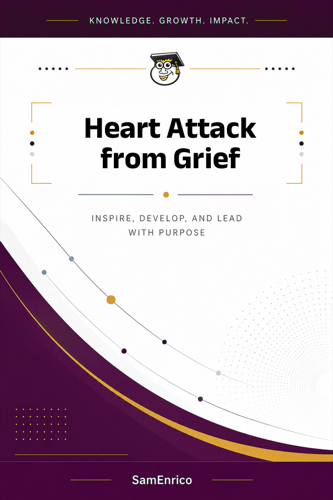
Heart Attack from Grief eBook
An elderly parent suffered a heart attack after le
An elderly parent suffered a heart attack after learning of their child's murder.
Formats
Free sample
Chapter 1: The Octopus Trap...–- The 78-year-old father sat in his recliner, a worn leather chair shaped by decades of his body, when the knock came at 9:47 PM. He had been dozing through a rerun of a western—something black-and-white, something he had seen fifty times before, something safe. His wife of fifty-three years was already upstairs, her hearing aids removed for the night. The knock was not loud, but it was insistent. Three raps.
A pause. Three more. He knew that rhythm. He had been a volunteer firefighter in his forties. That was the knock of bad news.
Not the frantic pounding of an emergency, but the measured, deliberate knock of someone who has been trained to deliver the undeliverable.He opened the door to two police officers, a man and a woman, both in crisp uniforms that seemed too bright against his dark porch. The woman’s face was pale, her lips pressed into a thin line. The man held his hat against his chest, a gesture of respect that the father recognized from military funerals. Before either spoke, the father’s heart began to change. Not metaphorically.
Literally. Inside his chest, a surge of adrenaline—more potent than any drug synthesized in a laboratory—flooded his bloodstream. His blood pressure, normally 130 over 80, spiked to 190 over 110 within seconds. His left ventricle, the powerful muscular chamber that had pumped faithfully for nearly eight decades, began to behave as if it had been grabbed by a giant fist. The apex of the heart—its tip—went still, frozen, while the base continued to contract violently.
The organ that had sustained him his entire life began to take the shape of an octopus trap. This is not poetry. This is pathophysiology.The officer said, “Sir, I’m very sorry to inform you that your daughter, Rebecca—”The father heard the name, then heard nothing else. His knees buckled. He grabbed the doorframe, missed, and collapsed backward onto the hardwood floor of his foyer.
His wife would later say she heard a sound like a bag of wet concrete hitting the ground. She came downstairs to find her husband gray-faced, his lips tinged with blue, his hand clutching his chest in a gesture that was almost theatrical in its precision—except this was not theater. This was a heart attack from grief.The Name of the Trap Takotsubo cardiomyopathy. The name alone requires translation. In Japanese, tako means octopus, and tsubo means pot or trap.
Fishermen in the coastal waters of Japan have used these pots for centuries: wide at the base, narrow at the neck, shaped to allow an octopus to enter but not to escape. In 1990, Japanese cardiologists first described a curious phenomenon in patients who presented with what appeared to be massive heart attacks. Their symptoms were classic: crushing chest pain, shortness of breath, ECG changes that suggested a major cardiac event. Yet when doctors threaded catheters into their coronary arteries, expecting to find clots or plaque, they found nothing. The arteries were clean.
The blood flowed freely. The heart, however, was not normal. It had changed shape. The left ventricle—normally a muscular cone that contracts and relaxes with metronomic precision—had ballooned at the apex. In echocardiograms and ventriculograms, it looked exactly like an octopus trap: wide and motionless at the bottom, narrow and hypercontractile at the top.For the first decade after its discovery, Takotsubo was considered a medical curiosity.
A Japanese oddity. Something seen in elderly women after the death of a spouse or a frightening car accident. Cardiologists called it “broken heart syndrome” in their less formal moments, a nickname that was both accurate and misleading. Accurate because it was a broken heart—a heart physically stunned by emotional catastrophe. Misleading because the phrase sounded gentle, almost romantic, as if the heart had simply given up out of love.
In fact, Takotsubo is anything but gentle. It is a catecholamine storm, a biochemical hurricane, a neurological ambush that can kill within hours.Today, we know that Takotsubo accounts for approximately 1 to 2 percent of all suspected heart attacks in the general population. Among women, the percentage is higher. Among postmenopausal women, higher still. Among elderly parents who have just learned that their child has been murdered?
The percentage is unknown because no one has been cruel enough to run that study. But emergency room physicians know. Cardiac intensive care nurses know. They have seen the pattern again and again: the phone call, the knock on the door, the officer’s solemn face—and then the collapse.The Anatomy of a Stunned Heart To understand why a parent’s heart fails at the moment of catastrophic news, we must first understand what a heart attack is—and what it is not.The classic heart attack, known medically as a myocardial infarction, is a plumbing problem. One or more of the coronary arteries—the pipes that deliver oxygen-rich blood to the heart muscle itself—become blocked.
Usually, the blockage is a clot that has formed on top of a cholesterol-laden plaque. The plaque has been there for years, growing silently, narrowing the artery like rust inside a pipe. When the clot forms, blood flow stops. Downstream, the heart muscle begins to die. It dies within minutes.
It dies within hours. Every minute that the artery remains blocked, more muscle is lost. The patient feels crushing chest pain, often radiating to the jaw or left arm. They may break out in a cold sweat. They may vomit.
They may feel a sense of doom—a phrase that sounds dramatic until you have heard a patient say it in a quiet voice, fully convinced that they are about to die.The classic heart attack is treated by reopening the artery. This is done with a balloon and a stent, threaded up through the femoral or radial artery, guided by live X-ray. When the balloon inflates, the clot is crushed against the artery wall. The stent holds the vessel open. Blood flows again.
The pain stops almost immediately. The patient survives, though they will carry permanent scar tissue on their heart for the rest of their lives.Takotsubo is different. It is not a plumbing problem. It is a chemistry problem.Inside the wall of the left ventricle, there are receptors called beta-adrenergic receptors. These receptors are like locks, and the keys are stress hormones—primarily epinephrine (adrenaline) and norepinephrine (noradrenaline).
When you face a threat, your sympathetic nervous system releases these hormones. Your heart rate increases. Your blood pressure rises. Your pupils dilate. Blood is shunted away from your digestive system and toward your large muscles.
This is the fight-or-flight response. It is ancient. It is elegant. It is designed to save your life when a predator is chasing you across the savanna.But the fight-or-flight response was not designed for the twenty-first century. It was not designed for a police officer at the door.
It was not designed for the words “your child has been murdered.” Because when those words are spoken, there is no fight to be had. There is no flight to be taken. The threat is not a predator that can be outrun. The threat…
This is the end of the free sample. Get the eBook to keep going. Buy now
About this book
Details
- Author
- Flowers Matthew
- Publisher
- SamEnrico
- Language
- English
- Genre
- Non-Fiction, True Crime, Medical Grief
- Released
- 2026-06-06
- Pages (approx.)
- 158
- Available as
- eBook, Audiobook

Read better in the ZLOADR app
Your eBooks on your phone or tablet. Sign in with your SamEnrico account and start reading.
More by Flowers Matthew
 Quit Line Coaching CompanionFlowers Matthew$11.99
 Teacher Name Recall GuideFlowers Matthew$11.99
 Self Esteem for Visible TattoosFlowers Matthew$11.99
 Legal Tech Capital StrategyFlowers Matthew$11.99
 Pauling Quantum Chemistry OriginsFlowers Matthew$11.99
 Divorce Sleep RecoveryFlowers Matthew$11.99
 Contrast Effect NegotiationFlowers Matthew$11.99
 The Gold Standard: How Black Economists Shaped Global FinanceFlowers Matthew$11.99
 Gold of the Pharaohs: The Luxury Craftsmanship of Ancient NubiaFlowers Matthew$11.99
 How to Produce Shaving Bowls and MugsFlowers Matthew$11.99
 How to Produce Food Dehydrator TraysFlowers Matthew$11.99
 Middle Eastern Women in Sales GuideFlowers Matthew$12.99
You may also like
 Hong Kong Handover 1997Dunn Johnnie$11.99
 Zumba For Postnatal Recovery CourseNeal Christian$11.99
 Zumba for BeginnersLadner Nikia$11.99
 YouTube Comment Mining GuideHumes Pandora$12.99
 Worry Box MeditationCarlin Rudy$11.99
 Workplace Stress MeditationNguyen Lynn$11.99
 Workplace Stress and Sleep RepairHawley Ivory$11.99
 Workplace Perfectionism CureDelaney Jeffry$11.99
 Workplace Injustice Anger GuideWallen Isabelle$11.99
 Work Addiction and Burnout LinkGreenwood Ester$11.99
 Women in Yoga and WellnessBeattie Galina$11.99
 Women in Stand Up ComedyChun Evangeline$11.99