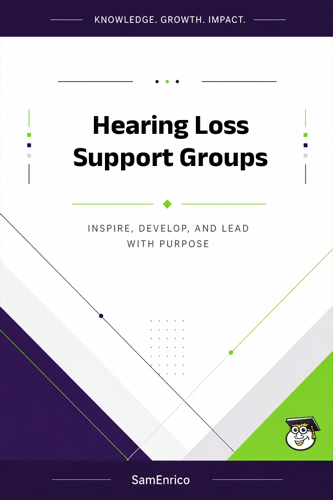
Hearing Loss Support Groups eBook
Find community and share coping strategies with pe
Find community and share coping strategies with peers experiencing similar loss.
Formats
Free sample
Chapter 1: The Silent Funeral--–- The first time I realized I was disappearing happened at my mother’s funeral. Not because I was grieving—though I was—but because I couldn’t hear the eulogy. I sat in the third row, my new hearing aids freshly cleaned and fully charged, and watched the pastor’s mouth move like a fish behind glass. Every few seconds, a word would break through the fog: “beloved” … “grace” … “home.” But the sentences—the stories, the memories, the reason two hundred people had gathered in that room—were lost to me. I nodded when others nodded.
I dabbed my eyes when others dabbed theirs. I performed grief while feeling something far worse than sorrow. I felt invisible.After the service, my sister grabbed my arm and whispered, “Did you hear what he said about the lullabies? About how she sang to us every night?” I smiled and said yes. I had heard nothing about lullabies.
I had heard nothing about singing. But I had learned, over ten years of gradual hearing loss, that saying “What?” more than twice in a row made people’s faces change. Their patience curdled into pity, then into annoyance, then into avoidance. So I had become an expert at bluffing. I nodded.
I laughed when others laughed. I constructed entire conversations from fragments and facial expressions, and I had become so skilled at this that almost no one knew how much I was missing.Almost no one.That night, alone in a hotel room, I took out my hearing aids and sat in the silence. Not the peaceful silence of meditation, but the oppressive silence of a room with no cues, no context, no connection. I thought about my mother—a woman who had sung lullabies I could no longer remember. I thought about the pastor’s words, now gone forever.
And I thought about the statistic I would later learn: that people with untreated hearing loss have a 500% higher risk of developing dementia, not because their ears are broken, but because their brains—starved of conversation, starved of story, starved of social engagement—begin to atrophy like a muscle never used.I was not just losing my hearing. I was losing my life.And yet, I had never told anyone the full truth. Not my sister. Not my wife. Not my closest friend.
I had mentioned the hearing aids, of course—they were visible, impossible to hide. But I had never said the words that mattered: I am lonely. I am exhausted. I am afraid that the person I used to be is already gone, and the person I am becoming is a stranger who nods and smiles while the world speaks a language he can no longer understand.This book is the book I needed that night.The Myth of the Broken Ear Let me begin with a confession that will sound strange to anyone who has never experienced hearing loss: The hearing aids work. That’s not the problem.Most people assume that hearing loss is a volume problem.
Turn up the sound, fix the ear, and the person returns to normal. This assumption is wrong in a way that causes enormous suffering. Hearing loss is not a volume problem. It is a fidelity problem. It is a processing problem.
It is a connection problem.Here’s what I mean. When you have normal hearing, sound enters your ear as a continuous wave of pressure. Your cochlea—a tiny, fluid-filled spiral in your inner ear—contains thousands of hair cells that vibrate at specific frequencies. These vibrations are converted into electrical signals that your brain interprets as speech, music, laughter, warning sirens, and the thousand other sounds that make up a human life.When you lose your hearing, you lose hair cells. And here is the cruel trick: the hair cells that die first are the ones responsible for the highest frequencies—the consonants.
The difference between “cat” and “hat,” between “seventy” and “seventeen,” between “I love you” and “I’ll leave you,” often comes down to a single high-frequency consonant that your damaged ear simply cannot distinguish.Hearing aids amplify sound. They can make the world louder. But they cannot restore the hair cells you have lost. They cannot unscramble the acoustic blur that turns “Did you take the trash out?” into “Did you make the splash now?” They cannot tell your brain which consonant was supposed to be there.So you strain. You concentrate.
You lean forward and watch lips and read body language and fill in the gaps with context and hope and guesswork. And at the end of a day of doing this—at the end of a meeting, a lunch date, a family dinner, a phone call with your doctor—you are not just tired. You are exhausted. Your brain has been running a marathon it was never designed to run.This exhaustion has a name. In the research literature, it is called listening fatigue.
In support groups, it is called “the thing no one warned me about.” And it is the first of three invisible symptoms that define the emotional landscape of hearing loss.The Three Invisible Symptoms Before we go any further, I want you to take a honest inventory of your own experience. You may have hearing loss yourself, or you may love someone who does. Either way, these three symptoms are almost certainly present, whether you have named them or not.Symptom One: Loneliness Not the loneliness of being alone. The loneliness of being with people and still feeling cut off.A study published in JAMA Otolaryngology followed more than 2,000 adults with hearing loss and found that they were 2.5 times more likely to report severe loneliness than their peers with normal hearing. This was not because they had fewer social contacts.
In fact, the study controlled for social network size. People with hearing loss had just as many friends, just as many family members, just as many opportunities for connection. But they could not access those connections. The medium was scrambled.Think about a restaurant. You are seated at a table for six.
The lighting is dim—atmospheric, the restaurant calls it. The music is loud—energetic, they say. Your friend across the table tells a story. You hear maybe half the words. You laugh when everyone else laughs, but you are not sure what was funny.
You try to ask a question, but by the time you formulate it, the conversation has moved on. You feel slow. You feel dull. You feel like the person you used to be—the quick, witty, engaged person—has been replaced by someone who sits at tables and nods.After a while, you stop going to restaurants. Then you stop going to parties.
Then you stop going to family gatherings, because the effort of pretending is worse than the pain of missing. Your world shrinks. Your invitations dry up. And the people who love you say things like “You never come out anymore” or “You’ve become so quiet” or “Is everything okay?”Everything is not okay. But you cannot explain why, because to explain would be to admit that the problem is…
This is the end of the free sample. Get the eBook to keep going. Buy now
About this book
Details
- Author
- Tripp Luvenia
- Publisher
- SamEnrico
- Language
- English
- Genre
- Non-Fiction, Health & Wellness, Support Groups
- Released
- 2026-06-06
- Pages (approx.)
- 133
- Available as
- eBook, Audiobook

Read better in the ZLOADR app
Your eBooks on your phone or tablet. Sign in with your SamEnrico account and start reading.
More by Tripp Luvenia
 Smoking Cessation for HIV PatientsTripp Luvenia$11.99
 Insider Trading Heist TheoryTripp Luvenia$11.99
 HIIT for Dancers GuideTripp Luvenia$11.99
 Parental Addiction and SchoolTripp Luvenia$11.99
 The Lost Tapes of Apollo 15: The Moon Conspiracy That Wasn’tTripp Luvenia$11.99
 How to Start a Pottery (retail) Business (Beginners Guide)Tripp Luvenia$11.99
 Jordan B2B Sales HandbookTripp Luvenia$12.99
 Browser Extension Removal GuideTripp Luvenia$12.99
 Understanding Carnitine Transporter DeficiencyTripp Luvenia$17.99
 Marketing and Events CoordinatorTripp Luvenia$11.99