
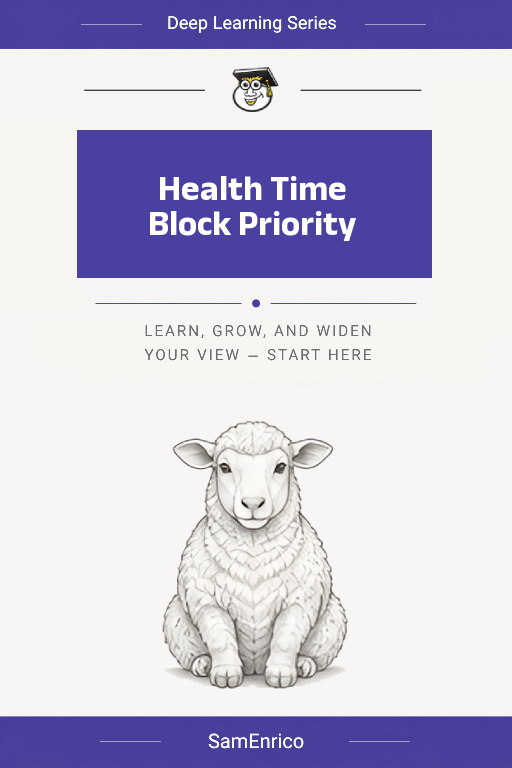
Non-FictionProfessional's Cheat Sheet
Health Time Block Priority eBook
Schedule exercise sleep and meals before any work
Schedule exercise sleep and meals before any work blocks.
Formats
Free sample
Chapter 1: The Exhausted Lie--–- The email arrived at 11:47 PM. Sarah, a senior marketing director with fourteen direct reports, had been working since 6:15 AM. She had answered 89 emails, attended six meetings, skipped breakfast, eaten a sad desk lunch of leftover pasta, and canceled her 6:00 PM workout because a client needed "one quick revision." She was exhausted, irritable, and couldn't remember the last time she had laughed at something that wasn't a work-related meme. When the email pinged, she sighed, opened it, and found a request for a 7:30 AM meeting the next day. She typed "Sounds good, see you then" and finally closed her laptop at 12:03 AM.The next morning, she hit snooze four times, skipped breakfast again, arrived at the meeting five minutes late with cold coffee, forgot a key data point, apologized three times, and spent the rest of the day playing catch-up.
That evening, she complained to her partner: "I worked fifteen hours yesterday. I don't know how I could possibly do more."She had articulated the lie perfectly without realizing it.The lie is this: working more hours produces more results. The exhausted professional believes that the number of hours spent in front of a screen is the primary driver of success. More hours equals more output. More output equals more value.
More value equals recognition, promotion, and finally, the mythical "arrival" at a life where work no longer consumes everything.But the data tells a different story. Sarah worked fifteen hours. She produced approximately seven hours of quality work. The remaining eight hours were a fog of low-grade productivity—re-reading the same email three times, rewriting a sentence six times, staring at a spreadsheet without seeing it, and answering low-priority messages while avoiding the one difficult conversation she needed to have. She was present at her desk.
She was not present in her brain.This chapter dismantles the single most destructive assumption in modern professional life: that busyness equals effectiveness. We will introduce the concept of Presenteeism, demonstrate the biological impossibility of sustained high performance without health infrastructure, and give you the tools to measure—for the first time—the actual return on investment of your waking hours. By the end of this chapter, you will understand why the "exhausted hero" is not a martyr but a victim of a broken equation. And you will begin to see the solution that the rest of this book will build: placing sleep, exercise, and meals before work blocks, not after them.The Productivity Graveyard: Where Hours Go to Die Let us define a term that will appear throughout this book: Presenteeism. In occupational health literature, presenteeism refers to the phenomenon of being physically present at work but functionally absent due to illness, fatigue, or distraction.
The classic example is the employee who drags themselves to the office with a flu, infects three colleagues, and produces work that must be redone the following week. Presenteeism costs the American economy an estimated $150 billion annually—significantly more than absenteeism, because the employee is there, collecting a paycheck, but producing negative value.But presenteeism is not limited to infectious illness. Chronic sleep deprivation, skipped meals, and sedentary work patterns produce the same cognitive impairment as being legally drunk. A person who sleeps four hours for five consecutive nights performs worse on cognitive tests than someone with a blood alcohol concentration of 0.1 percent—above the legal driving limit in every state. Yet we celebrate the "all-nighter" as a badge of honor.Consider the following experiment, conducted by the National Institute for Occupational Safety and Health.
Researchers tracked 500 white-collar professionals for three months, measuring both hours worked and objective output (defined as completed, error-free tasks). The results revealed a curve, not a line. Up to approximately forty hours per week, output increased predictably with hours. Between forty and fifty hours, output increased, but at a diminishing rate. Beyond fifty hours, total output decreased—meaning that someone working sixty hours produced less than someone working forty-five, because the additional fifteen hours were spent in a state of presenteeism so severe that they undid the work of previous hours.This is the productivity graveyard.
It is where your time goes to die. And the exhausted hero—the person who brags about "pulling another all-nighter" or "crushing it" by answering emails at 11:00 PM—is digging their own grave with every extra hour.The Biology of Burnout: Why Willpower Is Not a Resource You have likely heard someone say, "I just need to be more disciplined." This statement reveals a fundamental misunderstanding of human biology. Discipline and willpower are not infinite reservoirs that you can "draw from" when needed. They are finite biological resources, mediated by glucose availability, sleep quality, and stress hormone levels.In 1998, social psychologist Roy Baumeister conducted a now-famous experiment. He placed hungry college students in a room with two bowls: one filled with freshly baked chocolate chip cookies, the other with radishes.
Some students were told to eat the cookies. Others were told to eat the radishes—and to resist the cookies. Afterward, all students were given a difficult puzzle to solve, one that was actually unsolvable. The researchers measured how long each student persisted before giving up.The students who had resisted the cookies—exerting willpower to avoid temptation—gave up on the puzzle in approximately eight minutes. The students who had eaten the cookies persisted for nearly nineteen minutes.
The act of resisting the cookies had depleted their self-control, leaving nothing for the puzzle.This phenomenon, which Baumeister called ego depletion, has since been replicated dozens of times. The implication is profound: willpower is not a character trait. It is a fuel that burns. And when you spend your morning resisting the urge to check your phone, forcing yourself to focus on a boring spreadsheet, and suppressing irritation at a colleague's question, you enter the afternoon with less fuel available for important decisions.But ego depletion is not the only biological constraint on performance. Consider:Decision fatigue: Each decision you make—what to wear, what to eat, which email to answer first, how to phrase a response—draws from the same limited pool of cognitive resources.
By the end of a day filled with trivial decisions, you have less capacity for strategic thinking. This is why Nobel Prize-winning economist Daniel Kahneman observed that parole judges grant parole in the morning (approximately 65 percent of cases) and virtually never just before lunch (approximately 10 percent of cases). The judges were not biased. They were tired.Sleep debt: The glymphatic system—a waste clearance pathway in the brain—operates only during deep sleep. When you sleep fewer than seven hours, metabolic waste products (including beta-amyloid, associated with Alzheimer's disease) accumulate.
The result is slower processing speed, reduced working memory, and impaired emotional regulation. After one week of six-hour nights, your cognitive performance is indistinguishable from someone who has been awake for forty-eight hours straight.Glucose variability: The brain consumes approximately 20 percent of your body's energy despite representing only 2 percent of your mass. When blood glucose drops—because you skipped breakfast or ate a carb-heavy lunch—the prefrontal cortex (responsible for impulse control, planning, and decision-making) is the first region to suffer. This is why you snap at…
This is the end of the free sample. Get the eBook to keep going. Buy now
About this book
Details
- Author
- Fellows Petrina
- Publisher
- SamEnrico
- Language
- English
- Genre
- Non-Fiction, Professional's Cheat Sheet
- Released
- 2026-06-01
- Pages (approx.)
- 148
- Available as
- eBook, Audiobook

Read better in the ZLOADR app
Your eBooks on your phone or tablet. Sign in with your SamEnrico account and start reading.
More by Fellows Petrina
 Metta Self Compassion FirstFellows Petrina$11.99
 TM for Menopause ReliefFellows Petrina$11.99
 Low Self Esteem Wife SupportFellows Petrina$11.99
 Rapid Growth Team ExhaustionFellows Petrina$11.99
 Mood and Gut ConnectionFellows Petrina$11.99
 Power Shutoff WinterFellows Petrina$11.99
 Reformation Bloody Mary Persecution ManualFellows Petrina$11.99
 Men's AA Meeting GuideFellows Petrina$11.99
 Unsubscribe from Sale EmailsFellows Petrina$11.99
 The Architects of the Divine: Africa's Pyramid Builders and the Geometry of EternityFellows Petrina$11.99
 Burke and Wills: The Unyielding Spirit of the Australian OutbackFellows Petrina$11.99
 Understanding Achalasia, Familial EsophagealFellows Petrina$17.99
You may also like
 Hong Kong Handover 1997Dunn Johnnie$11.99
 Zumba For Postnatal Recovery CourseNeal Christian$11.99
 Zumba for BeginnersLadner Nikia$11.99
 YouTube Comment Mining GuideHumes Pandora$12.99
 Worry Box MeditationCarlin Rudy$11.99
 Workplace Stress MeditationNguyen Lynn$11.99
 Workplace Stress and Sleep RepairHawley Ivory$11.99
 Workplace Perfectionism CureDelaney Jeffry$11.99
 Workplace Injustice Anger GuideWallen Isabelle$11.99
 Work Addiction and Burnout LinkGreenwood Ester$11.99
 Women in Yoga and WellnessBeattie Galina$11.99
 Women in Stand Up ComedyChun Evangeline$11.99