
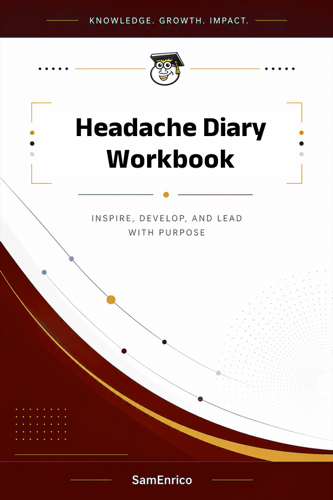
Headache Diary Workbook eBook
Track symptoms, triggers, and treatments with guid
Track symptoms, triggers, and treatments with guided journaling prompts.
Formats
Free sample
Chapter 1: The Pain Messenger--For most of your life, you have probably treated your headache like an enemy. You have fought it with medication, cursed it for ruining plans, and dreaded its inevitable return. This chapter asks you to consider a radical alternative: what if your headache is not an enemy but a messenger? What if the throbbing pressure behind your eye is not a random act of biological cruelty but a signal—distorted and painful, yes—carrying information about something out of balance?This reframing is not spiritual platitude or positive thinking. It is grounded in neuroscience.
The brain does not produce pain randomly. Pain is the brain’s alarm system, evolved over millions of years to tell you that something requires attention. When you touch a hot stove, pain screams “move your hand.” When you sprain an ankle, pain whispers “stop walking.” But in chronic headache disorders, the alarm system becomes faulty. It rings when there is no fire. It blares at full volume for a minor trigger.
It stays on long after the threat has passed. This is called central sensitization, and understanding it is the first step toward disarming it.This chapter will give you a new way of seeing your headaches. You will learn why tracking works better than medication alone, how the brain’s fear centers amplify pain, and why becoming an investigator rather than a victim is the single most powerful shift you can make. You will complete journaling exercises that establish your baseline and your motivation. And you will close this chapter with a clear picture of what “normal” could look like for you—not a fantasy of zero pain, but a realistic, achievable vision of a life where headaches no longer run the show.The Neuroscience of Chronic Pain: Why Your Brain Has Learned to Hurt Let us begin with a basic fact that most headache sufferers have never been told: chronic pain is not just repeated acute pain.
It is a different biological state. When you have occasional headaches, your brain processes pain normally. A trigger occurs, nerves fire, the brain registers the sensation, and when the trigger stops, the pain stops. But when you have headaches on fifteen or more days per month, your brain undergoes physical changes. The neurons that transmit pain signals become more sensitive.
The threshold for activating them drops. Pathways that were once quiet become noisy.This process centers on a small, almond-shaped cluster of neurons deep in your brain called the amygdala. You may know the amygdala as your fear center, and that is accurate. But its job is more specific: the amygdala is your brain’s threat-detection system. It scans incoming sensory information and asks one question: “Is this dangerous?” When the amygdala decides the answer is yes, it sends signals that amplify pain, increase muscle tension, and prepare your body for defense.
This was useful when the threat was a predator. It is less useful when the threat is a flickering fluorescent light or a missed meal.Here is the crucial insight: the amygdala learns from experience. Every time you have a severe headache, your amygdala files that memory under “dangerous.” Over time, it becomes hypervigilant. It starts treating mild sensations—a slight neck tightness, a change in barometric pressure, a moment of hunger—as if they were the early stages of a catastrophic attack. This is why people with chronic migraine often say they feel pain “waiting to happen.” The amygdala is sounding the alarm before the fire has started.The good news is that neuroplasticity works in both directions.
Just as your brain learned to amplify pain, it can learn to dampen it. One of the most effective ways to retrain the amygdala is through a process called habituation. Habituation is what happens when you move into a house near train tracks. The first night, every train wakes you up. After a week, you sleep through them.
Your brain has learned that the train sound is not dangerous, so it stops sending alarm signals. The same principle applies to pain. When you observe your headache without panic—without the internal narrative of “oh no, here it comes, this is going to be terrible”—you are teaching your amygdala that this sensation is not a threat. Over time, the alarm volume turns down.This is why tracking works better than medication alone. Medication treats the symptom.
Tracking treats the relationship between you and the symptom. A pill can block a neurotransmitter. But only you can change your brain’s threat assessment. And you do that by showing up, day after day, as a calm investigator rather than a terrified victim.The Critical Distinction: Symptom Versus Trigger Before you can investigate your headaches, you need to understand what you are investigating. Most people use the words “symptom” and “trigger” interchangeably, but they are fundamentally different, and confusing them leads to years of ineffective treatment.A symptom is the experience of the headache itself.
The throbbing. The nausea. The sensitivity to light. The brain fog. These are the things you feel during an attack.
When you take medication, you are treating symptoms. When you lie down in a dark room, you are managing symptoms. Symptoms are real, they are painful, and they deserve compassionate treatment. But they are not the cause.A trigger is a factor that contributes to the onset of a headache. Triggers can be internal (hormonal shifts, sleep deprivation, dehydration, stress) or external (barometric pressure changes, certain foods, bright lights, loud noises).
Here is the crucial clarification that this book will return to again and again: a trigger is almost never the sole cause of a headache. There is no single food, no single weather pattern, no single missed meal that, in isolation, guarantees an attack. Instead, triggers stack.Think of your headache threshold as a glass. Every trigger adds a small amount of liquid. A poor night of sleep adds an inch.
Skipping breakfast adds another inch. A stressful email from your boss adds two inches. A drop in barometric pressure adds another inch. For most of the month, the glass is half full. You feel fine.
But when the cumulative load reaches the rim, the glass overflows, and you have a headache. This is called the Pile-Up Effect, also known as threshold theory.The reason most people fail to identify their triggers is that they look for a single cause. They eat chocolate and get a headache two hours later, so they blame chocolate. But what they did not notice was that they also slept poorly, forgot to drink water, and were stressed about a deadline. The chocolate was simply the final drop that overflowed an already full glass.
If they eliminate chocolate but change nothing else, they will still get headaches from other final drops. This leads to the frustrating experience of “I cut out everything and nothing works.”Throughout this workbook, you will learn to see triggers as contributors, not causes. You will track them not to find the one evil food you must avoid forever, but to understand your personal threshold and learn how to keep the glass from filling up. This is a more forgiving and…
This is the end of the free sample. Get the eBook to keep going. Buy now
About this book
Details
- Author
- Schmitt Dagny
- Publisher
- SamEnrico
- Language
- English
- Genre
- Non-Fiction, Health & Wellness, Headache Tracking
- Released
- 2026-06-07
- Pages (approx.)
- 135
- Available as
- eBook, Audiobook

Read better in the ZLOADR app
Your eBooks on your phone or tablet. Sign in with your SamEnrico account and start reading.
More by Schmitt Dagny
 Shame Trigger RecoverySchmitt Dagny$11.99
 Progressive Relaxation Trance MethodSchmitt Dagny$11.99
 Geothermal Capital GuideSchmitt Dagny$11.99
 Gut Directed Yoga ProtocolSchmitt Dagny$11.99
 Strength Training Injury PreventionSchmitt Dagny$11.99
 Sam Sheppard Trial TimelineSchmitt Dagny$11.99
 Social Media Time BlockingSchmitt Dagny$11.99
 Angry With Anxious PartnerSchmitt Dagny$11.99
 The Trans-Saharan Caravans: The Gold Route of the Soninke TradersSchmitt Dagny$11.99
 The Last Dance of the Sun: How a 19th-Century Eclipse United the WorldSchmitt Dagny$11.99
 The House of Morgan: When Money Moved the WorldSchmitt Dagny$11.99
 Portfolio Optimization StrategiesSchmitt Dagny$11.99