
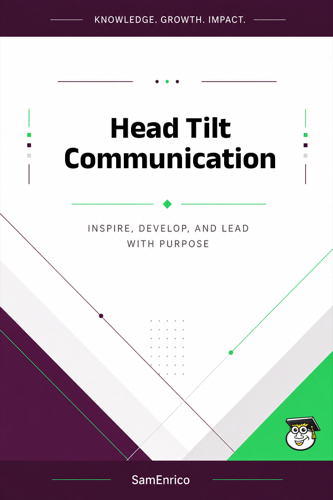
Non-FictionSelf-HelpHead TiltTrust
Head Tilt Communication eBook
Use slight head tilt to appear more trustworthy an
by Landrum Veda
Use slight head tilt to appear more trustworthy and engaged.
Formats
Free sample
Chapter 1: The $400 Million Mistake--It was 3:47 PM on a Tuesday when Bradley Thompson lost four hundred million dollars. He didn't lose it in a market crash, a fraudulent wire transfer, or a failed product launch. He lost it because he nodded his head.The acquisition had been nine months in the making. Thompson, the founder and CEO of a mid-sized software firm, was sitting across from the acquisition committee of a Fortune 500 company. The numbers had been agreed upon.
The legal teams had signed off. The only thing remaining was the final courtesy meeting—a ninety-minute conversation designed to reassure the buyers that Thompson would integrate smoothly into their culture.Thompson prepared meticulously. He studied their annual reports. He memorized the names of every committee member's spouse and children. He rehearsed his answers to difficult questions.
What he did not prepare was his head.Throughout the meeting, Thompson nodded. He nodded when they described their corporate values. He nodded when they asked about his retention strategy. He nodded when they mentioned their concerns about post-acquisition culture clash. He nodded so frequently and so vigorously that his neck actually ached by the end of the ninety minutes.He thought he was signaling agreement, enthusiasm, and engagement.Two days later, the deal collapsed.The acquisition committee's lead negotiator, a woman named Helen Voss who had closed seventeen major deals in her career, gave Thompson's board a single sentence of feedback: "He looked like he wanted me to finish, not like he cared about what I was saying."Thompson was devastated.
He had said all the right words. He had answered every question honestly. But his nonverbal communication had broadcast a different message entirely: impatience, anxiety, and a desperate desire for the conversation to end.Four hundred million dollars. Gone because of a head movement that took less than one second per repetition.This book exists because Bradley Thompson's story is not an anomaly. It is the rule.The Seven-Second Filter You Never Knew Existed Before you speak a single word in any new interaction, your brain has already been judged.
Not your resume. Not your sense of humor. Not your intelligence. Your face—specifically, the movements of your head and the exposure of your neck—has triggered a biological assessment that determines whether the person across from you perceives you as friend, foe, or something worse: irrelevant.This is called the 7-Second Trust Window, and it is one of the most well-documented yet least-discussed phenomena in human communication. Research spanning neuroscience, evolutionary psychology, and organizational behavior consistently shows that within the first seven seconds of meeting someone, the observer's limbic system—the ancient, pre-verbal part of the brain responsible for survival—has already made a binary decision: safe or not safe?Not smart or not smart.
Not funny or not funny. Not qualified or not qualified.Safe or not safe?This is not a social nicety. It is a survival mechanism. Your ancestors who accurately assessed whether a stranger intended to harm them within the first few seconds of an encounter lived to pass on their genes. Your ancestors who waited for a thirty-minute conversation to make that assessment often did not.The problem is that this ancient survival mechanism did not evolve to distinguish between physical threats and social threats.
To your limbic system, a hostile negotiation, an awkward first date, and a job interview with a skeptical panel all register as the same thing: a potential threat that requires an immediate assessment.And the single most powerful signal your limbic system uses to make that assessment? You are about to learn it.The Obama Principle: When a Head Movement Disarms Hostility In the summer of 2008, a relatively unknown junior senator from Illinois found himself on a debate stage with Hillary Clinton and John Mc Cain. By every traditional metric, he was the underdog: less experience, fewer connections, and a name that pollsters worried would alienate certain voters.But something strange happened during those debates. Viewers consistently described Obama as "likable," "trustworthy," and "someone I could sit down with over a beer." This happened even when he was delivering the same policy positions as his opponents. Even when he was under aggressive attack.
Even when the content of his speech was identical to theirs.The difference was not what he said. The difference was what he did with his head.Watch any Obama debate clip with the sound off, and you will see a pattern. When his opponent speaks, Obama does not nod rapidly like most politicians. He does not maintain a rigid, straight-ahead posture that signals defensiveness. Instead, he tilts his head—usually to his right, occasionally to his left—by approximately fifteen to twenty degrees.
He holds the tilt for three to five seconds. His eyes remain steady. His blinks slow down. And then, slowly, he returns to neutral before the next speaker begins.This gesture, which takes less than five seconds to execute, signals something profound: I am listening. I am not threatened by you.
And I am curious about what you are saying.The effect on viewers was measurable. Focus groups consistently rated Obama as more "engaged" and "trustworthy" than his opponents, even when his opponents delivered objectively better lines. Political commentators called it "charisma." Media trainers called it "stage presence." But the truth is simpler and more biological: Obama had intuitively mastered the head tilt.He did not invent it. He did not learn it from a book. He had likely been doing it his entire life without knowing why it worked.
But the fact that it worked is undeniable—and replicable.Why This Book Is Different from Every Other Body Language Guide You have likely seen other books about body language. Many of them are excellent. Joe Navarro's What Every BODY is Saying taught millions of readers to identify when someone is lying by observing their feet. Allan Pease's The Definitive Book of Body Language cataloged hundreds of gestures and their meanings. These books have one thing in common: they teach you to read other people.Head Tilt Communication teaches you to broadcast.This is a critical distinction.
Reading body language is a reactive skill. You observe, you interpret, and then you decide how to respond. Broadcasting is a proactive skill. You send signals intentionally, shaping the emotional landscape of the interaction before the other person even has time to form a judgment.Think of it this way: reading body language is like being a meteorologist who can predict the weather. Broadcasting is like being a pilot who can change the weather.Most body language guides are written for detectives, therapists, and interrogators—people whose job is to observe without revealing themselves.
But you are not a detective. You are a human being who wants to be trusted, liked, and understood. You do not need to know every possible tell of deception. You need to know one gesture—executed correctly, in the right context, with the right accompanying signals—that instantly lowers the defenses of everyone you meet.That gesture is the head tilt.And the reason it works is not magic. It is not "energy" or "vibes" or any other vague concept.
It is hard biology, rooted in the same evolutionary pressures that gave you your opposable thumbs and your upright posture.The…
This is the end of the free sample. Get the eBook to keep going. Buy now
About this book
Details
- Author
- Landrum Veda
- Publisher
- SamEnrico
- Language
- English
- Genre
- Non-Fiction, Self-Help, Head Tilt, Trust
- Released
- 2026-06-09
- Pages (approx.)
- 143
- Available as
- eBook, Audiobook

Read better in the ZLOADR app
Your eBooks on your phone or tablet. Sign in with your SamEnrico account and start reading.
More by Landrum Veda
 Tree Trunk BillboardLandrum Veda$11.99
 Canva Brand Identity for Pet BrandsLandrum Veda$11.99
 Cannabis Tobacco Spliff CessationLandrum Veda$11.99
 The Hollywood Exiles: Errol Flynn’s Downfall in Australia’s Golden AgeLandrum Veda$11.99
 Learn to Play the TaepyeongsoLandrum Veda$11.99
 How to Start a Baptist Church Business (Beginners Guide)Landrum Veda$11.99
 Fiber Optic TechnicianLandrum Veda$11.99
 AI for Job Description MatchingLandrum Veda$12.99
You may also like
 Hong Kong Handover 1997Dunn Johnnie$11.99
 Zumba For Postnatal Recovery CourseNeal Christian$11.99
 Zumba for BeginnersLadner Nikia$11.99
 YouTube Comment Mining GuideHumes Pandora$12.99
 Worry Box MeditationCarlin Rudy$11.99
 Workplace Stress MeditationNguyen Lynn$11.99
 Workplace Stress and Sleep RepairHawley Ivory$11.99
 Workplace Perfectionism CureDelaney Jeffry$11.99
 Workplace Injustice Anger GuideWallen Isabelle$11.99
 Work Addiction and Burnout LinkGreenwood Ester$11.99
 Women in Yoga and WellnessBeattie Galina$11.99
 Women in Stand Up ComedyChun Evangeline$11.99