
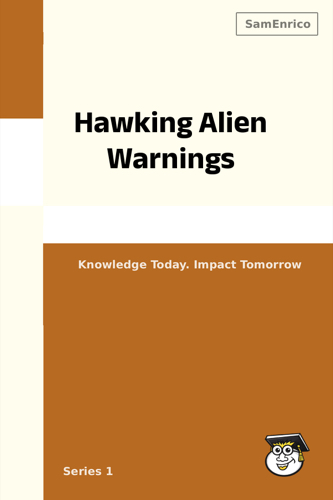
Hawking Alien Warnings eBook
Learn Hawking's concerns about contacting extrater
Learn Hawking's concerns about contacting extraterrestrial intelligence.
Formats
Free sample
Chapter 1: The Columbus Precedent...–- The warning arrived not as a screaming headline or a presidential address, but as a quiet observation buried in the middle of a television interview. In 2010, Stephen Hawking sat for a taping of 60 Minutes and, with the characteristic detachment of a man who had spent his life contemplating black holes and the origins of the universe, said something that should have stopped humanity in its tracks. When asked about the possibility of extraterrestrial intelligence, Hawking replied: "If aliens visit us, the outcome would be much as when Columbus landed in America, which didn't turn out well for the Native Americans." The sentence lasted perhaps ten seconds. The interviewer nodded. The show moved on.
And the most important warning in the history of the human species was effectively ignored.Two decades later, we are still ignoring it. We have built bigger telescopes, launched more probes, and composed more messages to the stars. In 2023, NASA's independent study team on Unidentified Anomalous Phenomena released its report, carefully avoiding conclusions about extraterrestrial origins while acknowledging that some phenomena remain unexplained. In 2024, the European Space Agency's Juice mission began its journey to Jupiter's moons, searching for the chemical signatures of life. In 2025, China's FAST telescope—the largest filled-aperture radio telescope on Earth—continued its survey of the galactic plane, listening for signals that would prove we are not alone.
And in 2026, as this book goes to press, no one has asked the obvious question: what if we find something?This chapter is about that question. It is about the single most famous warning Stephen Hawking ever issued about extraterrestrial intelligence, and why that warning is not a metaphor but a predictive framework. It is about what actually happened when Columbus landed in the Americas, and why that history—not science fiction, not Hollywood, not optimistic speculation about benevolent star-faring civilizations—is our only empirical guide to what happens when a technologically superior civilization meets a technologically inferior one. And it is about the concept of asymmetric interests, the central insight that explains why Hawking was almost certainly right.The Man Who Looked at the Abyss Before we examine the warning itself, we must understand the man who issued it. Stephen Hawking was not a pessimist by nature.
He spent his entire adult life confined to a wheelchair, unable to speak without technological assistance, his body deteriorating from amyotrophic lateral sclerosis (ALS) while his mind remained brilliant, restless, and relentlessly curious. He wrote A Brief History of Time, a book about the origins of the universe that sold over twenty-five million copies—not because it was easy, but because Hawking had a rare gift for making the incomprehensible feel urgent and personal. He believed in the value of exploration. He believed in the power of human curiosity. He believed that the future of our species lay among the stars.And yet, when it came to the specific question of contacting extraterrestrial intelligence, Hawking's optimism hit a wall.
He was not afraid of aliens in the way that Hollywood is afraid of aliens. He did not imagine bug-eyed monsters with ray guns and world-conquering fleets. His fear was much deeper, more philosophical, and more difficult to dismiss. He feared that any civilization capable of reaching us would be so vastly superior to us that the encounter would be, for humanity, an extinction event—not necessarily because the aliens would be cruel, but because they would be indifferent.This distinction matters. A cruel enemy can be negotiated with, because cruelty implies desires that can be satisfied.
An indifferent superior is far more dangerous, because indifference implies no constraint at all. Hawking's warning about Columbus was not a warning about Spanish cruelty, though the Spanish were certainly cruel. It was a warning about the structure of asymmetric power: when one civilization possesses technology that the other cannot comprehend, when one civilization has weapons that the other cannot defend against, when one civilization views the other as beneath moral consideration, the outcome is not conflict. It is annihilation.The Columbus analogy appears in several of Hawking's later works, most notably in Brief Answers to the Big Questions, published posthumously in 2018. In that collection, Hawking wrote: "We only have to look at ourselves to see how intelligent life might develop into something we wouldn't want to meet.
I imagine they might exist in massive ships, having used up all the resources from their home planet. Such advanced aliens would perhaps become nomads, looking to conquer and colonize whatever planets they could reach." The language is careful. Hawking does not say that aliens will be hostile. He says that we have no reason to assume they will be friendly, and every reason to assume that the laws of evolution and resource competition apply everywhere in the universe.What Actually Happened in 1492To understand the power of Hawking's analogy, we must set aside the sanitized version of Columbus that many of us learned in school. The story we were told goes something like this: Columbus sailed the ocean blue in 1492, discovered America, made peaceful contact with the native people, and opened the door to European settlement and the exchange of ideas, goods, and cultures.
This is not history. This is mythology.What actually happened is far darker and far more instructive. On October 12, 1492, Columbus and his crew made landfall on an island in the Bahamas, which he named San Salvador. The people he encountered were the Taíno, a branch of the Arawak-speaking peoples who had inhabited the Caribbean for centuries. They were not primitives living in ignorance of the wider world.
The Taíno had a sophisticated agricultural system, growing cassava, maize, and beans. They had a complex social structure organized into chiefdoms. They had a religion, a system of governance, and a population that modern demographers estimate at somewhere between several hundred thousand and several million across the Caribbean islands.Columbus's first description of the Taíno is telling. In his journal, he wrote: "They ought to be good servants and of quick intelligence, since I see that they very soon say all that is said to them, and I believe they would easily be made Christians." Note the framing: good servants. Columbus did not see the Taíno as equals, as trading partners, or as potential allies.
He saw them as labor. Within days of landing, he began capturing Taíno people to take back to Spain as evidence of his discovery. Within weeks, he had established a settlement, La Navidad, and left thirty-nine men behind with orders to find gold.When Columbus returned to the Caribbean in 1493, he found that all thirty-nine men were dead. They had been killed by the Taíno, who had apparently grown tired of the Spaniards' demands for gold, women, and food. Columbus's response was not to negotiate or to withdraw.
It was to conquer. He launched a brutal campaign against the Taíno, using superior weapons—steel swords, crossbows, cannons, and war dogs—to subdue the population. The Taíno had never seen horses, which the Spanish rode into battle. They had never seen armor that could stop their wooden spears. They had never encountered anything like the Spanish military technology, and…
This is the end of the free sample. Get the eBook to keep going. Buy now
About this book
Details
- Author
- Haywood Wilfredo
- Publisher
- SamEnrico
- Language
- English
- Genre
- Non-Fiction, Biography, SETI
- Released
- 2026-06-11
- Pages (approx.)
- 134
- Available as
- eBook, Audiobook

Read better in the ZLOADR app
Your eBooks on your phone or tablet. Sign in with your SamEnrico account and start reading.
More by Haywood Wilfredo
 Compassion for Other DriversHaywood Wilfredo$11.99
 The Gambling Harm Reduction CourseHaywood Wilfredo$11.99
 The Parent Death Meditation GuideHaywood Wilfredo$11.99
 Remote Worker Flexibility RescueHaywood Wilfredo$11.99
 The Midnight Vote: Nixon’s Resignation and the 1974 Impeachment CrisisHaywood Wilfredo$11.99
 The Lost Fleet of the Chola Dynasty: India's Ancient Mariners of the Indian OceanHaywood Wilfredo$11.99
 Gravitational Wave Data AnalysisHaywood Wilfredo$11.99
 One Page Seasonal Marketing PlanHaywood Wilfredo$12.99
 Cohort Insurance Spending HandbookHaywood Wilfredo$12.99
 Understanding Barrett SyndromeHaywood Wilfredo$17.99
 10 Ways to Use Chicken Leg (Recipe Book)Haywood Wilfredo$11.99
You may also like
 Hong Kong Handover 1997Dunn Johnnie$11.99
 Zumba For Postnatal Recovery CourseNeal Christian$11.99
 Zumba for BeginnersLadner Nikia$11.99
 YouTube Comment Mining GuideHumes Pandora$12.99
 Worry Box MeditationCarlin Rudy$11.99
 Workplace Stress MeditationNguyen Lynn$11.99
 Workplace Stress and Sleep RepairHawley Ivory$11.99
 Workplace Perfectionism CureDelaney Jeffry$11.99
 Workplace Injustice Anger GuideWallen Isabelle$11.99
 Work Addiction and Burnout LinkGreenwood Ester$11.99
 Women in Yoga and WellnessBeattie Galina$11.99
 Women in Stand Up ComedyChun Evangeline$11.99