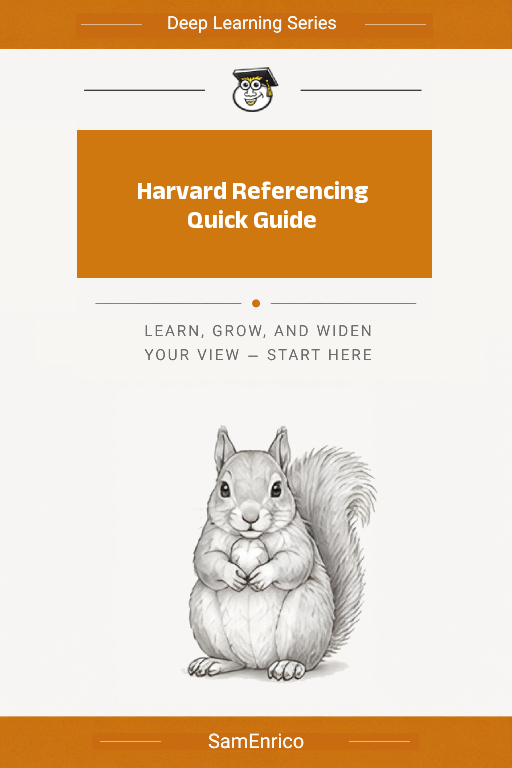
Harvard Referencing Quick Guide Audiobook
Use author-date citations and reference lists for
Use author-date citations and reference lists for business, economics, and sciences.
Formats
Free sample
Chapter 1: The Consistency Principle--–- Every year, thousands of students and professionals lose marks, miss publication opportunities, or damage their credibility not because their research is flawed, but because their citations are a mess. A missing comma here, an ampersand instead of the word 'and' there, a journal title italicised in one reference but left plain in another. These might seem like trivial details, but in the world of business, economics, and the sciences, inconsistent referencing sends a clear and damaging message: the author does not pay attention to detail. And when your argument rests on evidence—whether a market trend, an econometric model, or a clinical trial—any signal of carelessness undermines your entire case.This chapter introduces the single most important concept in Harvard referencing. It is not about memorising every variation for every source type.
It is not about knowing whether to use single or double quotation marks around article titles. The golden rule, the foundation upon which all other rules rest, is this: choose one style and apply it consistently across your entire document.Why does consistency matter more than any individual formatting decision? Because Harvard referencing has no official manual. Unlike the American Psychological Association (APA) style or the Modern Language Association (MLA) style, which publish authoritative handbooks that every user follows, 'Harvard' is a generic label for a family of author-date citation systems. Oxford University Press's Harvard guide differs slightly from Cambridge's.
The Economic Journal's requirements differ from the Journal of Finance's. Your university's library guide may require a hanging indent of 0.5 inches, while another institution demands 1.27 centimetres. None of these is universally correct. What is universally unacceptable is mixing them.Imagine reading a research paper where the author writes 'Smith and Jones (2021)' in one paragraph and '(Smith & Jones, 2021)' in the next. Or a reference list where some journal titles are italicised and others are not.
Within seconds, your trust erodes. If the author cannot be bothered to apply a simple formatting rule consistently, you think, how can I trust their data analysis or their conclusions? In the high-stakes environments of business consulting, economic policy advising, and scientific research, such sloppiness is professionally fatal.This chapter will teach you the two fundamental citation formats—narrative and parenthetical—and then drill down into the specific punctuation, spacing, and grammatical rules that you must apply uniformly. By the end, you will understand not just how to…
This is the end of the free sample. Get the Audiobook to keep going. Buy now
About this book
Details
- Author
- Dobson Katherina
- Publisher
- SamEnrico
- Language
- English
- Genre
- Non-Fiction, Student's Shortcut, Harvard
- Released
- 2026-05-29
- Pages (approx.)
- 160
- Available as
- eBook, Audiobook

Listen in the VoxFlicks app
Audiobooks and audio dramas wherever you go. Sign in with your SamEnrico account and press play.
More by Dobson Katherina
 Nostril Sensation Breath FocusDobson Katherina$11.99
 Self Esteem for Partner with Mental IllnessDobson Katherina$11.99
 Emotional Vaccination GuideDobson Katherina$11.99
 Alcohol Free Fitness ProtocolDobson Katherina$11.99
 Rental Property Financing GuideDobson Katherina$11.99
 Marianne Williamson RiseDobson Katherina$11.99
 Antwerp Heist Movie TieDobson Katherina$11.99
 Accrual Accounting For FoundersDobson Katherina$11.99
 Dragonbone Lyrics: The Ballads of the Yellow EmperorDobson Katherina$11.99
 The Water Machines of Rome: Hero's Legacy in EngineeringDobson Katherina$11.99
 How to Produce Hair CurlersDobson Katherina$11.99
 How to Produce a StiffenerDobson Katherina$11.99